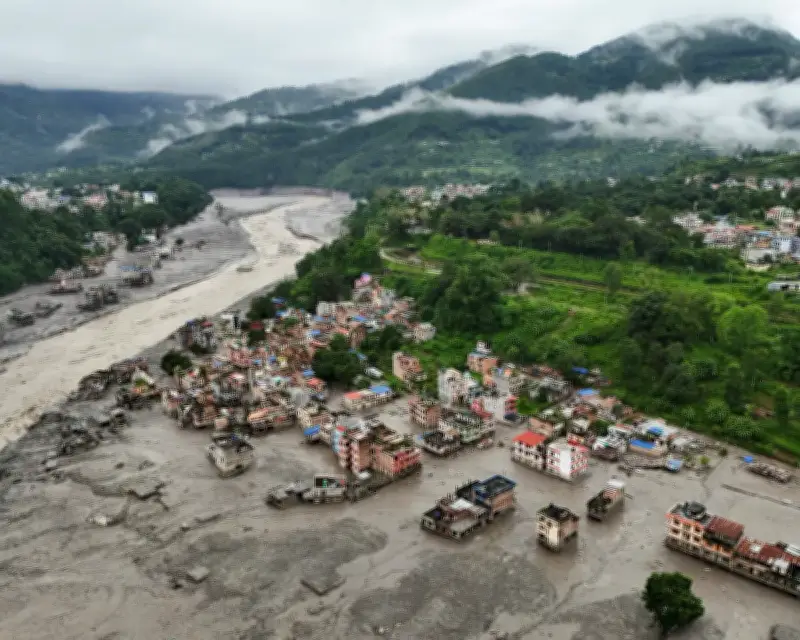
At least 275 Indians were missing after a glacier collapse triggered flash floods in Nepal's Bhote Kashi River, with 149 people rescued as of Monday. The disaster unfolded when a melting glacier slammed into the valley, unleashing a cascade of rock and ice down the river that flows from Tibet into Nepal.
Among the missing are hydropower project workers and Hindu pilgrims traveling to Mount Kailash in Tibet. Another 128 people of Indian origin, including a large group from Sadhguru's Isha Foundation spiritual group, are also unaccounted for, according to reports at the time of writing.
Families Search for Missing Loved Ones
Gauri Joshi, whose five relatives remained missing over the weekend, described the last few days as a blur of calling their numbers in vain, watching rescue operations, and repeatedly trying to reach Indian officials. Her relatives, part of a pilgrim tour group from Maharashtra, cleared immigration at the Gyirong border between Nepal and Tibet and boarded buses shortly before flood waters destroyed the crossing.

“Chances appear very bleak now. But maybe a miracle will happen,” Joshi said.
Expert Warns of Rising Himalayan Hazards
The tragedy has reignited questions about Himalayan vulnerability to climate change. Dr Ashim Sattar, a professor at Indian Institute of Technology Bhubaneswar and an expert on glacial lake outburst floods, outlined three cryospheric hazards: glacial lakes, glacier ice, and permafrost. “With climate change, these grounds will go above zero degrees and will start to degrade. These would need very little … to mobilise debris. We might expect a higher frequency of debris flows in the future,” he said.
Sattar noted that while the number, size, and volume of glacial lakes in the Indian Himalayas are increasing and glaciers are retreating, the downstream risks remain unquantified. “The risk exists because it might happen any time,” he added, stressing that every Himalayan state faces hazards, though eastern regions have more full-grown lakes while western and central areas have more scope for lake growth as glaciers retreat.
Early Warning Systems and Prevention
Sattar praised the National Disaster Management Authority's proactive steps under the Glacial Lake Outburst Flood (GLOF) Risk Mitigation Programme to install early-warning systems. He suggested such systems should be community-based, incorporating local knowledge. “It’s not always the scientist or the policymakers who can actually make this work at its full potential,” he said.
On prevention, Sattar acknowledged it is possible but expensive—computationally, financially, and in manpower—while minimising damage requires intervention in difficult high-mountain terrains. “We know that the mountains are changing and the hazard levels are increasing, so the only way forward is to minimise the exposure to the risk below,” he said, adding that anything in the hazard's path should be removed.