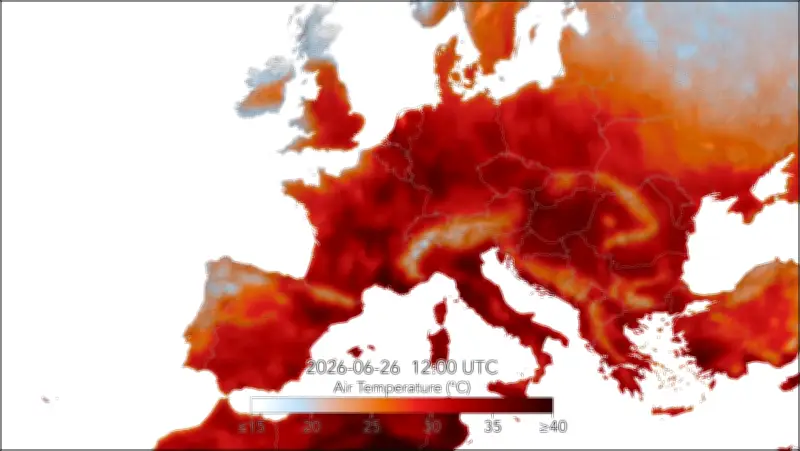
A timelapse video from NASA has illustrated how large parts of Europe endured scorching 40C heat over the past four months, as repeated heatwaves contributed to a rise in hospitalisations and deaths. The footage, produced by NASA's Goddard Earth Observing System (GEOS), tracks daily maximum surface air temperatures across much of Europe from May 1 to August 19.
The clip shows regions turning deep red as temperatures climbed to 40C and beyond. By late June, much of the continent was shaded dark red, with Italy, Hungary, Poland and eastern Germany among the worst-affected areas. A month later, France, Italy, Greece and coastal Turkey experienced the brunt of the summer heatwaves, while other parts of the continent saw some relief.
August heat and European vulnerability
Into August, Spain, Portugal, the Balkans, Eastern and Southern Europe appeared in shades of deep red in the timelapse. The summer heat exposed vulnerabilities in Europe, which has fewer air conditioning units than the US. A lack of green space and high nighttime temperatures in some cities led to heatstroke in certain cases, as hospitalisations and heat-related deaths spiked.

"Air conditioning is an especially critical issue in Europe in the short term," said Anamika Shreevastava, a researcher at New York University who studied urban heat islands as a postdoc at NASA's Jet Propulsion Laboratory. Data from the International Energy Agency shows that 23 per cent of European homes have air conditioning, compared with 90 per cent in the US.
Heat-related deaths and health risks
The difference contributes to higher death tolls, with at least 35,000 more people having died in Europe during four back-to-back heatwaves this summer, according to incomplete figures. Figures from multiple European countries were released as temperatures exceeded 40C. NASA indicated the heatwaves could be associated with 10,000 excess deaths, including thousands of people in the UK, France, Germany and Belgium.
Analysis from the World Health Organisation indicates that heat stress is the world's leading cause of weather-related deaths. The organisation noted that high temperatures exacerbate underlying illnesses including cardiovascular disease, diabetes, mental health conditions and asthma. Researchers calculated that around 489,000 heat-related deaths occur each year, with 36 per cent in Europe and 45 per cent in Asia.
"For older adults with physical health problems, temperatures as low as 26.7C (80F) can pose significant danger," warned Deborah Carr, a Boston University sociologist specialising in the study of ageing. "Nighttime heat is especially harmful for older adults whose homes lack air conditioning."
Drought, records and infrastructure strain
Carr is part of a team using demographic data alongside temperature and climate data archived by NASA to identify areas of the world at greatest risk of current and future heat exposure. Among the areas researchers found facing growing heat exposure and an ageing population was Southern Europe.
High temperatures also contributed to the severe drought that gripped Europe for months, leading to record-low water levels and disrupting water and power supplies, transportation routes and agriculture. Train tracks buckled and destructive wildfires raged across areas not only accustomed to them, but those where they were once rarely seen.
The heat has broken multiple records in Europe, with temperatures soaring to 35.1C in London and 42.5C in Bordeaux, France. Slovakia set new national records for both daytime and nighttime highs, while combined June and July temperatures in Western Europe were the highest on record, according to Europe's Copernicus climate monitoring service.