The Met Office has warned that the El Niño climate phenomenon is now the strongest on record and "the biggest weather event in a century". Professor Adam Scaife, Head of Long Range Prediction at the Met Office, said its impact is already being felt worldwide.
Scientists monitoring the Pacific Ocean established that daily sea surface temperatures in a key region of the central-eastern Pacific were 3.05C above average this week, exceeding the previous record of 3.02C set during the very strong El Niño of 2015. Some longer-term measures of El Niño have not yet hit record levels, but that is likely to change, as the peak is not expected until later this year.
Exceptional rate of warming
Professor Scaife said: "The first thing to say is that the rate of warming in the Pacific is exceptional, and probably the biggest event in 100 years if not longer. We have not seen them that high. The event is huge, I have been in the field for a long time, and I have not seen it. It is a really big event."
He added: "We are already seeing the impact around the world: drought in India. There have been no hurricanes, which is really strange, and there is drought in Panama. The Amazon is now at risk of severe drought. We are a long way from the central Pacific, but mechanisms show a chain of events that crosses the globe - it is like dropping a boulder in a pond."
UK impact expected in autumn and early winter
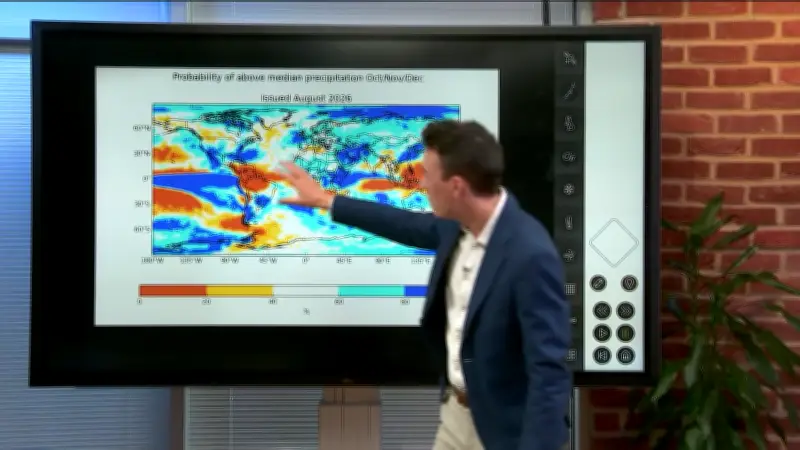
Discussing the impact on Europe, Professor Scaife said: "What we see in Europe is low pressure peaking in November, just west of the UK. For a weather expert, this pattern is called the East Atlantic Pattern, and it means deeper pressure associated with more rainfall and more storms for the UK. All the data points to extra pressure and that is what we have been warning about."
The impact of El Niño is likely to be seen in the UK in autumn and early winter, covering the months of October, November and early December. "It increases the risk of more named storms," added Professor Scaife. Each El Niño is different, so the changes to global weather patterns are not guaranteed.
Historical context and preparation
Professor Scaife noted: "There was a 'monster' El Nino in 1877. It is unclear if this one is going to be bigger or smaller, but it may be comparable." The winter of 2015 and 2016, which coincided with a very strong El Niño, brought a succession of major storms and delivered what experts at the time described as the most extreme flooding on record. El Niño can also be associated with UK cold spells in the late winter, but the link is not a strong one and the past evidence is mixed.
The so-called Big Freeze of winter 2009/2010 was, at the time, the coldest in three decades - and this coincided with an El Niño. However, 2006/2007 was also an El Niño winter and that was unseasonably warm. As this unprecedented El Niño approaches its likely peak towards the end of 2026, scientists will continue to monitor its development and its impact on weather around the world.
El Niño creates a heightened risk of drought in the tropics, southern Africa and north-east Australia, while north-western Europe - including the UK - is likely to experience wetter and stormier conditions in the coming autumn and early winter. Environment Secretary Dame Angela Eagle said people in the UK should prepare for the increased risk of national weather emergencies. She said earlier this year: "We're about to experience probably the largest El Nino that has ever been seen, and that will lead to drier summers, wetter winters, with more extreme storms in this country. It will do a lot more damage in Asia with flooding, and therefore I think that we need to take it seriously."
Professor Bill McGuire, professor emeritus of geophysical hazards at University College London, last month said the Met Office and other scientific forecasts "suggest that the world is in for one hell of a ride". He added: "The astonishing and unprecedented amount of heat building across the Pacific Ocean is all but certain to make this the most powerful El Nino in living memory - possibly even the biggest in several centuries."