
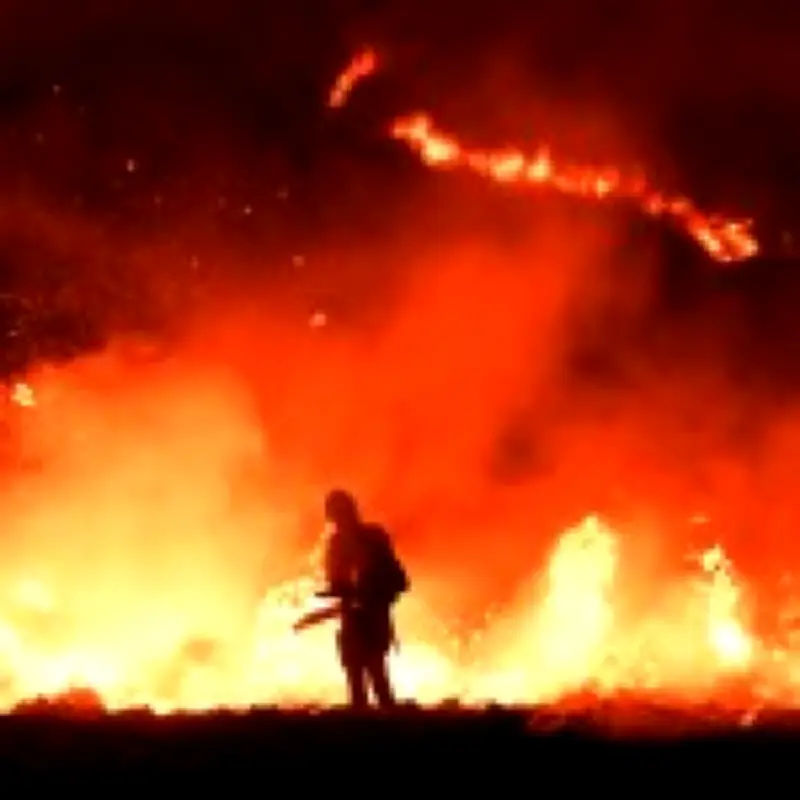
Nearly all of England and Wales are at 'very high' risk of wildfires, according to a map updated by Natural England, as the UK endures a heatwave and a so-called 'firewave.' At least 19 wildfires were burning across the country on July 14, with one moorland fire in Derbyshire having burned for three weeks. The blazes are threatening communities, destroying ecosystems, and causing air pollution for thousands.
What Is a Firewave?
The term 'firewave' describes wildfires in urban areas sparked by hot, dry weather. Dr. Theo Keeping, who studies extreme weather at Imperial College London, suggests a more accurate term would be 'fire weather wave.' 'Each consecutive day of extreme fire weather means that a wildfire can grow larger, spreading faster each day as the edge of the fire grows longer,' he says. 'Fire weather waves account for a small number of days (about 4% of days in forested areas), but coincide with about half of the top 1% of extreme forest fires.'
Wildfire Statistics and Causes
The UK has seen 564 wildfires since January 2026, a 717% increase compared to the same period in 2024, according to fire chiefs. Wildfires require fuel and a spark. Heatwaves in May, June, and July have killed trees and dried out dead grass and twigs, creating abundant fuel. The UK has also experienced little to no significant rainfall for days or weeks in some regions, with no rain expected until at least next week. Strong winds are further spreading flames. Almost all wildfires are caused by human activity, such as discarded cigarettes or unattended campfires.
Areas Most at Risk
Natural England's wildfire risk map, updated on July 15, shows 'very high' risk (orange warning) across almost all of England and Wales. 'High' risk (yellow warning) covers a sliver of the west coast and northeast of England, while parts of northern England are under 'moderate' risk. Wildfires have recently raged in London, Devon, Somerset, North Yorkshire, County Durham, Greater Manchester, East Sussex, West Sussex, and North Wales. Thomas Smith, associate professor in environmental geography at the London School of Economics, says no part of the UK is immune. 'There is really no part of the UK that is immune to wildfire,' he says. 'It doesn't take months of drought. Just a few weeks of hot, dry weather can dry fine fuels such as grasses, leaves and other dead vegetation enough for them to sustain a fire if an ignition occurs.'
Precautions and Warnings
London Mayor Sadiq Khan warned residents to take precautions, including creating firebreaks, keeping grass cut short, clearing garden waste, cutting back trees and shrubs, and positioning sheds away from buildings. He stated on X (formerly Twitter): 'An extreme wildfire risk remains in place across our city. @LondonFire is urging Londoners to take extra precautions.'
When Will the Firewave End?
Meteorologist Jim Dale of the British Weather Services says the firewave will end when the heatwave does, potentially from July 26 as an Atlantic low-pressure system and rain attempt to move in. However, he stresses that 'without a shadow of a doubt, the risk of wildfires will continue to increase' due to climate change. A 2023 study found that the frequency and intensity of extreme wildfires have more than doubled in the last two decades. Climate change makes fire seasons drier and hotter. Much of Europe is experiencing blistering heat driven by a heat dome, and the European Forest Fire Information System reports very extreme fire weather conditions across western and central Europe. Spain is battling one of its deadliest wildfires on record, which has killed 13 people, including seven from the UK, and ravaged 7,000 hectares.
Future Challenges
Smith warns that climate change means fire services may need to prioritize incidents. 'The reality is that during future firewaves, fire and rescue services may have to prioritise which incidents receive the greatest resources, while focusing on protecting lives, homes and critical infrastructure,' he says. 'That represents a significant shift from the traditional expectation that every wildfire can be suppressed quickly.'




