It has been 25 years since Manchester Airport's second runway opened for business. Officially opening in February 2001, it cost £172m to build but faced opposition years before the planes took off.
Passenger Surge and Economic Boost
The opening of the second runway prompted a surge in passenger numbers, which now stand at 32.3 million, and a huge financial boost to the north's economy, now valued at £9.5bn per year. However, back in 1997, environmental campaigners occupied the site of the new runway in fierce opposition to the planned two-mile concrete runway.
It's remembered as a creative but incredibly dangerous protest that saw celebrity activist Swampy and his fellow protestors trapped deep underground for months. Swampy was the nickname of Daniel Hooper, an environmental activist who became a household name in the 1990s and even appeared on the BBC satirical news show Have I Got News for You.

The Underground Protest
His notorious protests saw him living in underground tunnels, or up in makeshift tree-houses, over environmental issues. And the six-month-long protest at Manchester Airport back in 1997 was no different.
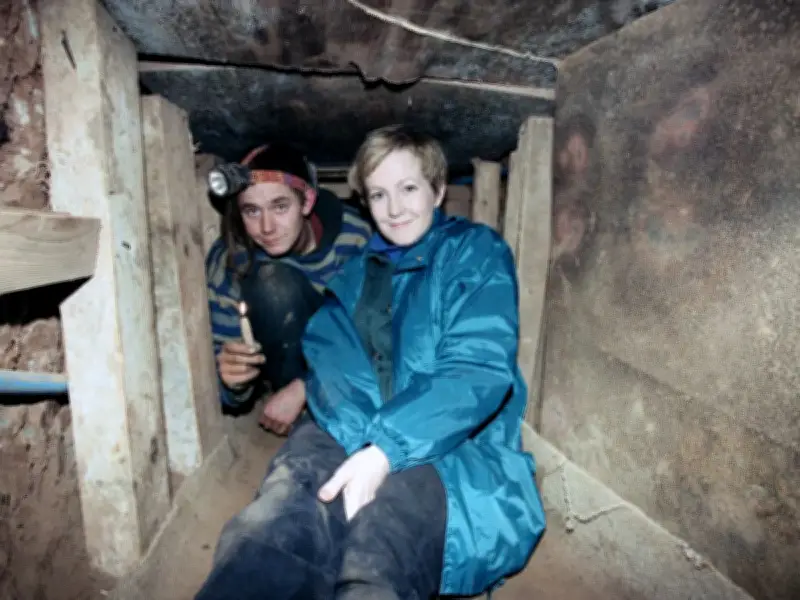
Activists had occupied a camp on the proposed site of the runway. It was there that the protestors moved in for the long haul, digging a tunnel network deep underground. While many of the campaigners took to occupying trees on the proposed site, four activists burrowed underground in a hand-built tunnel dubbed the 'cakehole'.
The tunnel was believed to be one of the most complex built at a protest, with campaigners claiming it went 50ft deep and its defences included bolted boilerplate doors. Another of the tunnels, dubbed The Worm, was reported in the Daily Mirror as a foot high by a foot wide - "Just enough for a slim man to squeeze through head first with arms outstretched."
Life as 'Human Moles'
With a ventilation pipe supplying air and enough supplies for six weeks, the activists were dubbed 'human moles' by the press. Photographs of the tunnels show that protestors had reinforced them with wooden panels and concrete, but there was barely enough room for one adult to crawl through at a time.
At the end of The Worm, lay a 3ft high "coffin-shaped chamber". This is where a number of the activists lived underground, eating tins of cold spaghetti and dried fruit. Daily Mirror photographer Frank Parker was reportedly the first outsider to enter the tunnels. Describing them, he told The Mirror: "It's like being buried alive. It's very difficult to move, extremely claustrophobic and takes about 10 minutes to reach the end.
"Then you drop headfirst into the sleeping chamber where there's just enough room to sit up." He added: "There's no noise from the outside world - it feels as though there's no one else alive. When the lights go out, it's as dark as the grave. I can't believe people are brave enough to live down there for so long."
Eviction and End of Protest
Using head torches and candles to illuminate their subterranean world, protestors continued to hole up as an eviction above ground began, with bailiffs conducting digging operations. By May 31, 1997, four months after the activists occupied the site, the Daily Mirror reported there were 30 protestors still in the camp, which consisted of "seven treehouses and four tunnels".
Removing the protestors was proving incredibly difficult with one female activist boobytrapping one of the trapdoors, which, if opened, would have throttled her by way of a makeshift "noose" which had been tied around her neck. However, the eviction team of tunnellers had dug around the surrounding area and cut the noose, allowing the activist to be freed unharmed.
As operations to remove the remaining activists from the tunnels continued, the protest ended on June 17, 1997. One 24-year-old protestor had become trapped for five hours after a partial collapse of the 'cakehole' tunnel. The last remaining campaigner had spent 17 nights in the tunnel. Now, alongside one of the professional tunnellers trying to evict him, the delicate operation to bring the two men to the surface commenced.

Following his rescue, the protestor is quoted as saying in the Aberdeen Press and Journal on June 17: "One of the tunnellers came in and said it had collapsed. I didn't believe him at first, I thought it was a bluff to get me out." He added: "They passed an oxygen meter in for us to monitor the air quality and we had communication with them all the time. We were perfectly safe."
The activist praised the tunnellers, who got to know the protestors well as they evicted them from the maze on the site. "I can't praise them enough," he said. "They were excellent. They did everything for my safety they could have done."
At the end of the eviction operations, it was reported that more than 160 arrests had been made. Randall Hibbert, Cheshire Under-Sheriff and the man tasked with overseeing the eviction operation, said the 'cakehole' tunnel was of a complexity never seen before at a protest. He told the Aberdeen Press and Journal that the tunnel had 10 doors, mostly made of steel, set in heavy concrete. He added: "It was an engineering feat in that sense."