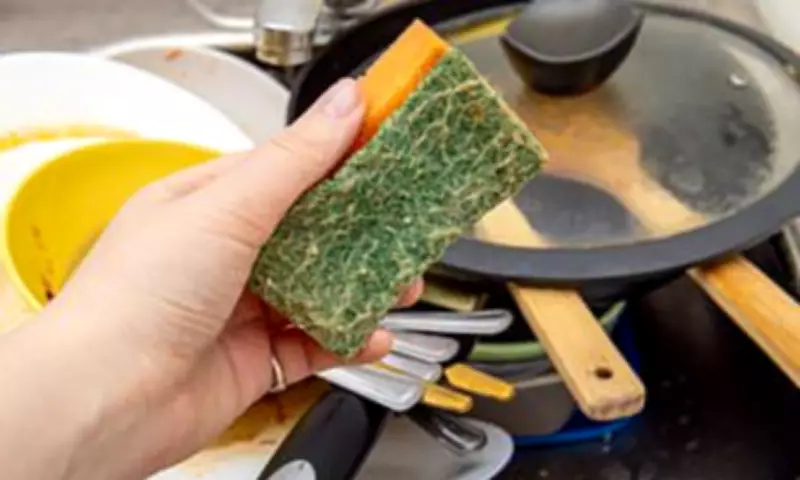
Your kitchen sponge is shedding millions of tiny microplastics every time you wash up, according to a new study. Researchers asked households to use one of three sponge types as part of their washing-up routine and documented how they broke down over time. They discovered each sponge lost material during use, resulting in the release of microplastics.
Annual Microplastic Emissions from Sponges
Depending on the sponge type, annual emissions ranged from about 0.68 grams to 4.21 grams of microplastics per person. While this may seem small, the researchers estimate this could add up to 355 tonnes of microplastics per year in a single country if everyone used the most polluting sponge type. Although wastewater treatment plants capture a large share of these particles, several tonnes could still enter rivers, lakes, oceans, and soils each year.
"All three types of kitchen sponges lose material during use, both in a citizen science and laboratory setup," the researchers from the University of Bonn said. "If these sponges contain plastics, they inevitably also release microplastics into the wastewater system."

Sponge Types Tested
For the study, the team selected three different types of washing up sponges to test. The first, a conventional European sponge, consists of a scrubbing layer, an inner foam layer, and a cloth layer on top. The second was a conventional North American sponge, made up of a scrubbing layer and a foam layer. The third was an organic sponge made predominantly from plant-based fibres. They worked out the plastic content of each sponge and found the European one contained 59.3 per cent plastic, the American one had 41.9 per cent plastic, and the organic one contained 15.9 per cent plastic.
Participants were given a sponge to use for several weeks before returning them to be weighed to determine how much plastic had been lost. Analysis, published in the journal Environmental Advances, revealed the European sponge released the most plastic by a substantial margin, while the organic sponge released the least.
Environmental Impact and Recommendations
"Microplastic release from sponges could be reduced by replacing the plastic content in the sponges," the team wrote. "A lower plastic share in kitchen sponges can significantly reduce microplastic release and related negative effects in the environment." Average microplastic release rates for each sponge type were: European sponge 19 mg/day, North American sponge 5 mg/day, and organic sponge 4 mg/day.
Despite their prevalence, scientists still do not know the long-term effects of microplastics on human health. Researchers are increasingly concerned about the capacity of such particles to be internalised within cells, causing alterations in cellular function, particularly when interacting with organs in children and causing definitive alterations in adult life. There is a growing body of evidence that plastics could play a key role in early-onset cancer genesis, where healthy cells turn cancerous. In 2024, a study found cancer cells in the gut spread at an accelerated rate after contact with microplastics. Experts have also raised alarms about a potential link between microplastics and reproductive health.
While the new results showed sponges do shed measurable amounts of microplastics over time, the researchers found the biggest environmental burden linked to hand washing dishes was water use. The environmental assessment found that approximately 85 to 97 per cent of the total impact of manual dishwashing comes from water consumption. Compared with water use, microplastic emissions contributed a much smaller share of overall ecosystem damage.
Reducing Your Environmental Footprint
To reduce your environmental footprint, the researchers suggest using less water while washing dishes and choosing sponges with lower plastic content to reduce microplastic release. They also recommend keeping sponges in use for longer periods, as extending their lifespan lowers overall resource consumption. However, an expert recently claimed you should change your kitchen sponge daily for hygiene reasons.

Dr Primrose Freestone, Associate Professor in Clinical Microbiology at the University of Leicester, said: "How often you clean your kitchen sponge depends on what you have been using the sponge for. If for something likely to be germ-ridden such as dirty vegetables or raw meat or fish, then I dispose of these after a single use as it is not easy to clean all microbes off a kitchen sponge. For everyday usage, I throw my sponge away after a single day – and during this day, the sponge will get multiple antibacterial detergent treatments."
Urban Flooding and Microplastics
Urban flooding is causing microplastics to be flushed into our oceans even faster than thought, according to scientists looking at pollution in rivers. Waterways in Greater Manchester are now so heavily contaminated by microplastics that particles are found in every sample, including the smallest streams. This pollution is a major contributor to contamination in the oceans, researchers found as part of the first detailed catchment-wide study anywhere in the world. This debris, including microbeads and microfibres, is toxic to ecosystems. Scientists tested 40 sites around Manchester and found every waterway contained these small toxic particles.
Microplastics are very small pieces of plastic debris including microbeads, microfibres, and plastic fragments. It has long been known they enter river systems from multiple sources including industrial effluent, storm water drains, and domestic wastewater. However, although around 90 per cent of microplastic contamination in the oceans is thought to originate from land, not much is known about their movements. Most rivers examined had around 517,000 plastic particles per square metre, according to researchers from the University of Manchester who carried out the detailed study. Following a period of major flooding, the researchers re-sampled at all of the sites. They found levels of contamination had fallen at the majority of them, and the flooding had removed about 70 per cent of the microplastics stored on the river beds. This demonstrates that flood events can transfer large quantities of microplastics from urban rivers to the oceans.