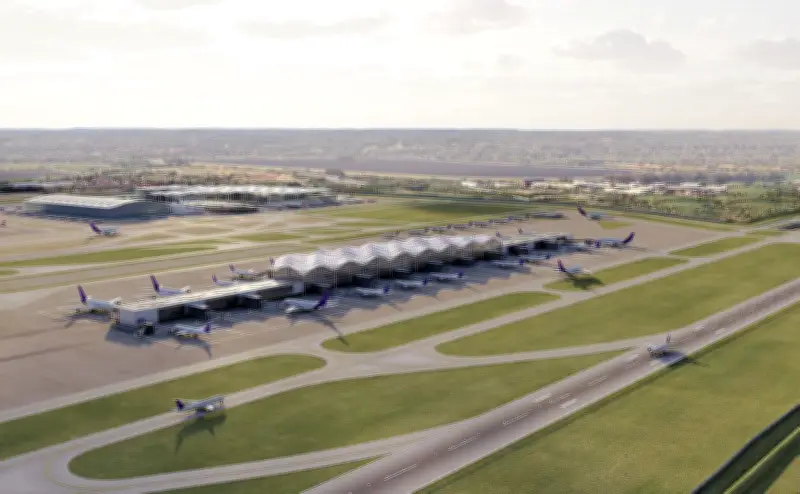
The Mayor of London has said the government's case to move forward with expanding Heathrow Airport has not been “sufficiently made” and relies heavily on outdated evidence from 2015.
Ministers are currently reviewing development proposals to install a third runway at the West London site, having backed it earlier this year despite opposition from local and environmental campaigners.
Sir Sadiq Khan has opposed the expansion for years due to the “severe impact it will have on noise, air pollution and meeting our climate change targets”.

Outdated policy
In a new submission to the House of Commons Transport Committee, the Mayor and Transport for London (TfL) said that the government’s case for the need for increased capacity at Heathrow “relies heavily” on findings that are almost a decade old.
The Department for Transport published the Heathrow Expansion National Policy Statement (HENPS) in June to “provide the basis for decision making on any development consent application” for a new runway.
But City Hall has said that there is a “significant gap between the strategic narrative and the evidence presented”, adding: “Many of the benefits underpinning the government’s argument are uncertain, only partially quantified, outside the core appraisal framework, or require complementary policies beyond airport expansion which are not assessed.”
The written submission accuses the government of relying on the 2015 report from the Airports Commission – which recommended a new runway be built – with “inadequate account taken of material changes”, including a drop in business travel, the expansion of other UK airports and new targets on Net Zero carbon emissions.
Environmental concerns
Much of the objections stated are based on environmental concerns, with the Mayor and TfL claiming that the revised environmental tests “do not provide sufficient reassurance that an expanded Heathrow can be delivered without very serious environmental impacts”.
They suggest the approach laid out would allow more flights – and the emissions that accompany them – while “taking advantage of environmental improvements unrelated to airport expansion”.
Doing this would simply allow ministers to capitalise on the “headroom” created in the capital through policies such as the Ultra Low Emission Zone (ULEZ), the Mayor said, which has enabled London to meet legal limits for air pollution almost 200 years earlier than initially predicted. In the Heathrow area itself, average NO2 concentrations have been reduced by 34 per cent, and PM2.5 concentrations have been reduced by 28 per cent.
“This progress must not be undone by the expansion,” the submission warns.
City Hall has been keen to flaunt London’s progress on air quality improvement and reduced emissions, though the Mayor has admitted that the city will not be able to achieve Net Zero status by 2030 as originally targeted.
Noise and transport impacts
The HENPS says that the installation of a third runway must not lead to any extra noise than what was recorded in 2024. However, the Mayor has said that this will “deny local communities the benefits of any reduction in noise that comes from technological and operational advances, as this will be used instead to enable more flights”.
Annual passenger numbers at Heathrow are projected to rise by 79 per cent to 150 million people if a third runway is built. This could result in far more car journeys transporting passengers to and from the area – the submission predicts 60,000 extra highway trips every day, or 22 million annually, creating “intolerable strain on the highway network, worsening congestion, increasing air pollution and carbon emissions and eroding the economic benefits in the wider region”.
Both TfL and the Greater London Authority (GLA) “welcome recognition of the need for a significant shift” to more sustainable transport modes. Ministers have suggested that Heathrow can expand without resulting in any extra road trips to and from the airport, but for this to happen with a third runway, the percentage of people using public transport to get there would need to increase from 39 to 65 per cent.

TfL’s analysis indicates that this cannot happen without extra connectivity and capacity on the rail networks serving the airport. The submission claims that while the Piccadilly Line upgrade and new trains on the Elizabeth Line would add more capacity, direct services to other destinations, such as Waterloo, Basingstoke and Reading would be needed to meet expected additional demand.
There is no indication that the new government will reverse plans to push on with the third runway. Ministers are aiming for planning approval by 2029 and for operations to begin by 2035.
A DfT spokesperson has previously told the LDRS: “Airport expansion will unlock jobs, strengthen Britain’s connectivity, and attract international investment, and we have been clear that it must support our decarbonisation goals while minimising impacts on local communities.”