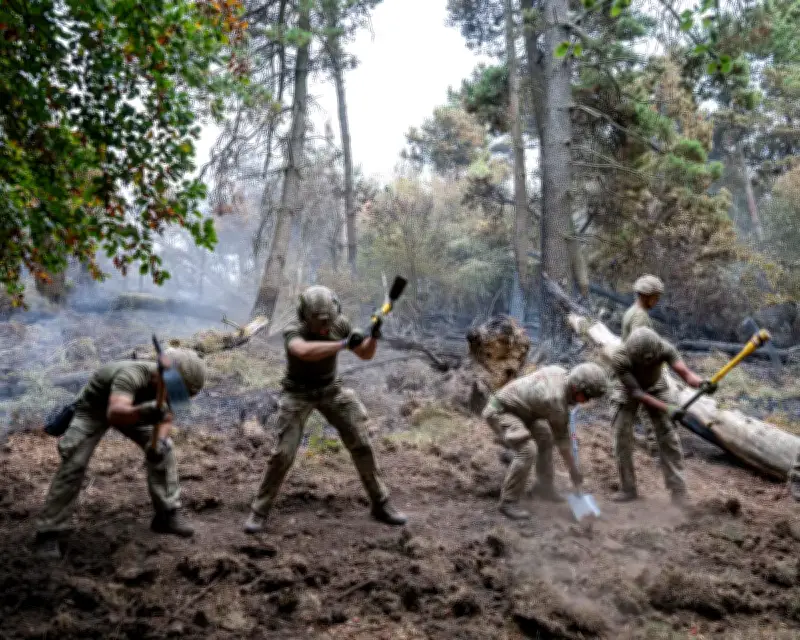
More than three weeks after it began burning and two days after the military deployed to the area, there is hope that the huge wildfire on the hillside above the Ebbw valley village of Blaenavon may finally be coming under control.
Emergency workers and soldiers described a gruelling battle against the deep-seated peat fire that has spread over 4,000 hectares (9,800 acres), putting lives, farmland and property at risk.
Military deployment and national context
At least 13 other fires have blazed across the valleys this weekend, prompting South Wales fire and rescue service to ask for military support – the first UK military deployment to deal with wildfires since 2018.
Nationally, approximately 36 fires are still burning, 11 of which have been declared major incidents. Extreme heat and a lack of rain, supercharged by the climate crisis, have made this summer the busiest on record for wildfires in the UK, placing significant pressure on crews and resources.
Challenges of the peat fire
Jamie Windsor, a group commander at Ebbw Vale station, said underground layers of peat beneath the orange and purple heather on the Blaenavon hillside had made the fire harder to put out.
“It burns very deep, the peat, and because it’s been so hot, it’s not cooling down at night. You think you’ve got a handle on it but it’s burning underground and it just pops up again somewhere else,” he said. “We’re got a lot of wildfire experience here in south Wales but I’ve never seen anything like it in 30 years.”
During the Guardian’s visit to the scene on Sunday, soldiers from the Queen’s Own Gurkha Logistic Regiment tirelessly dug firebreaks and turned over smoking soil to minimise the spread of fire. Small flames licked around the base of blackened trees a few metres away as they worked, while in another part of the woods several trees lit up quickly with no warning.
Innovative tactics and community impact
On the ridge of the hill, a civilian-contracted helicopter picked up water from a huge plastic pool fed by a local dam and circled again and again to dowse reigniting pockets of the smouldering hillside.
Smoke from the area has been visible as far away as Cardiff and Gloucestershire. Firefighters from services around the UK have come to help improvise how to get water to hard-to-reach places, using an old steel mill on the edge of town as a temporary headquarters. New thermal camera drones and specialised response vehicles designed by the South Wales fire service came online this summer.
“Just in time,” said Darren Cleaves, the group manager for the service, as he radioed a colleague at the perimeter of the fire to report what he could see on the drone screen. “The drone means we can be much more accurate with pinpointing where we need to go, and it keeps our teams safer.”
The combined efforts have worked, saving houses in Blaenavon a few hundred metres away. For weeks, residents on Llanover Close, a road on the village boundary, have watched a steady stream of fire engines, water tankers, tractors and other emergency vehicles and equipment go back and forth to the forestry track above their homes.
Cindy Rogers, 60, lives in the last house on the road where Blaenavon meets the hillside. A fire in 2004 that began on the top of the mountain almost reached her house, she said, pointing from her back garden to where the fire line is still visible.
“It’s a worry that this is going to get worse in the future with climate change, but I wouldn’t move unless I really had to,” she said. “All it takes is the wind to change direction and that’s it.”
Progress and ongoing concerns
By Sunday afternoon, the Blaenavon fire was showing signs it may be slowing, said Fin Monahan, the chief fire officer of South Wales fire and rescue.
“It’s been very tough, but I’m so proud of the professionalism of these teams and how hard they are working,” he said. “Morale is still high, everything is calm and controlled … It’s just the scale of what we’re dealing with is unprecedented. We normally get about 1,000 999 calls a week, and at the moment it’s 7,000.”
Arson had been a major contributor to this summer’s fires, Monahan said. “Not every investigation has been completed yet but we can already see it’s been a significant issue this year in south Wales. Fire safety education is another key area we focus on … Driving home last night, I saw smoke and I went and found a guy burning tires and other stuff in his garden, under a tree. I had to tell him to put it out.”
The cause of the Blaenavon fire is still unknown, but across the country arson arrests have been made in relation to this summer’s fires. On Saturday, four teenage boys from Porth in the Rhondda valley were detained on suspicion of arson and later released on bail.
In Stoke-on-Trent, a man and woman have been arrested in connection to a fire that destroyed four homes, and a man in King’s Norton and another in east London have been arrested on suspicion of arson to endanger life.
The UK has experienced multiple heatwaves this summer, as climate breakdown makes extreme heat, drought and wildfires more likely. The whole of Wales and almost three-quarters of England were declared officially in drought last month, and the Met Office said this week that the UK was on course for its hottest summer on record by average temperature.
The Blaenavon fire and many others across the country may only finally settle with cooler temperatures and rain, but the onset of autumn and more rainfall is not guaranteed to reverse the drought conditions, the Met Office said on Saturday.
In Blaenavon, flash flooding has plagued residents in recent years. A supercharged El Niño is now predicted to bring wet and stormy conditions to the UK this winter.
An 89-year-old resident of Llanover Close, who did not want to give his name, said he had lived on the street since it was built. “It’s the flooding that worries me. My basement flooded last winter,” he said. “Fire and flood … I never thought it would come to this.”