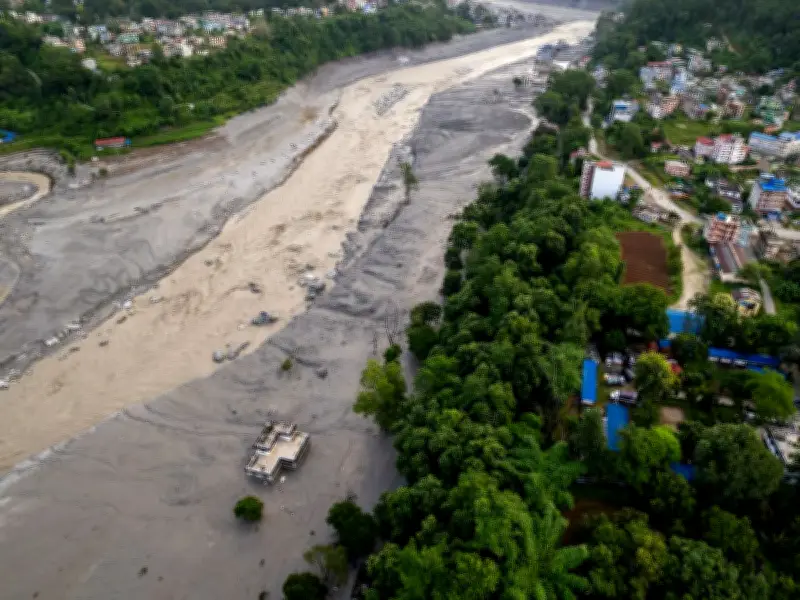
Satellite imagery suggests a huge glacier collapse high in the Himalayas triggered the deadly torrent of mud, water, rock and ice that tore along the Bhotekoshi River on Wednesday, sweeping away buildings and roads and leaving at least 543 people dead and 1,400 missing.
A magnitude 4.4 earthquake had initially been blamed for the catastrophic collapse. But scientists now believe the opposite happened. A vast wall of ice and rock broke away from the northern slope of Langtang Lirung, a 7,000-metre Himalayan peak which sits at the Tibet-Nepal border. The impact as it crashed down was so powerful it generated seismic waves that initially appeared to be an earthquake.
"Additional analysis of long-period seismic waves indicates that the seismic energy was instead generated by a glacial collapse and debris flow," the US Geological Survey said. Exactly what triggered the collapse is still being investigated and scientists caution against attributing a single disaster directly to the climate crisis.

Warming temperatures and the monsoon
But two days before the collapse, ground temperatures recorded six miles away reached their highest level in two years, according to Dr Hamish Pritchard, a glaciologist with the British Antarctic Survey.
"These high temperatures would have weakened the snowpack, filled crevasses with water and thawed the bonds between ice and rock that hold these glaciers in place," he said.
The disaster also struck during the monsoon, when heavy rainfall can saturate slopes and swell rivers. Whether global heating was the immediate trigger or not, the wider transformation of the Himalayas is unmistakable.
Rapid change across the Himalayas
The region is warming nearly twice as fast as the global average. Nepal is home to thousands of glaciers which are shrinking as temperatures rise and scientists have warned for years that the consequences extend far beyond the loss of spectacular glaciers. As ice retreats from steep mountainsides, it can remove support from rock faces. At the same time, warming can thaw high-altitude permafrost - collapsing buildings and leading to more frequent landslides.
"The logic is that with a warming planet, you will see shrinking glaciers, lots of snow melt," said Dr Simon Cook, an expert in glacial hazards. "The permafrost that is partially holding some mountainsides together is warming and thawing and degrading. So you are going to get more landslides, debris flows, glacial meltwater, lake outbursts, glacier collapses, because climate warming ultimately destabilises these high mountain environments."
Growing risks and past warnings
Glacial avalanches, rockfalls and floods are not new. But the speed of the change is particularly concerning. An analysis by the International Centre for Integrated Mountain Development found glaciers across the Hindu Kush Himalaya are now losing ice at twice the rate they were at the beginning of this century.
Disasters linked to unstable glaciers and mountains have already provided warnings of what may lie ahead. For example, in 2021, a huge mass of rock and glacier ice collapsed in Chamoli in northern India, plunging into the valley below and generating a devastating torrent of water, rock and debris that killed more than 200 people. Scientists later calculated the energy released by the collapse was equivalent to around 15 Hiroshima atomic bombs.
Similar glacier and rock collapses have occurred in the European Alps, while the same region of Nepal experienced serious flooding last year after a glacial lake in Tibet burst.
Mohd Farooq Azam, a glaciologist, said the growing frequency of hazards in the cryosphere – the frozen regions of our planet – was becoming "more visible than ever before". "The pace of change is so rapid," he added.
As temperatures climb, glaciers retreat, meltwater increases and frozen ground begins to thaw, the risks are growing for millions of people living beneath the world's highest mountains. But the consequences will not stop there. What happens to the "Third Pole" will be felt far beyond the Himalayas.