
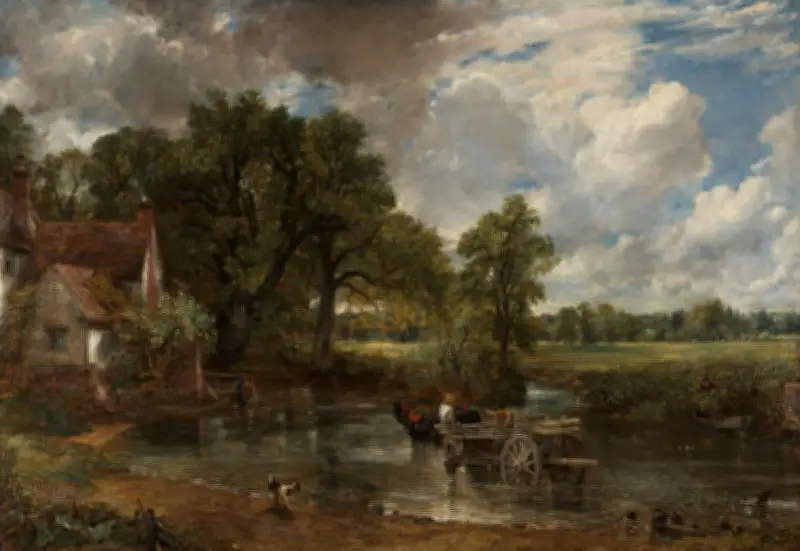
Exhibition Contextualizes Constable's Masterpiece Amidst Climate Crisis
A new exhibition at Christchurch Mansion in Ipswich, titled The Hay Wain: Walking Constable’s Landscape, reexamines John Constable's 1821 painting The Hay Wain through the lens of the climate crisis. The show, running from 11 July to 4 October, presents the work not as a static pastoral scene but as a conservationist plea, especially poignant during the current heatwave that has turned the surrounding Suffolk landscape into a parched, straw-yellow terrain.
The Painting's Scale and Ambition Revealed
Brought from the National Gallery to its local setting, The Hay Wain regains its original scale and ambition. The exhibition includes drawings, watercolours, and oil sketches that trace Constable's lifelong obsession with the countryside of his birth. Among the earliest items is a graffiti carved by a 16-year-old Constable on a beam from his father's windmill at East Bergholt, depicting the mill itself.
Constable as Conservationist, Not Conservative
Constable is often stereotyped as a conservative, but the exhibition argues he was a conservationist. He was aware of the Industrial Revolution, having painted London's industrial chimneys, yet chose to preserve a rural world in his art. Works like Golding Constable’s Kitchen Garden (1815) show his family growing food for subsistence, while broader views of Dedham Vale reveal a subtle blend of buildings with fields, woods, and water.
The Hay Wain's Elegiac Quality
The Hay Wain is Constable's most elegiac work, capturing space and time. The foreground shows Willy Lott's house by Flatford mill pond, while fields stretch for miles in a dappled vista. The hay wain appears stuck in the water, with a boy fishing and a dog pausing—a depiction of rural toil, from laundry to reaping. The painting evokes a sense of slow, timeless labour.
Movement and Light in Constable's Landscape
Constable and Gainsborough introduced movement to landscape painting. The light in The Hay Wain seems to change as one contemplates it, contrasting with earlier classical landscapes by Claude and Poussin. Constable playfully references these masters by placing the dog on a curved bank reminiscent of a classical bay, only to emphasize that this is a small, uneventful corner of Suffolk.
Climate Commentary on a Temperate Scene
The exhibition's timing during a heatwave adds an ironic layer. Inside the Tudor house, clouds in the paintings offer shade, but outside the landscape is scorched. This contrast underscores the fragility of the natural world Constable cherished. The Hay Wain, often parodied for its idyllic vision, now serves as a reminder of what could be lost to climate change.




