
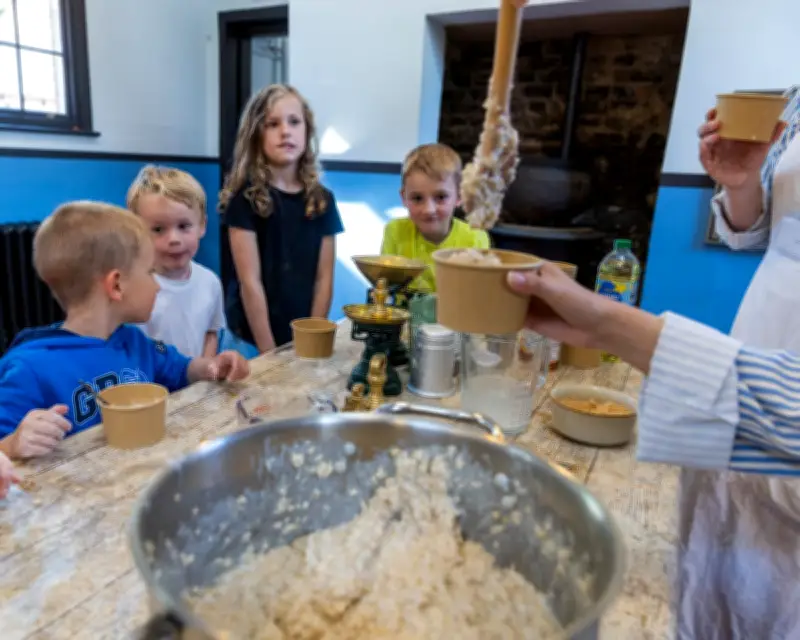
Visitors to one of Britain's most complete surviving Victorian workhouses won't have to strip and bathe in someone else's bath water. But they might get some gruel, they can sweep the yard and there are "schoolmaster" volunteers happy to tell children how to behave.
"You are literally going to walk in the footsteps of people who have experienced this place," said the director of the Ripon Museums Trust, Alexa Vernon. "I'm not sure we can serve gruel every day, but children will be able to get stuck into sewing and hunt for mice and listen to the sounds, and they might realise how lucky they are compared to Victorian children."
Revamped museum reopens after £2.8m redevelopment
Vernon was speaking before the reopening of the Ripon Workhouse Museum after a £2.8m redevelopment. A key part of the revamp has been to make the experience more immersive with volunteers who might be baking bread or putting clothes through a mangle.
Visitors are asked if they would survive the Victorian workhouse. As they enter the vagrants' block, the sound of unpleasant coughing fills the air. There are baths, a one-size-fits-all coarse men's nightshirt and a reproduction "de-infestor" used to fumigate paupers' and vagrants' clothes.
"All their possessions would be taken from them," said the curator, Laura Allan. "They would be stripped. They would be bathed. If you were lucky you would be the first person in the bath water. If you were unlucky, you were the third. It's interesting that the reasons people became homeless in the past are very similar as today – so alcoholism, mental health, family breakdown, veterans returning from war."
Visitors can experience vagrants' cells and workhouse uniforms
Elsewhere in the museum, visitors can shut themselves in a vagrants' cell, pick oakum from old ropes or pose for a family portrait in replica workhouse uniforms.
The museum reopens to the public on Tuesday after major conservation and restoration work supported by the National Lottery heritage fund. It became a museum in 2017, telling the story of the Victorian solution to poverty and homelessness – give people a bed and food, but make it as grim, unpleasant and rules-bound as possible.
Building needed urgent repairs and a more engaging experience
A revamp of the museum building had been badly needed, said Vernon. "You could honestly stick a screwdriver in the rotting window frames and it would stand up independently," she said. "The roof was leaking. We had water damage throughout. The wiring was like spaghetti junction. We had unsupported arches. Our structural engineer said that technically the building shouldn't stand up."
On top of that the museum experience was more like walking round a 1970s council offices with bits of interpretation, unsurprising given that it was once office space for North Yorkshire social services. "Some of our Tripadvisor comments were along the lines of … it looks like they've not finished it," Vernon said. "It wasn't finished."
Lottery funding transforms museum and opens cellar
The lottery money has been transformative, and not just in fixing the leaking roof and rotting windows and painting the walls in horrible – but original – taupes, pinks and greens. One particular joy, curators say, has been the opportunity to open the cellar, allowing visitors to see where meat was slaughtered and stored.
"This space, we think, was probably last opened in the 1930s," said Allan. "This is probably exactly how it would have looked when it was a workhouse. It's the only space that really has never been touched."
Museum tells a national story of poverty and welfare
The museum tells a story about Ripon but much more than that, said Vernon. "This is a national story," she said. "Workhouses have an important story to tell about poverty, welfare and justice and there were workhouses up and down the country. This was the Victorian solution to poverty."
The revamped museum is one of three in Ripon that tell vivid stories of Victorian life. There is also a courthouse museum and a prison and police museum. They tell historical stories, but their curators are passionate in their belief that they have contemporary resonance. "Poverty still exists, doesn't it," said Vernon. "People can come here and think about poverty, think about how we treat people and think about whether we are treating people more fairly now."
She hopes visitors to the museum will leave feeling more informed, "but also more compassionate, thoughtful and connected to the stories of those who came before us".




