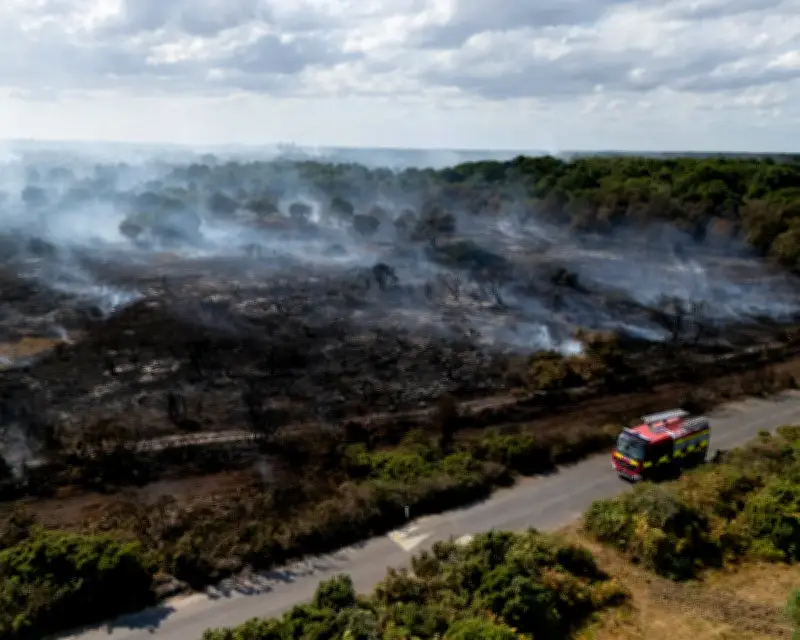
The government quietly scrapped plans to prepare the countryside in England for wildfires, despite new data showing fire crews do not have the proper protective gear to tackle them. This summer has been a potent reminder of the scale of the threat posed by the climate crisis, with the UK experiencing record-breaking wildfires after punishingly hot and dry weather turned large parts of the countryside into a tinderbox.
Plan never implemented
In the third national climate adaptation programme, published in July 2023, the Conservative government, then headed by Rishi Sunak, said it would run a wildfire risk programme in England from 2023 to 2027 so land management would be adapted for the risk. However, it has now emerged the programme was never implemented, with the current government stating the commitment “was made by the previous government but was not brought into effect”.
The environmental campaigner and author Guy Shrubsole, who obtained the information via a freedom of information request, said it was “appalling” the government “couldn’t be bothered to pay attention to wildfire risks until jolted into doing so by Britain burning this summer”. After a wildfire spread across an area including several homes in Stourbridge in the West Midlands in August, the prime minister, Andy Burnham, convened an emergency Cobra meeting and issued a temporary ban on the sale of disposable barbecues, criticised as being too little too late.
Concerns over preparedness
“Successive governments have been asleep at the wheel in preparing us for the impacts of the climate crisis,” Shrubsole said. Alistair Carmichael, a Scottish Liberal Democrat MP and the chair of the Commons environment food and rural affairs committee, said it was alarming that ministers had not prioritised work to adapt land for wildfire risk. “It begs further serious questions about whether this summer’s wildfires could have looked different with more resources on the ground,” he added.
Shrubsole said the government must agree a plan to re-wet the UK’s peat bogs, restore lost ponds in farmers’ fields, and stop grouse moor owners setting fire to moorland.
Lack of protective gear
New data obtained by the Country Land and Business Association has also revealed that more than half of the 29 fire services that responded to requests for information had no wildfire personal protective equipment (PPE). They included the Suffolk fire and rescue service, which had to deal with an “apocalyptic” wildfire earlier this summer that burned close to the Sizewell B nuclear power station and destroyed vast areas of a protected nature reserve.
Standard particle-filtering respirators do not protect against dangerous gases such as carbon monoxide, which are heavily present in wildfire smoke. Standard PPE can also be too hot and heavy for wildfire conditions. This can cause crews to overheat, or remove their PPE altogether, exposing them to greater danger from heat, smoke and radiation.
The data also revealed that training for wildfires was limited. For example, in Cleveland just five staff (1.2%) were qualified to give tactical advice or command wildfires, and in Cheshire just 8.62% of employees were trained to undertake wildfire operations.
Calls for action
In response to these findings, the Fire Brigades Union is calling for correct PPE to be provided to all members combating wildfires, alongside adequate training programmes. Steve Wright, the union’s general secretary, said: “It is vital for our country’s wildfire resilience to have better land management, stronger public awareness campaigns and long-term prevention measures. Only by proper investment and a wildfire strategy can we make the country more resilient.”
A government spokesperson said: “We have made wildfire preparedness a government priority and, following incidents this summer, we are convening a summit with fire and rescue service partners to make sure we are as resilient as possible. This includes making sure services have the right equipment and resources, building on the £100m we previously gave to upgrade our national resilience assets. Land management and landscape adaptation play an important part in this, and we work closely with land managers and experts to support the restoration of peatlands, the creation of firebreaks and other adaptations that help to prevent fires from starting or from spreading as quickly during incidents.”