
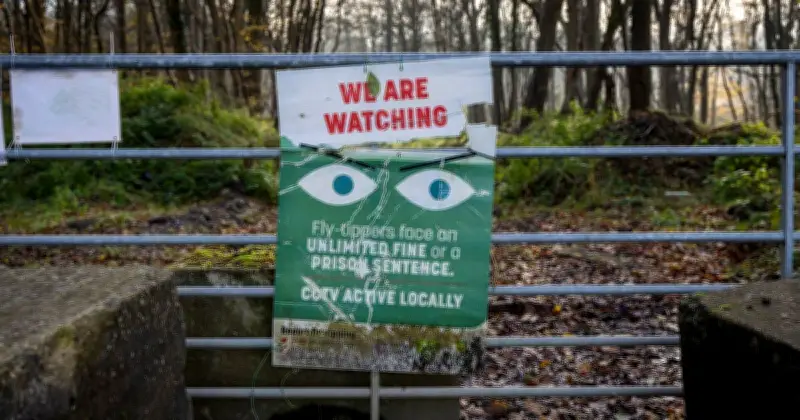
An 80-year-old farmer in Hertfordshire was left with 200 tonnes of rubbish dumped on his land, forcing him to face a £40,000 clean-up bill. Generous Britons raised the cash through a crowdfunder to help clear the mess left by fly-tippers.
Rising incidents and costs
England dealt with 1.26 million incidents of fly-tipping in 2024/25, a 9% rise from the 1.15 million recorded the previous year. Clearing the mess cost local authorities £19.3 million, meaning taxpayers often foot the bill for rubbish dumped by people who evade punishment.
Local authorities in England carried out 572,000 enforcement actions during 2024/25, up 8% from the 530,000 taken the previous year. Despite the increase in enforcement, catching culprits can be notoriously difficult due to a lack of CCTV, fake number plates, and criminals operating under the cover of darkness. Local councils have started deploying drones with high-resolution cameras, thermal imaging, and laser mapping to spot, track, and gather evidence.
Organised waste crime
The problem extends beyond residential bin bags. Organised waste crime operations have ballooned, with lorry loads of rubbish frequently dumped at illegal sites. The UK has at least 8,000 illegal dumping grounds, containing millions of tonnes of rubbish.
Cowboy builders and organised crime networks have driven the rise, viewing illegal waste disposal as a low-risk alternative to crimes such as narcotics. Criminals charge unsuspecting customers for legal disposal, then dump the waste at little or no cost and pocket the difference.
Mo Metcalf-Fisher, of the Countryside Alliance, said: “The public need it made absolutely clear to them what their duty is in stamping out fly-tipping and that starts with ensuring they use a licensed refuse collector that disposes of waste legally.
“Households need to do their due diligence in advance. Public awareness is as important as enforcement. Where there's a market for the fly-tippers, they'll continue to operate. We need to shut down their revenue stream.
“A proper refuse collection will usually be more expensive because it's regulated and regulation incurs costs. If someone is struggling financially, they may opt for a more illicit, and cheaper, option. This is where the fly-tippers pounce.
“The Government needs to not only address the fly tipper but members of the public who are either knowingly or unknowingly fuelling the crisis.”
Regulatory changes and penalties
A loophole in the law means waste carriers currently do not have to prove they are qualified to remove waste. They just need to complete an online form and pay a £191.02 registration fee. That system is set to change from next year, with applicants having to undergo identity and criminal record checks and show they meet requirements.
The crackdown came after a cow, aptly named Beau Vine, was legally approved to dispose of household rubbish. Ann Maidment, a director at the Country Land and Business Association, applied for the licence with the Environment Agency on behalf of her animal, and it was approved in “under three seconds”. Under new rules taking effect in 2027, custodial sentences of up to five years will also be introduced for the illegal transportation of waste.
The maximum on-the-spot fixed penalty notice for fly-tipping is up to £5,000, with around 69,000 issued in a year. If offenders are prosecuted through the courts, they face unlimited fines, up to 12 months in prison in a magistrates’ court, or up to five years in serious Crown Court cases. However, the average court fine for fly-tipping is £539, £87 lower than the £626 average fixed penalty notice councils can issue.
Impact and response
Fly-tipping and wider waste crime cost the UK economy an estimated £1 billion every year. The issue rocketed to the top of the political agenda after fury erupted over 21,000 tonnes of waste dumped along the River Cherwell and the A34 near Kidlington in Oxfordshire.
A £7.3 million Environment Agency operation to remove the waste began in April because of the fire risk and is expected to take six months. Workers discovered “further buried waste” hidden beneath a thick layer of soil. In July, workers uncovered a pit measuring approximately 6ft 6in deep and 32ft 9in wide. At its peak, up to 30 lorry-loads of waste were removed each day. Four men have so far been arrested in connection with the illegal waste tip, all released while the investigation continues.
Private landowners are also left to deal with consequences. Farmers can ultimately be legally responsible for paying to remove rubbish dumped on their own land. The Environment Agency tries to ensure those responsible pay, but if that is not possible, the responsibility falls to the landowner. The National Farmers’ Union (NFU) is among organisations calling for reform.
NFU Vice-president Robyn Munt said: “Fly-tipping disrupts working farms, takes valuable food-producing land out of use and places an unthinkable emotional and financial burden onto British farmers and growers.”
She added: “With only one in 1,000 fly-tipping incidents prosecuted by the police, it is vital that local authorities are properly resourced and a simplified reporting system is implemented to catch, deter and put a stop to these dangerous criminals.”
Experts believe the coronavirus pandemic exacerbated Britain’s fly-tipping nightmare after local landfills changed visitor rules, making it more difficult for households to dispose of waste. Booking systems were introduced as an emergency measure during the health crisis, and some local authorities have kept stringent rules in place.
Fly-tipping risks serious environmental damage, with plastics, chemicals, tyres, asbestos, and other hazardous materials potentially entering soil, rivers, and habitats. In March, the Government unveiled its waste crime action plan. The question now is whether tougher rules and stronger enforcement can finally get to grips with a problem that has spread from isolated dumping incidents to a sprawling waste crime economy.




