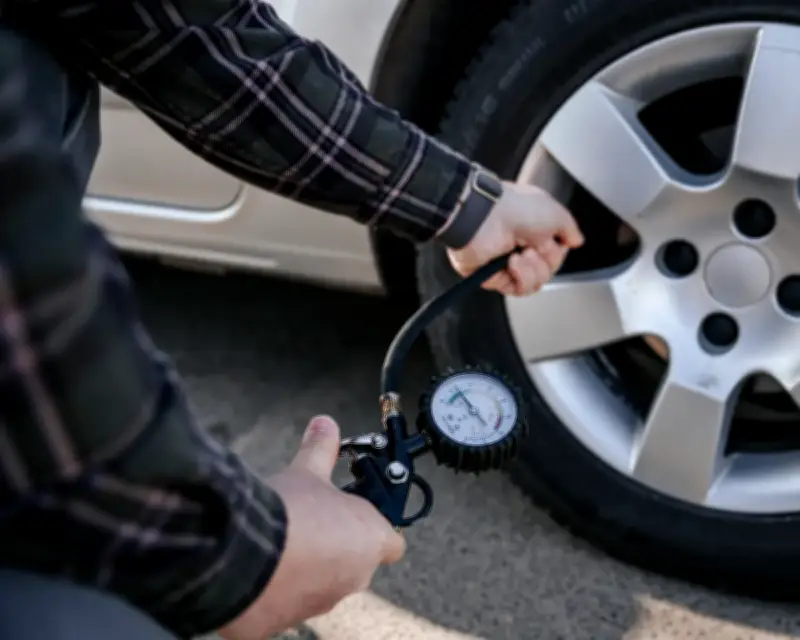
Filling every car tyre on the planet with carbon dioxide would lock up only a tiny fraction of annual emissions, and the gas would quickly leak back into the atmosphere, according to readers of The Guardian's Notes and Queries series.
The question, posed by Chris Coldwell of Lancaster, asked whether pumping all vehicle tyres with CO2 would significantly lower the amount of carbon in the air, and whether there would be other issues such as the carbon cost of trapping it.
The maths of tyre storage
One reader, DrLBlack, calculated that an inflated car tyre contains about 14g of air. CO2 weighs about 50% more than air, giving 21g of CO2 per tyre, or 105g per car. With just short of 1.5bn cars on the planet, that works out at 157,700 tonnes of CO2 in all of the world's car tyres. By comparison, CO2 emissions in 2025 were 38.1bn tonnes, or about 100,000 tonnes per minute.

Another reader, mill1806, noted that 400 tonnes per hectare per year means that achieving capture of hundreds of thousands of tonnes would require either thousands of hectares or thousands of years, which is "well, well short of current emissions."
Practical and safety concerns
Several readers pointed out that the carbon would be held only until a tyre punctured or wore out, much quicker than the 100-year time CO2 persists in the atmosphere. FrankieandDexy noted that the cost of collecting, transporting and storing CO2 for the purpose of filling tyres would probably be astronomical compared to the current simple and cheap compressed air method, and that billions of CO2-filled tyres would simply add to pollution levels upon deflation.
PolyphonicPoly added that CO2 leaks out of rubber much faster than nitrogen, meaning more of it would need to be compressed and people would need to check tyre pressure daily or have underinflated tyres, which is bad for fuel efficiency. They also noted that if CO2 is not completely dry, it will form carbonic acid that can corrode materials at high concentrations, and that an infrastructure with so much high-concentration CO2 would pose safety issues, as CO2 above 2% in air can cause blood to turn acidic.
Alternatives suggested
Readers suggested more effective approaches. king_tubby recommended bubbling CO2 through algae, trapping it in basalt, turning it into bicarbonate and putting it in the ocean, planting trees, creating kelp forests, educating more girls, and making voting compulsory. jupiterblue advised two immediate actions: not buying anything from the livestock industry and not buying air tickets, arguing that there is no sustainable future that includes the mass-production livestock industry or the mass aviation industry.
TotallyTukTuk suggested reacting captured CO2 with hydrogen to form methane for the gas grid, though Randomusername222 countered that thermodynamics shows the electricity used to recreate the methane is equal or greater than the heat gained by burning natural gas, and that a heat pump would be many times better off leaving natural gas in the ground.
DrLBlack concluded: "It would be interesting to compare the 157,700 tonnes stored here to the area needed to get the same carbon store in a rewilding project. I imagine that it would be a relatively small area of woodland on a map?"