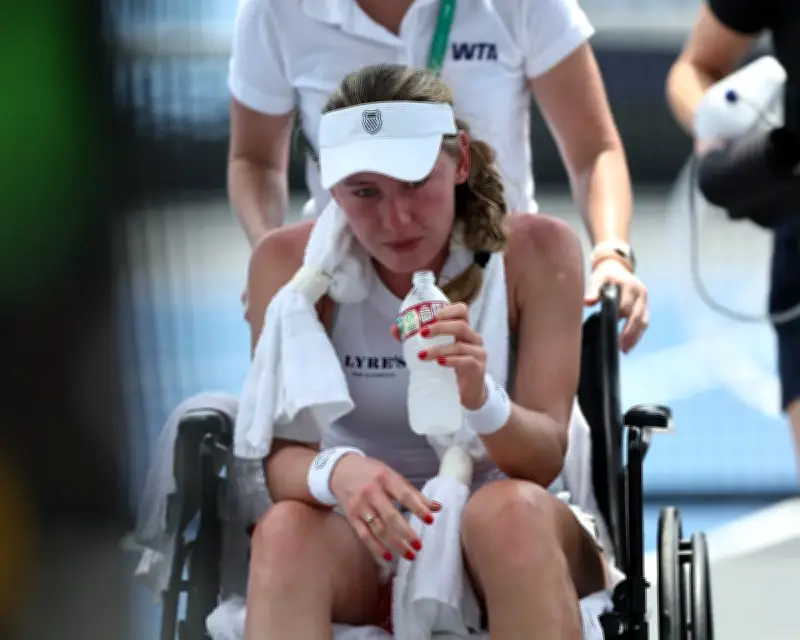
Extreme heat has become a defining challenge for elite sport this summer, with athletes collapsing on courts and fields, and experts warning that sports must adapt to survive rising temperatures. From tennis players forced to leave matches to a rugby player dying of suspected heatstroke, the impact of the climate crisis on athletics is no longer a distant threat but a present reality.
Heat-Related Emergencies on the Rise
This summer, tennis player Ekaterina Alexandrova was forced to leave the court due to a heat-related emergency during the Memphis Classic in July, while Jakub Mensik collapsed in Paris. Cyclist Tom Pidcock called the Tour de France a “war zone,” and a referee at the World Cup was later found to be suffering from heat strain. On 7 August, Fijian rugby player Saimoni Vunilagi died of suspected heatstroke in Fukuoka, Japan, where temperatures had hit 35C, after training with his club, Kyuden Voltex.
Adaptation Strategies in Play
Dr Lee Taylor, from Loughborough University, a world leader in preparing athletes for extreme environments, says, “The reality is that we live in a climate-change world. It’s inevitable, whatever sport you play, at whatever level, that more of that training and playing is going to be in a hot environment. So either we stop playing sport altogether or we adapt.”
During the World Cup, adaptations included mandated hydration breaks, but there was no extra flexibility for games with a wet bulb globe temperature above 32C, nor any extension of half-time, despite what Taylor describes as “a clear rationale to do so in some games as a very robust way to make the players safe by reducing their body temperature.” The commercial interests, he suggests, held the upper hand.
Heat as a Performance Opportunity
Despite the dangers, experts see heat as a potential performance advantage when properly managed. Taylor points to the 2019 Doha World Athletics Championships, where up to 40% of road race participants did not finish due to inadequate preparation, meaning well-prepared athletes gained a significant edge. He warns, however, about athletes with undeclared illnesses or medications, and stresses the need for a “heat deck” – medical expertise and facilities to rapidly cool someone with exertional heat stroke.
As the Premier League kicks off, Taylor notes that clubs may have used the unseasonable heat for pre-season training. “If someone has engaged in about six weeks of heat training, they can expand their haemoglobin mass by approximately 3%-6%. That’s the same type of adaptation we get in those red blood cells at an altitude camp – super desirable for our elite athletes.” The challenge, he adds, is maintaining training quality in the heat, which is more tiring and compromises recovery.
Uncertain Future
The unpredictability of future conditions poses an existential problem. “We used to prepare for the worst possible outcome,” says Taylor. “What does the historical data tell us is going to be the most challenging humidity and heat? But that’s gone out the window over the last five years because we have these crazy outliers.” When even the data cannot guide preparation, the need for flexible, adaptive strategies becomes paramount.