
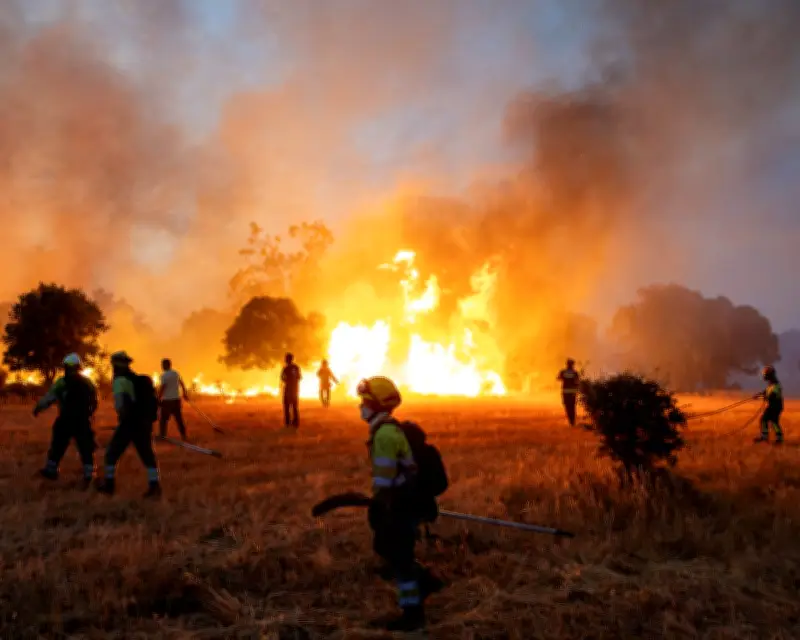
The European Union has experienced record-breaking fire weather severity for this time of year, according to new data. Since the start of the year, hot, dry, and windy conditions fueled by carbon pollution have been 43% more severe than the end-of-July average over the past two decades, data from the European Forest Fire Information Service (Effis) shows.
Fatalities and Progress in Firefighting
Three firefighters died in Greece on Tuesday, officials said. Meanwhile, firefighters in France and Spain made overnight progress tackling large blazes that burned dangerously close to major cities. The figures, published Thursday but subject to revision, indicate that 435,000 hectares (1,075,000 acres) have burned so far this year—roughly triple the recent historical average. This devastation resulted from 1,400 fires, more than double the average.
France and Spain Suffer Extensive Damage
In France, a blaze in the dense pine forests near Bordeaux grew so large it generated a rare thunderstorm that could ignite more fires. A total of 91,000 hectares have burned, breaking the country's record for a full year of fires with one month of summer remaining. Regional authorities in Gironde said the fire remained under control after a quiet night, with work continuing around its edge and active hotspots. They expected Thursday's temperatures to be “fairly favourable” after Wednesday's 38°C heat and strong winds hampered efforts. An additional 84,000 people were allowed to return home on Thursday, following 60,000 who received the green light on Tuesday.
In Spain, which saw its largest wildfire on record west of Madrid, 207,000 hectares have burned across the country, according to Effis. That figure is nearly five times the average for this time of year but shy of the devastation reached by late July during the 2022 fires. Regional authorities in Madrid said the fire situation had been declared “stable,” but residents of seven housing estates were unable to return home. Prime Minister Pedro Sánchez announced the end of the national emergency in the regions of Ávila and Madrid on Thursday morning. However, a new fire near the Portuguese border prompted the evacuation of 600 people, officials said. Spain's meteorological agency, Aemet, forecast temperatures above 35°C on Thursday in large areas of the interior, with some regions bracing for highs of 40-42°C.
Widespread Evacuations and EU Support
Wildfires in France and Spain have forced more than 300,000 people from their homes and tourist accommodation this month, prompting both countries to request EU support in the form of firefighters, fire engines, and water-dropping planes and helicopters. European Commission President Ursula von der Leyen thanked firefighters for their “courage and commitment” on Wednesday as crews sent by Romania and Greece extended their stays. “As the fires in France and Spain continue to ravage, European solidarity knows no limit,” she said.
Outlook for Italy and Greece
Officials at the EU's crisis management centre said on Wednesday morning that difficult weeks ahead are expected as fires worsen in Italy and Greece. Later that day, the Greek fire department announced the deaths of two firefighters tackling a blaze on the island of Crete, and another in the south of the mainland. Greece has had a relatively calm fire season so far, Effis data up to July 29 shows, with slightly fewer fires than usual and a burned area well below average. Italy and Portugal have seen near-record numbers of fires and burned areas well above average, but they have so far been spared the scale of destruction experienced by France and Spain. One firefighter died in Italy last week while tackling blazes in Sicily.
Climate Change and Fire Trends
Climate breakdown is causing Europe to burn this summer, with a series of almost back-to-back heatwaves drying out vegetation and providing a vast fuel surplus that has allowed small fires to grow into raging infernos. Prime Minister Sánchez repeated calls for a “national pact” to address the climate emergency during a visit to a command post on Wednesday. “These fires may or may not be caused by humans, but in any case, they increase exponentially as a result of these high temperatures, low humidity, and also the atmospheric phenomena that these fires, these large fires, cause in our forests,” he said.
A study by an international team of scientists, published in the journal Scientific Reports, found that since the 1980s, southern Europe experienced a steady decline in the number of fires and area burned as authorities improved prevention and suppression. The trend began to reverse in 2018, the study published Thursday found. Summer days conducive to strong wildfires have more than doubled since 1981 across large parts of Portugal, Spain, France, Italy, and Greece; in parts of France and Spain, the summertime fire weather index over the past decade was up to 50% higher than the 1981-2010 average. The scientists said this has resulted in European fires shifting to “fewer, but more intense and larger events,” with fires that escape initial attacks able to “quickly become catastrophic.”
José Miguel Viñas, a meteorologist at the forecaster Meteored who was not involved in the research, said the study scientifically demonstrates a fact observed in southern Europe and other parts of the world in recent years. “Increasingly extreme conditions of heat, dryness, and wind are fuelling large forest fires. Once started, they spread rapidly and become uncontrollable, overwhelming the firefighting efforts,” he said.
Rapid analyses have found western Europe's June heatwave would have been “virtually impossible” in a world without climate breakdown, while the level of soil dryness—a major factor in bigger blazes—was made five times more likely. The heatwaves are estimated to have killed at least 10,000 people and cost grain farmers €2bn (£1.7bn) in lost crops. The increase in temperatures from fossil fuel pollution has come as rural regions in southern Europe have hollowed out, with farms abandoned as populations age and young people move to cities. The resultant overgrowth of vegetation has troubled firefighters and wildfire researchers across the Mediterranean.




