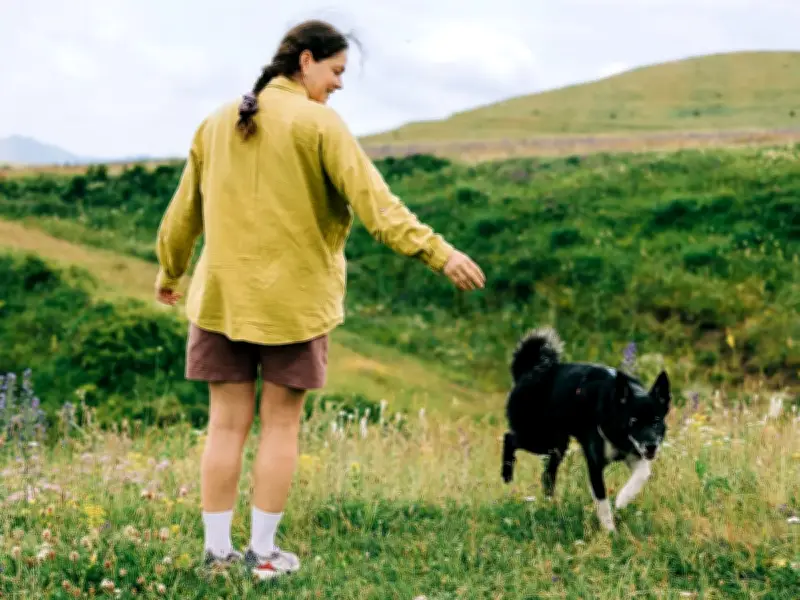
Signs have been placed at the entrances to Farthing Downs, an open space in the south of London bordering Surrey, warning dog walkers about a parasite that can have devastating consequences for cattle. The parasite, Neospora Caninum, is carried in dog faeces and causes neosporosis in dogs, leading to abortion in breeding cows.
The rolling hills of Farthing Downs include wildlife-rich chalk grassland where cattle roam freely. The signs state that an unborn calf was lost this year and two last year as a result of cattle coming into contact with the disease.
Warning sign details
The sign reads: "Are you aware? An unborn calf was lost this year and two last year as a result of cattle coming into contact with a disease carried in dog faeces."
It continues: "Neospara Caninum is a parasite carried in dog faeces, which has devastating consequences for our breeding cows, causing them to abort their unborn calves. Our cattle are blood tested every year and any cow found to have the disease must be taken out and prematurely culled."
The sign adds: "The disease cannot be passed between cows but can be passed down genetically from a mother to her calf. For this reason, and the high risk of abortion, we do not breed from infected animals."
Advice for dog walkers
The sign offers practical advice for visitors with dogs: "Please do not think that just because your dog's mess is off the path it is OK to leave as the cows graze freely across the Downs. Please pick up after your dog to keep our cows safe and for the benefit of all other site users."
Neospora Caninum can also cause issues in sheep, goats, horses, and deer species such as red deer and roe deer. Small groups of roe deer are sometimes seen on the downs.
Farthing Downs is managed by the Coulsdon Commons charity, whose sole trustee and principal funder is the City of London Corporation. A spokesperson for the charity said: "Parasites in dog mess can cause the loss of unborn calves in our grazing herd. By picking up after your dog, you can protect our animals and support the charity that cares for Farthing Downs."
Legal changes
The downs are a Site of Special Scientific Interest because of their prehistoric burial mounds dating back some 5,000 years. Together with neighbouring Happy Valley, Farthing Downs has the largest population of the greater yellow-rattle flower in London, and orchids, bedstraws and scabious can be seen in the spring and summer.
Legal protections over livestock worrying were recently strengthened, with the maximum fine increased from £1,000 to an unlimited fine. The law now applies to public roads, paths, and rights of way, not just enclosed fields, and has expanded to include camelids such as llamas and alpacas. It already applied to cattle, sheep, goats, pigs, horses and deer.