
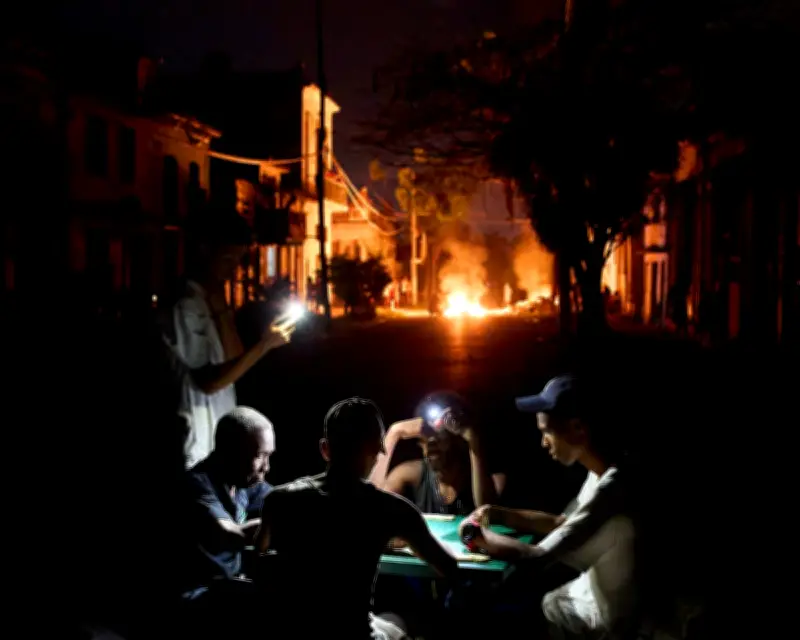
Cuba is edging toward societal breakdown as a six-month US oil blockade and frequent nationwide blackouts push the island nation to the brink. On Tuesday, the national grid collapsed for the third time in ten days, triggering widespread frustration and unrest among the 9.5 million inhabitants.
Infrastructure in Crisis
The backbone of Cuba's electricity system consists of aging power plants that are increasingly unreliable. "The backbone of the system is still the big power plants," said Jorge Piñon, a senior energy researcher at the University of Texas. "And they're old, broken and tired." Summer temperatures in the mid-30s Celsius and 80% humidity exacerbate the misery, with blackouts becoming a regular part of life.
Local blackouts have merged with nationwide collapses, leading to spontaneous protests. In Havana's Vedado neighborhood, residents bang pots and pans in nightly cacerolazos, expressing shared agony over sleepless nights, spoiled food, and fading hopes. "An hour isn't enough time to run the pump to get water or to charge phones," said Alberto, a middle-aged man, amid the din. "People want the government to act right now."
Government Blames US Blockade
The Cuban government says it has few options. Energy Minister Vicente de la O Levy stated, "We've said it before, there is a total absence of fuel. And we do not have access to spare parts for our thermoelectric units." The US oil blockade, imposed since January, has cut off fuel supplies and pressured foreign companies to leave the island. Hotel operators, airlines, miners, and shipping companies have been driven out. For instance, Canadian nickel miner Sherritt plans to sell its interests to Ray Washburne, a former adviser to Trump.
An electric car importer noted, "We have seven containers in Kingston and another 40 in China, but we have no idea when, or if, they will arrive." In May, a Florida court charged 95-year-old Raúl Castro with murder over the 1996 shootdown of planes from Miami, opening the possibility of extradition.
Rising Crime and Political Repression
Even before the US cranked up pressure, Cuba faced hyperinflation during the pandemic. Now, services are faltering. Once one of Latin America's safest countries, Cuba now sees rising crime: street fights, break-ins, and muggings. Police are scarce, and victims complain of hours-long response times. However, political repression persists. Prisoners Defenders, a Madrid-based group, reports 1,306 political prisoners, including Héctor Ochoa Vergara, detained after a peaceful demonstration against blackouts and water shortages in Ciego de Ávila.
Artist Luis Manuel Otero Alcántara, Cuba's most famous political prisoner, was en route to exile in the US after serving a five-year term for disorderly conduct, but was held in an unknown location for a week awaiting a visa.
Internal Strains and US Negotiations
The government's unity appears strained. The US has leaked discussions on a possible deal over political and economic reforms, channeled through Raúl Guillermo Rodríguez Castro, grandson of Raúl Castro. Last week, the 42-year-old gave an interview to USA Today, wearing Hermès sneakers, a Rolex, and carrying documents in a Salvatore Ferragamo bag. "It pains me that many people can't live the way I do," he said, adding that while he has no interest in politics, "if at some point the revolution needs me to step up, I will do it."
His display sparked outrage among musicians, academics, and former diplomats. Julio César Guanche, a respected academic, noted Rodríguez Castro is "without recognised institutional public functions." Even younger government-linked Cubans criticized him. Michel Torres Corona, whose Con Filo TV show was considered state propaganda, wrote, "To usurp the functions of government, to assume a public role for which no one elected you, to proclaim yourself spokesperson for measures or new directions for the country … would anyone else be allowed to do that?"
US Pressure and War Drums
Michael Bustamante, chair of Cuban and Cuban American studies at the University of Miami, suggested the interview may signal a collapse in US-Cuba negotiations, calling it "a cry for relevance." He said, "I think there's an open question as to who exactly he speaks for, and whether the channel of communication with him is ongoing or not."
War drums are beating again in the US. At the Biltmore hotel in Coral Gables, former Florida governor Jeb Bush stood next to an Iranian Shahed drone and linked Cuba to Iran over unconfirmed reports that Cuba bought 300 attack drones. "I think it's important to recognise that Iran has consistently been working with Cuba," he said. President Trump followed up, stating, "We're not going to allow that to happen."
Cuba's government announced 176 yet-to-be-enacted measures to expand the private sector and invite investment, but the US State Department dismissed them as "superficial smoke signals."
Daily Life in Blackout
The grid was reconnected at 7am on Wednesday, with people cheering if their block received electricity. But everyone knew it was temporary. Since then, blackouts have worsened. Laura Garcia, an illustrator and single mother from Havana's 10 de Octubre neighborhood, said her neighbors live only in the present. "What I hear is a level of desperation that doesn't allow the distance to discuss the future," she said. After 72 hours without power, she muttered, "What has to fall doesn't fall."




