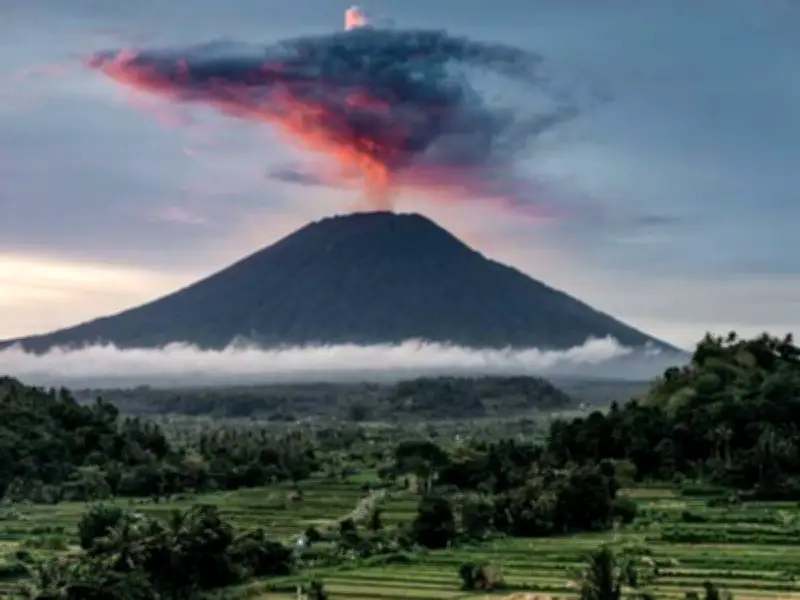
Researchers from the University of Cambridge have warned that the world is "completely underestimating" the risk of a supervolcano eruption, calculating a one in six chance of a magnitude seven volcanic eruption occurring this century. Such an event could severely disrupt global supply chains, climate and food production.
Eruption risk compared to asteroid impact
The team noted that a large eruption would have consequences comparable to a 1km-wide asteroid striking Earth, though volcanic eruptions are far more probable. Despite this, governments invest hundreds of millions in preparing for asteroid impacts while allocating minimal resources for volcanic eruption preparedness.
In the study published in the Nature journal, the researchers highlighted that measures including enhanced monitoring, improved public awareness and magma manipulation could prevent complete planetary devastation.

Frequency and past impacts
The eruption on the Pacific island of Tonga in January was the most powerful ever documented by contemporary instruments. Nevertheless, an eruption 10 to 100 times more powerful occurs once every 625 years, double the frequency previously estimated.
The most recent magnitude seven eruption occurred in Indonesia in 1815, claiming 100,000 lives and causing global temperatures to fall by one degree. This triggered agricultural failures, leading to starvation, disease outbreaks and violent unrest, costing the world trillions.
Unknown hazardous volcanoes
The researchers emphasised the importance of identifying where these massive eruptions might occur. Over the past 60,000 years, only a small number of the 97 eruptions classified as large magnitude on the "volcano explosivity index" have been pinpointed, indicating there could be dozens of exceptionally hazardous volcanoes across the globe that humanity remains unaware of.
Research author Dr Lara Mani, from the university's Centre for the Study of Existential Risk, said: "Data gathered from ice cores on the frequency of eruptions over deep time suggests there is a one-in-six chance of a magnitude seven explosion in the next 100 years. That's a roll of the dice.
"Such gigantic eruptions have caused abrupt climate change and collapse of civilisations in the distant past.
"Hundreds of millions of dollars are pumped into asteroid threats every year, yet there is a severe lack of global financing and coordination for volcano preparedness.
"This urgently needs to change. We are completely underestimating the risk to our societies that volcanoes pose.
"The Tonga eruption was the volcanic equivalent of an asteroid just missing the Earth, and needs to be treated as a wake-up call.
"The current underinvestment in responding to this risk is simply reckless."
Dr Mike Cassidy, the author of the study, stated: "The last magnitude seven eruption was in 1815 in Indonesia.
"We now live in a world with eight times the population and over 40 times the level of trade.
"Our complex global networks could make us even more vulnerable to the shocks of a major eruption.
"We may not know about even relatively recent eruptions due to a lack of research into marine and lake cores, particularly in neglected regions such as Southeast Asia.
"Volcanoes can lie dormant for a long time, but still be capable of sudden and extraordinary destruction."