
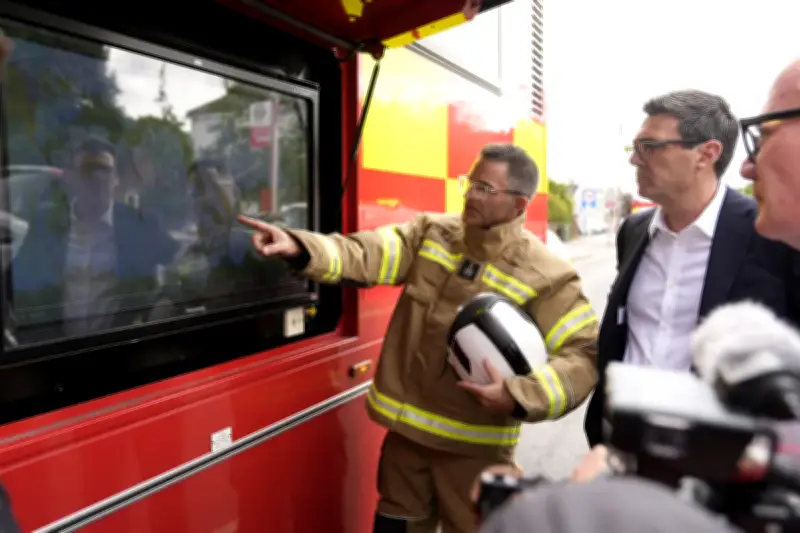
The Prime Minister, Andy Burnham, has set out an emergency package of measures in response to the devastating wildfires and summer heatwave affecting Britain. The measures include calling in the military, banning disposable barbecues, and warning smokers about the risk of setting light to a “tinderbox” country.
Military deployment and firefighting planes
Mr Burnham announced that 100 military personnel had been deployed to a blaze in South Wales to offer “critically needed” support. He also revealed plans to commission firefighting planes, similar to those used in Europe and the US, to combat the spread of wildfires. The Prime Minister said the country must “face up” to the “changing climate” and transition to “more clean energy”.
Speaking during a visit to Stourbridge to see the impact of a devastating blaze, Mr Burnham told broadcasters: “I’ve never seen scenes like this in Britain, where you just see a whole house gutted, smouldering.” He said “Britain is a tinderbox right now” with “37 fires smouldering around the country”.
Support for fire services and climate adaptation
Plans were being drawn up for emergency financial support for fire services battling the wildfires. Mr Burnham acknowledged that aerial firefighting capabilities would help and would be commissioned nationally for use around the country. He promised a summit with fire services, admitting they had not been given the funding needed to cope with the impact of climate change, including the possibility of floods later in the year.
“I can’t say today that we’ve done enough to fully resource them to deal with these type of incidents, and I want our firefighters to know that I understand how it seems from their point of view, and I’m going to convene that summit to make sure we get in place the right support, including the aerial support, permanently if that is what they deem is needed,” he said. “Obviously, there’s other adjustments that we need to make in relation to climate change.” He added that experts had warned the UK could face a wet autumn and winter because of the El Nino effect, “so, after fire could come floods”.
Health alerts and drought conditions
A heat health alert was extended until Saturday for much of England amid warnings that high temperatures may increase health risks for vulnerable groups. Temperatures provisionally reached 38.1C at Kew Gardens in London on Thursday, the second time this year the country has seen temperatures hit 38C. The UK Health Security Agency (UKHSA) extended the current amber heat health alert for the East Midlands, West Midlands, South East, South West, London and East of England until 10am on Saturday, with all other regions in England remaining under an amber alert until 9pm on Friday.
With record dry conditions in July and a dry start to August, nearly three-quarters of England and the whole of Wales are in drought, heaping pressure on water resources for households, agriculture and the environment. MPs have urged the Prime Minister to deal with the “desperately worrying” strain on the UK’s water resources by speeding up the rate at which new reservoirs are built.
Risks to vulnerable groups
Analysis by the UKHSA found that around one in six of all heat-associated deaths in England during summer last year were thought to be linked to dementia. Angelo Makri, senior knowledge officer for wellbeing at the Alzheimer’s Society, said: “High temperatures can pose serious risks for people living with dementia if they are not supported to stay cool and hydrated. People with dementia may not always recognise when they need a drink or wear suitable clothing, which can increase the risk of dehydration and heat-related illness. With temperatures set to reach extreme highs this week, we’re urging families, friends and carers to make sure loved ones are drinking enough, wearing light clothing and keeping their homes as cool as possible.”
Dan Scorer, director of public affairs at Mencap, said: “This week’s extreme heat is not just uncomfortable, it can be life-threatening. And for people with a learning disability, the risks are often greater. Too often these risks are overlooked, but much of the harm caused by hot weather is preventable with the right support and action.”




