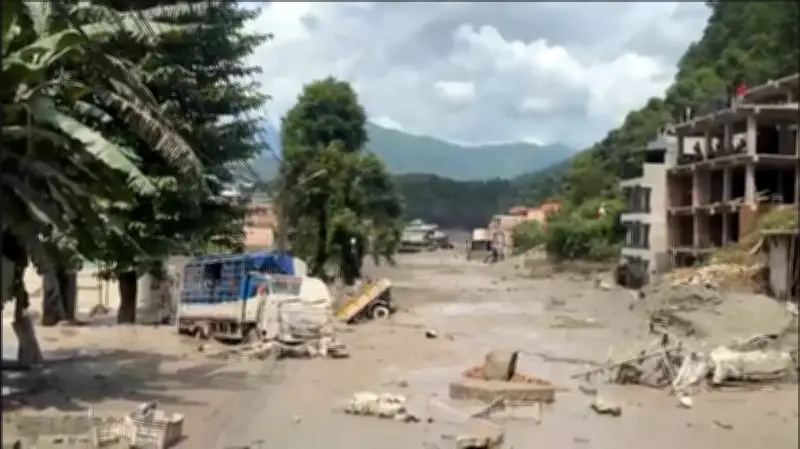
At least eight people have been killed and hundreds are missing after an avalanche triggered devastating flash floods in Nepal, with 384 tourists among those unaccounted for, including nationals from the UK, US, India and Malaysia.
Tourists among the missing
Authorities confirmed 384 tourists are missing. According to local media reports, these include 105 Indian nationals, 12 from the United Kingdom, four from South Africa, 17 from Malaysia and three from the USA. One each from Australia and the Netherlands has also been reported unaccounted for.
The Bhotekoshi River burst its banks at around 9am on Wednesday, obliterating several villages along with roads and hydropower projects, according to officials. Warnings were subsequently issued to residents across several Nepalese districts, urging them to keep well away from the banks of the Bhotekoshi, Trishuli and Narayani rivers.

Rescue efforts and regional impact
"We have asked both India and China to help us with the rescue efforts," said Sasmit Pokharel, a spokesperson for the Nepali government.
The hardest-hit area, Rasuwa district, experienced similar flash floods to those that struck in August last year, when a glacial lake in neighbouring Tibet overflowed due to soaring temperatures in the mountain region. Nine people lost their lives on that occasion, and vital infrastructure, including a bridge linking the two countries, was severely damaged.
Climate experts point to glacial avalanche
Climate experts at the Kathmandu-based International Centre for Integrated Mountain Development believe a glacial avalanche most likely triggered Wednesday's flash floods.
The Lhende Khola River, a tributary of the Bhotekoshi River, recorded the most severe flooding on Wednesday, they added. "The Lhende Khola has flooded twice in fourteen months, this time triggered by an ice rock avalanche from a glacier on the Nepal side that blocked the river and released a sudden surge downstream," said Saswata Sanyal, a disaster risk reduction specialist at the climate research group.
"In a warming Himalaya, early warning is the first line of adaptation," he added.
Warming Himalaya heightens vulnerability
The Himalayan region, spanning Nepal and several neighbouring countries including India, faces heightened vulnerability to severe rainfall, flooding and landslides, as the area is experiencing warming at a faster pace than the global average due to man-made climate change.
Studies have demonstrated that extreme weather phenomena, such as heatwaves, torrential downpours and glacial melting, have become increasingly common across the region.
Researchers at the Kathmandu research group discovered earlier this year that glaciers throughout the Hindu Kush Himalaya region are melting at an accelerating pace, with ice loss rates having doubled since 2000, driven primarily by rising global temperatures and climate change.