The first gas has been drawn from the Beetaloo basin in the Northern Territory, a moment described by the NT chief minister as a landmark day, but one that has drawn sharp criticism from climate commentators given the potential scale of emissions.
Celebratory photos and climate warnings
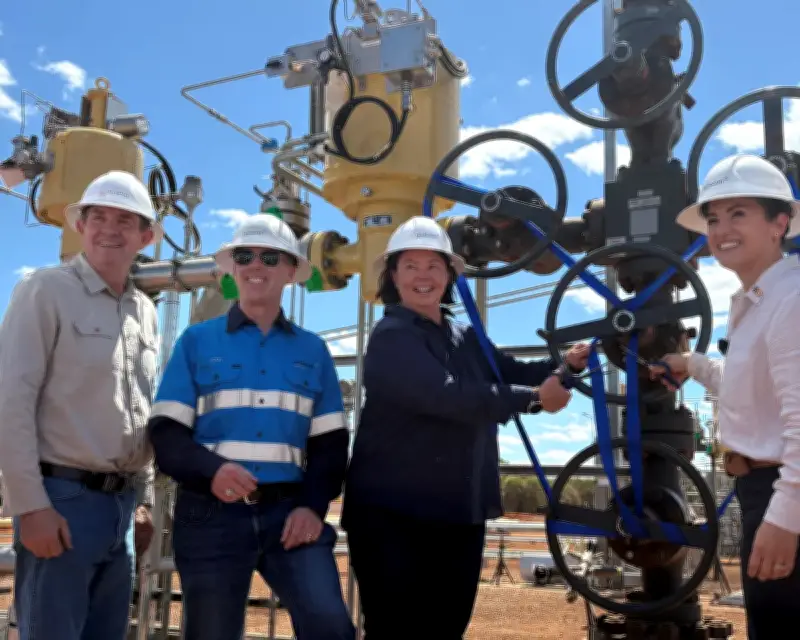
The federal resources minister, Madeleine King, joined the NT chief minister, Lia Finocchiaro, and the chief executive of Tamboran Resources, Todd Abbott, to turn on the gas supply to Darwin. The image of King marking the opening alongside the Country Liberal party's Finocchiaro received only passing attention in national discussion this week, but my guess is it will linger.
At some point, scientists will be able to estimate the amount of heating and destruction caused by the gas that is ultimately drawn from the Beetaloo. The celebratory photo may come to be seen as real-time evidence of how some political leaders felt about that prospect. Very obviously, they won't be able to say they weren't warned.

The scale of the Beetaloo basin
The Beetaloo is huge, spread across about 28,000 square kilometres of Indigenous and pastoral land between Katherine and Tennant Creek, roughly 500km south-east of Darwin. It is home to shale gas, which means the fossil fuel is trapped inside sedimentary rock and can be extracted through fracking – a highly contentious process.
Estimates of the scale of the basin vary. Abbott stood alongside King and Finocchiaro this week as he told reporters that the sub-basin contained about 200 trillion cubic feet of gas, making it the world's largest non-oil gas field outside the Middle East or Russia. He said that was enough gas to power every home in Sydney 20 times over for more than a century.
None of the trio acknowledged what else extracting and burning that gas would mean: the release of a globally and historically huge amount of heat-trapping pollution that would have a real impact on lives, livelihoods and ecosystems.
Political decisions and industry influence
Few people believe the Beetaloo will be developed to its full extent and the pilot project launched this week, while locally significant, is relatively small. But the goal is mass extraction, and some experts didn't think it would get this far. Several projects are in the works. Its potential expansion should be taken seriously.
There is a strong case it has only come this far due to politicians prioritising gas industry demands by offering taxpayer support, weakening climate policies and pushing aside concerns about the impact on culture and water resources raised by some traditional owners. This has been demonstrated through reporting by the Guardian's Lisa Cox, among others.
In 2018, when the NT was considering lifting a moratorium on fracking, a government inquiry recommended that any shale gas development should not be allowed to increase Australia's net emissions. That meant the full emissions released in the country from extracting, processing, transporting and burning the gas must be offset through the purchase of carbon credits.
Carbon credits are controversial for a range of reasons, but they have at least one unarguable effect – laws forcing industry to buy them increases the cost of fossil fuel developments as polluters pay a cost for their pollution. That might not hurt a company of the scale of Woodside, but it makes marginal projects harder to get off the ground.
The then NT Labor administration claimed it backed this recommendation, but documents show it abandoned it after the gas industry objected. It also signed a contract to buy gas from the Tamboran pilot development to use in Darwin. Would it have launched this week without taxpayer underwriting? It seems unlikely.
NT government's stance and climate resilience
The Country Liberal party supported Labor's stance and doubled down after it was elected by stripping away support for cleaner alternatives. It scrapped a renewable energy target of 50% by 2030 that it backed in opposition and abandoned a promised emissions reduction target.

It maintained its position as the NT suffered through an unprecedented five overlapping natural disasters last wet season, including flooding that displaced some Aboriginal communities on the Daly River for months. Rather than reconsider its fossil fuel stance, the CLP released a climate resilience plan that, in its first listed action, committed to accelerate production of Beetaloo gas.
Projects that result from this will not be required to limit emissions under NT law. Some will fall under the safeguard mechanism, a federal climate policy, but analysis suggests it will have little affect on emissions from Beetaloo gas in the next few years.
Economic and energy cost concerns
Finocchiaro declared the start of pilot production a landmark day that would change the future of the local economy, largely because it would address energy affordability worries. She then tempered this a little by saying prices would “stabilise over the long term”.
Who knows what that means? The reality is that gas is routinely the most expensive form of energy used in Australia and far more costly in most cases than firmed renewable energy. Production at new basins such as the Beetaloo will be more expensive again.
That cost will multiply if an industry dream of a federally backed, multibillion-dollar gas pipeline from Beetaloo to the east coast goes ahead. With demand for gas in the eastern states falling that seems unlikely, and suggests whatever gas is produced in the Beetaloo will be for local use or exported.
On cost grounds alone, it would be logical to be working hard to reduce gas demand. Instead, the NT chief minister is arguing she can provide cheap fuel for datacentres, while attacking suggestions otherwise.
Federal government's position and climate impact
A question for the Albanese government is: what exactly is its minister celebrating here? Asked on Tuesday about criticisms she was backing a “carbon bomb”, King offered a word salad in which she said Labor was “dealing with climate change” while also supporting gas.
She didn't mention a UN Environment Programme report this week said the Paris agreement goal of limiting global heating to 1.5C above pre-industrial levels – which Labor says it still strongly supports – will inevitably be passed, and a temperature rise that peaks at 1.8C is now the most optimistic future available.
Every extra fraction of a degree intensifies the risks from extreme weather, glacier melt and coastal and island submersion. Human health, water supplies, nature, cities, infrastructure and economies could all be severely damaged.
Limiting that requires immediate and sustained emissions cuts alongside strategies to draw CO2 from the atmosphere. Australia can't do that on its own. But chuckling while opening a new gas basin – and while climate-friendly options are being ignored – is what you might call a hell of a choice.