
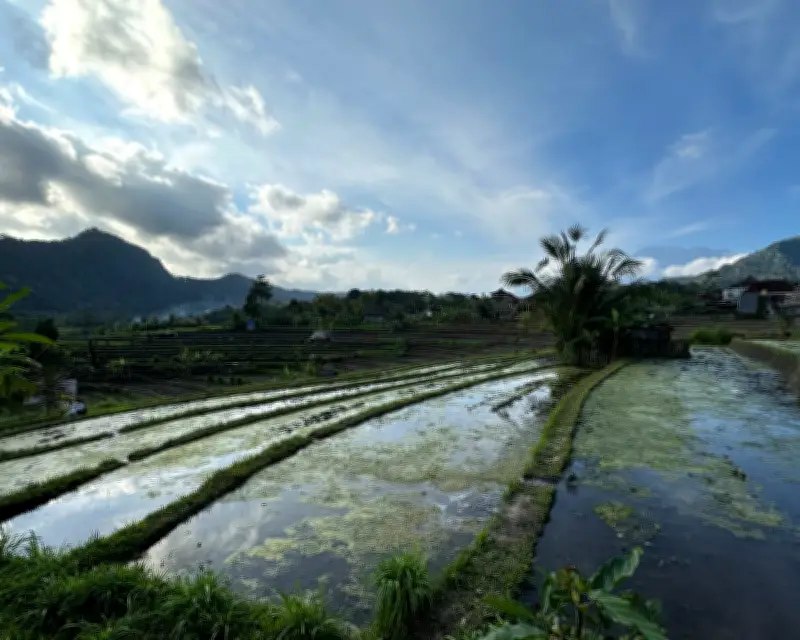
I Putu Partayasa, a 52-year-old farmer known as Parta, squats at the edge of a rice terrace in Bali, pushing his fingers into dry soil. His field still receives water, but his neighbour's does not. 'Fifteen years ago, we have water every day. But today it's getting less,' he says. Parta blames tourism: 'Companies take our water and bring it to the tourism places.'
Parta belongs to a subak, a water-sharing cooperative that has governed Balinese irrigation since the ninth century. Recognised by Unesco as a world heritage site in 2012, the system treats water as a gift to be shared, with members meeting in temple courtyards to decide distribution. But this ancient chain is breaking. According to the Bali national land agency, the island has lost more than 6,500 hectares of rice fields in the past five years – a decline of over 9%. A 2018 Transnational Institute report found that Bali had already lost nearly a quarter of its agricultural land as tourism grew by 330% in 25 years.
Tourism now consumes over 65% of Bali's fresh water. In 2024, the island recorded more than 16 million visitors, four times its permanent population. The IDEP Foundation, a local NGO, declared a water crisis in 2018 and has since found seawater intrusion in at least six of Bali's nine districts. In southern Bali, where development is concentrated, groundwater extraction has pushed aquifers beyond sustainable levels, with coastal wells turning brackish as seawater moves inland.
Kadek Siska, 35, lives in Uluwatu, one of Bali's most popular tourist areas. Many mornings begin with the question: is there water today? Her home is connected to the public water network, but on a good day, water flows for only an hour. 'My mom leaves the taps on so we can hear it, and then we stand by and fill everything we have,' she says. When the station runs dry, they rely on water trucks, with a 5,000-litre delivery costing about 350,000 rupiah. Drinking water is bought separately, eroding a tenth of the household's income.
The IDEP Foundation estimates that a tourist in a resort uses 2,000 to 4,000 litres per day for pools, gardens, and laundry, while the average Balinese uses just 120 litres. As rice fields are sealed under concrete for hotels and villas, the land loses its ability to slow runoff and recharge aquifers. Parta's neighbours have sold their land, and his children have no interest in farming. 'The forest is getting smaller. The springs are drying,' he says. 'We used to drink from the river. Now we buy plastic bottles.'




