
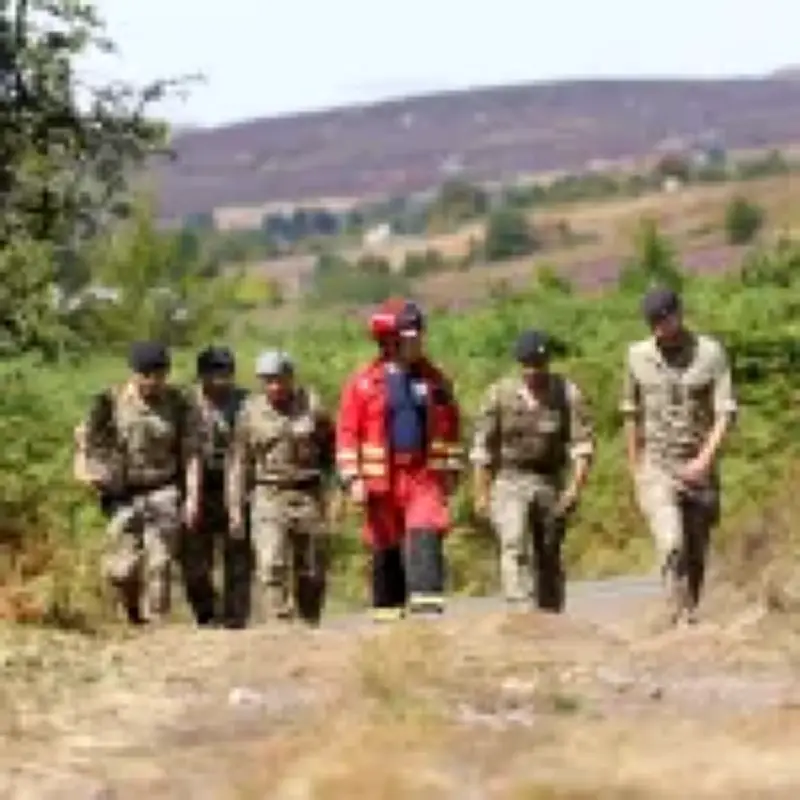
The British Army has been deployed to help tackle wildfires sweeping England and Wales, following a formal request for 200 military personnel to assist civilian fire crews. The move comes after days of 'apocalyptic' scenes that destroyed livelihoods in the West Midlands and South Wales.
In Stourbridge, 19 homes were gutted and 18 others damaged. In Stoke-on-Trent, residents in the Goldenhill area lost 'everything' as their houses turned to ash within seconds. Two people were later arrested after allegedly starting a grass fire.
In South Wales, 30 separate wildfires have continued raging, with fire crews warning there is an 'extremely high risk' of fire spreading across the region.
Prince of Wales sends message of thanks
In a message this weekend, the Prince of Wales wrote: 'To the firefighters, emergency responders and volunteers battling wildfires across the UK, thank you. Our thoughts are with everyone affected, particularly those who have lost their homes, and with those working tirelessly to protect communities, homes and the countryside.'
South Wales Fire and Rescue Service escalated the response after days of trying to contain the fires, submitting a formal request for military support. Having declared a major incident, Welsh authorities warned that the fires are 'affecting a number of communities in various locations and are generating smoke that may be visible for miles'. The request was granted.
Government officials respond
Elin Jones, MS, Cabinet Minister for Finance, said: 'We are extremely grateful to the Army for providing this additional support. The Welsh Government stands ready to provide funding for these military support operations should this be required.'
Stephen Kinnock, Secretary of State for Wales, added that military personnel were there for logistical support and to 'ease the pressure on the ground'. Ministry of Defence sources also told The Telegraph that the department was exploring how resources could be diverted further, including deploying water pumps and fire engines used by the Defence Fire and Rescue Service.
The developments come after a Cobra meeting on Wednesday, where Andy Burnham met with officials to address plans for navigating soaring weather conditions. Rhun ap Iorwerth, the Welsh First Minister, said afterwards that attendees had considered 'specialist capabilities such as helicopters and support from the Ministry of Defence and RAF where appropriate'.
Military support and firefighting capabilities
Military support was previously given to emergency services during the Covid-19 pandemic to help administer vaccines. While uncommon for troops to be deployed onto the streets in the UK, Military Aid to the Civil Authorities (MACA) requests can be granted by the Cabinet Office in emergencies.
Wildfire-fighting helicopters can drop up to six tonnes of water onto flames, but UK fire brigades do not currently have direct access to any. Britain's military firefighting aircraft are all deployed in Cyprus.
The Fire Brigades Union (FBU), which represents around 34,000 in the rescue service, said access to aerial firefighting capabilities is needed where 'appropriate' due to the increasing risks.
Public urged to prevent fires
Andy Burnham has urged the public 'not to light anything that could spark a fire, including barbecues, campfires, and fireworks'. This came shortly after a ban on the sale of disposable barbecues was implemented due to their 'significant' risks.
An emergency alert startled millions on Friday night, which the Prime Minister later explained was a 'direct request from fire and rescue services'. He has urged everyone to take the message 'seriously', having likened Britain to a 'tinderbox' when temperatures exceeded 38°C on August 13.
Now, the Labour leader has said the focus is on 'to keep everyone safe and prevent more fires from starting'.




