
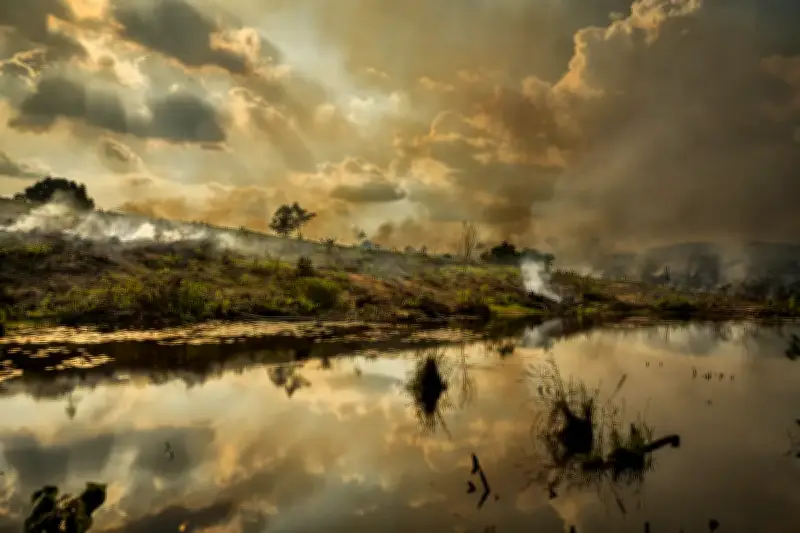
As a supercharged climate scorches Europe with wildfire and deluges Asia with floods, the Amazon is bracing for a drought that strikes fear into the hearts of forest defenders and food producers alike. But it should worry even more of us.
Scientists are predicting that the peak of El Niño will occur at the worst possible time for the world's biggest tropical rainforest: the end of the dry season between October and December, when rivers are at their lowest and undergrowth is most likely to be tinder dry. This will be a period of extreme vulnerability for the forest, which plays a globally important role in stabilising the climate and irrigating crops.
Global Climate Chaos
The planet's life-support system is already reeling from a double whammy. Human-driven climate disruption, caused by burning fossil fuels and trees, is relentlessly heating the world and amplifying extreme weather events, such as heatwaves and storms. On top of this long-term trend is the latest El Niño, a naturally occurring phenomenon of high Pacific Ocean temperatures that leads to warming – and drought and fire – for much of the rest of the world.
Scientists say this El Niño is on course to be the strongest in 150 years by a "mind-blowing margin." Even in its incipient phase, it is wreaking havoc across the planet.
Western Europe has endured the hottest June and July in history, with exceptionally low rainfall, sparking extreme wildfires in France, Greece and other Mediterranean countries and water shortages in the Seine, Rhine and Danube basins. Three-quarters of England is in drought and baked by what is forecast to be the hottest UK summer on record.
In Asia, South Korea and Japan are sweltering in a record heatwave, while China has been battered by Typhoon Dolphin, which has turned Shanghai's streets into rivers, torn roofs from houses and forced the evacuation of more than 1 million people. Floods have killed more than 100 people in India's Assam state, with more rain forecast.
Swathes of the world are burning. In Canada, "out of control" wildfires have forced tens of thousands to flee British Columbia and darkened the skies of distant New York. Huge fires are also raging on Java Island in Indonesia and Utah in the US, which has also been scorched by a record July heatwave.
In Africa, the UN is predicting a severe hit to food production. In the Middle East, local temperature records are being broken almost every day, with the United Arab Emirates registering 51.2C in Al Dhafra.
Amazon on the Brink
Meanwhile, sea surface temperatures are trending far outside previous parameters, threatening coral reefs and other marine life. Because the oceans are the world's main heat absorber, their temperatures are a prelude to what follows on land.
But among the greatest concerns about what comes next is the Amazon, which is essential for maintaining biodiversity and ensuring rainfall for food-producing regions across South America.
A few decades ago, the idea of drought in the rainforest would have seemed outlandish. The Amazon is the world's biggest river and its principal tributaries – the Xingu, Negro, Tapajós, Madeira, Purus, Juruá and Japurá – are among the planet's main sources of freshwater. The forest around them has always been famed for humidity, with giant trees that sucked up moisture and pumped it into the atmosphere, generating "flying rivers" that cooled and watered an entire continent. The trillions of trees and plants in the Amazon also draw down huge quantities of carbon dioxide with benefits to the entire planet. Any weakening of this function adds to the risks of instability, food insecurity and extreme weather.
Now, the Brazilian meteorological agency has released a forecast that the unusually strong El Niño will delay the onset of the Amazonian rainy season, raise temperatures, deplete rivers and intensify fire risks.
As in many other parts of the planet, this creates an emergency within an emergency: the onset of a natural but extremely powerful "Godzilla" El Niño that could last well into the new year, on top of human-driven warming.
Scientists and Indigenous residents say the Amazon is struggling to recover from the devastation caused during the last El Niño in 2023-24, which left some of the world's greatest rivers at record-low levels, sparked unprecedented fire outbreaks and caused mass deaths of dolphins and fish.
With a third of the Amazon now degraded by farming, mining and human-caused climate disruption, the trees and undergrowth are more flammable and vulnerable to "megafires," raising concerns that many parts may tip beyond the point of no return.
Government Response and Expert Warnings
The government is trying to address this with satellite monitoring, enforcement operations and greater investment in firefighting capacity. This produced positive results last year, when the burned areas of the Amazon fell to their lowest level since records began in 1985.
But one year is not long enough for the forest to recover, and it now faces a far greater threat.
Three previous El Niños (1997-98, 2015-16 and 2023-24) proved disastrous for the Amazon. Prof Jos Barlow, an Amazon specialist at the Lancaster Environment Centre, said the prospect of a still stronger phenomenon was deeply worrying: "It is hard to imagine the outcome of even more severe droughts and heat."
The Amazon fire season has already started but the peak is still a couple of months away.
Indigenous communities are setting up their own firefighting units to cope with outbreaks in deeper parts of the forest. Dr Erika Berenguer, a forest expert at Oxford University and author of a book on how to deal with rainforest fires, said: "It's crazy. The humid forest should not be burning."
A major part of the problem, Berenguer said, was multiple El Niños hitting in a relatively short space of time: "It's similar to if you are already sick and then you get an infection. That infection is going to have much greater impacts on your body because your immune system is already compromised fighting the sickness."
The brutal conditions are likely to drag on – and possibly intensify – in 2027 because there is a lag of about three months between the peak of El Niño warming in the Pacific Ocean and temperature rises elsewhere in the world.
Carlos Nobre, a professor at the University of São Paulo and one of Brazil's leading climate scientists, said: "The Amazon has to be very prepared from now through the beginning of 2027, at least up to March, because this El Niño is very likely to induce a severe drought."
Impact on Agriculture and Indigenous Communities
Farmers are bracing for a turbulent year. "Fellow ranchers, GET READY FOR EL NIÑO," reads a post on a popular WhatsApp group for beef producers in the Amazonian state of Pará. "El Niño will impact Brazilian cattle farming by causing heat stress in animals, reducing pasture quality, and leading to 'water scarcity'. This drives up supplementation costs and can reduce weight gain and milk production."
Other agricultural businesses post apocalyptic images of parched soil or flooded cities (the south of Brazil is forecast to get much more rain). "The 2026 Super El Niño has evolved from a mere weather phenomenon into a symbol for a new era of global instability," warns one post.
The industry magazine Agroforte reports that Brazil's soya bean harvests have fallen during previous strong El Niño years, but omits any mention of the human causes for the more hostile climate: deforestation – usually by farmers – and the burning of fossil fuels.
Indigenous groups, in contrast, tend to preserve the forest and help to maintain a stable climate – but they, too, face the triple threats of global heating, forest clearance and El Niño.
The government has warned that traditional lands will face increased fire risks, and has stockpiled food in case of shortages. During the previous El Niño, some forest communities in the Xingu and Tapajós basins were left isolated, thirsty and worried about hunger when rivers – the main transportation route – ran dry and vegetable gardens shrivelled up. Anything worse next year and Brazil could face the apocalyptic scenario of drought refugees in a rainforest.
That this is even a possibility should alarm the world. A severely weakened Amazon will further disrupt the climate and agricultural production at a time when farmers across many parts of the world are already saying that changes are too quick for them to adapt. Global food prices are at a three-year high as falling harvests combine with the fuel inflation caused by the US-Israeli attack on Iran. The UN is predicting that 49 million more people are likely to face acute hunger because of El Niño.
Much more needs to be done to protect biomes such as the Amazon, on which the world depends. Investing more in firefighters is a necessary short-term step, but it only deals with the consequences rather than the local and global causes. Unless deforestation is halted and fossil fuels are phased out, the atmosphere will continue to warm and amplify extreme weather. Even this year's Godzilla El Niño will seem like a pussycat compared with what is coming.




