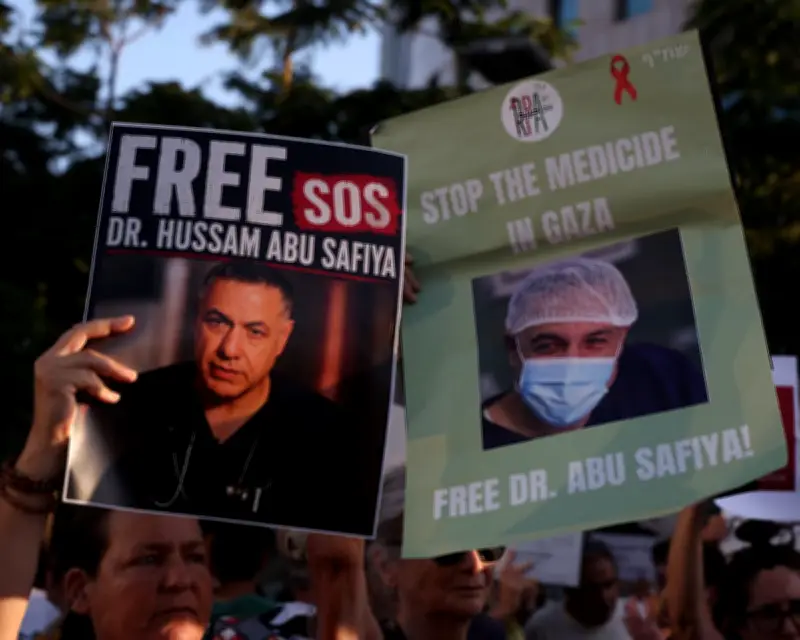
Dr Hussam Abu Safiya, director of Kamal Adwan hospital in northern Gaza, was seized by Israeli forces 18 months ago and held without charge or trial. He reports being struck with hammers and batons, daily beatings, and loss of consciousness. In June, he was transferred to Rakefet prison, an underground facility reopened by far-right minister Itamar Ben-Gvir, where prisoners never see daylight—a violation of the Geneva conventions.
Administrative Detention and Abuse
Across Palestinian territories and Israel, about 3,500 prisoners are held under administrative detention, renewable every six months indefinitely. Nearly 200 are children. Once detained, Palestinians face what Ali al-Samoudi, a journalist released earlier this year, called “real hell.” He lost 60kg—half his body weight—and told CNN: “Everything they practised with us was punishment and revenge.”
Earlier this month, a photo taken by an Israeli soldier showed a Palestinian man from Gaza face down, stripped to his underwear, bound with ropes to a plank and an iron rod, captioned “good morning” in Hebrew. The image echoes Abu Ghraib with sexualised humiliation and trophy-taking.
Systemic and Longstanding
These are not isolated incidents. The abuse has accelerated during the current conflict but is part of a longstanding system designed to terrorise, break morale, and collectively punish Palestinians. Israel practices a policy of keeping bodies of Palestinians, refusing to hand them over for burial. Some are buried in numbered graves in sealed military zones; others are held in freezers. Among these are 100 Palestinians who died in custody, with no information on how they died.
HaMoked, an Israel-based human rights organisation, is tracing almost 2,000 people who were detained but never recorded—amounting to “enforced disappearances.”
Psychological Dimension
The abuse signals that Palestinians’ lives and even corpses belong to the Israeli state. Many detained include journalists, doctors, and civil society members—part of the network underlying Palestinian society, which must be shattered to communicate that there is no such thing as Palestine or a Palestinian people.
Lack of Accountability
Despite documentation by rights groups, posting by Israeli soldiers, and bragging by politicians, there is little protest within Israel or real outrage from Western allies. In the UK, focus on settler violence and banning trade with illegal settlements avoids the heart of the Israeli state. The UK deputy permanent representative to the UN expressed concern about “documented sexual violence by Israeli forces against Palestinian detainees” and called for investigation, but little action is expected.
As Nesrine Malik writes: “What is taking place is not an aberration, not a deviation, but a norm that is enacted and blessed explicitly by successive generations of Israeli politicians and, it seems, by Israeli society. Until that fact is confronted, Palestinians will continue to be detained, disappeared, tortured and sexually abused, and the abusers asked politely, concernedly, occasionally, to please investigate themselves.”