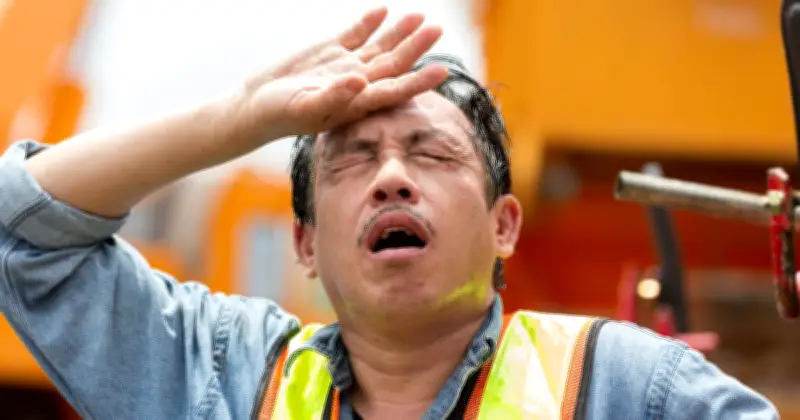
Tradespeople and outdoor workers across the UK have been issued a health warning and key dates to be aware of as hot summer weather puts them at risk of various heat-related illnesses. The Met Office recently announced that the UK has a higher-than-normal risk of heatwaves this summer. In its three-month seasonal outlook covering June, July, and August, the Met Office stated that above-average temperatures are twice as likely compared to historical averages.
Met Office Warning
Met Office meteorologist Alex Burkill said: "There are signs that we could see another heatwave by the end of the week and into the weekend. We could get temperatures, particularly across central-eastern parts, of 27C or 28C, so we could be looking at getting to heatwave threshold. Thursday is likely to be the first hot day before temperatures rise through the weekend." He added: "We are going to see our weather quietening down as high pressure builds across us, and warmer air is coming in, so temperatures are rising. This set-up is different from the heatwave in May, so there is uncertainty about the temperatures, but it looks like a heatwave at the end of the week and into the weekend isn't out of the question."
No Legal Maximum Temperature
The UK has no legal maximum working temperature, and outdoor workers have no enforceable right to stop work in extreme heat. To highlight the risk, new research from tradesman insurance provider Protectivity has revealed when and where tradespeople face the hottest working conditions when temperatures do rise. The research shows that June is the most risky month. Analysing weather data across UK cities, the research identifies the highest-risk locations and the specific calendar dates most likely to put outdoor workers in danger.
Despite more than 100 million working hours estimated to be lost to heat stress across the British labour force, there is currently no legal maximum working temperature in the UK. While other European countries enforce upper limits beyond which outdoor work must pause, UK employers are only required to maintain a 'reasonable' temperature, with no legal definition and no enforceable upper limit.
Research Methodology
To reveal both the locations and the dates carrying the greatest risk, Protectivity analysed historical weather data where temperatures hit 27C or above for at least two hours during the working day (6am–6pm). The same data was then broken down by calendar date to reveal which days of summer are statistically most likely to see dangerous temperatures for outdoor workers, using the 27C threshold that the TUC recommends for when strenuous outdoor work should stop.
When working outdoors in hot weather, the body's ability to regulate its temperature is greatly compromised, which can lead to mild heat exhaustion or even deadly heatstroke. Factors such as intense physical activity, insufficient water intake, and lack of acclimatisation to the heat make outdoor workers especially at risk for these problems.
Top 10 UK Cities With Most Heat Days
- St Albans – East of England – 47 days over 27C
- City of London – London – 45 days
- Oxford – South East England – 37 days
- Cambridge – East of England – 37 days
- Chelmsford – East of England – 34 days
- Birmingham – West Midlands – 33 days
- Gloucester – South West England – 32 days
- Worcester – West Midlands – 32 days
- Winchester – South East England – 31 days
- Peterborough – East of England – 29 days
St Albans in Hertfordshire tops the table, recording an average of 47 days where temperatures reach high levels during working hours, according to the research. Urban areas also face a compounded risk due to the 'heat island effect', where concrete, tarmac and traffic push temperatures up several degrees. London City comes in second place with 45 days of high temperatures recorded, followed by Oxford (37) and Cambridge (37).
Hottest Dates for Outdoor Workers
But it isn't just where tradespeople work that increases their risk this summer, it's also when, and the data shows that June heat is often more than the peak summer months of July and August.
- 12th August – 61 days over 27C in last 3 years
- 20th June – 43 days
- 13th June – 42 days
- 11th July – 41 days
- 30th June – 37 days
- 11th August – 36 days
- 21st June – 35 days
- 12th July – 34 days
- 13th August – 33 days
- 25th June – 31 days
Across the full study period, August 12 stands out as the single 'hottest' working day of the summer, registering a total of 61 days where the temperature reached 27C over the last three years. But with June 13, 20, 21, 25 and 30 all featuring in the top ten, the data carries a timely warning for tradespeople right now.
Expert Comment
Chris Trotman, Underwriting Manager at Protectivity, comments on the research: "What makes this research particularly striking is that the risk isn't concentrated in one place or one month and it's actually spread across cities many wouldn't necessarily flag as heat hotspots, and it also starts earlier in the summer than most people would assume. Five of the ten most dangerous dates in our dataset fall in June, and yet June is often when sites are running at full capacity with no particular heat protocols in place. Self-employed tradespeople in particular, who make up the largest self-employed workforce of any sector in the UK, have no employer to mandate rest breaks or enforce a heat policy on their behalf. The data makes clear this isn't a niche risk and for tradespeople working outdoors right now, this is a very present and very real danger."
Safety Tips for Tradespeople
In a sector where many outdoor workers are at risk of heat-related illnesses, preparing for safe working practices as temperatures rise is crucial. For concerned tradespeople, James Crame, Health and Safety Advisor at Start Safety shares his top five tips to survive the summer.
1. Conduct a Site Heat Risk Assessment
He said: "Every site should have a documented heat risk assessment that identifies which tasks, roles and workers are most exposed. This should be updated at the start of each summer season and whenever new workers join. Key factors to assess include direct sun exposure by task type, PPE heat burden per role, access to shade and water, worker age and health status, and acclimatisation status."
2. Implement an Acclimatisation Schedule
He said: "The majority of heat fatalities occur in the first few days of hot conditions. New workers, those returning from holiday or sick leave, and workers new to physically demanding roles must be given a structured acclimatisation period by gradually increasing their exposure and workload over five to seven days."
3. Reschedule Strenuous Tasks
He said: "Outdoor task scheduling should be adjusted during periods of forecast heat. Strenuous physical work should be moved to early morning (before 10am) or late afternoon (after 4pm) wherever possible. UV radiation and ambient temperature are highest between 11am and 3pm so these hours should be avoided."
4. Establish Work, Rest and Hydrate Regime
He said: "Telling workers to drink water is not a heat policy. A compliant heat management approach requires documented rest rotation schedules, with frequency increasing as temperature rises. Workers should be encouraged to hydrate every 15–20 minutes by drinking small amounts frequently, rather than large volumes infrequently. Shade structures or site welfare units should be positioned to allow genuine rest, away from radiated heat from plant, machinery and structure."
5. Review and Adapt PPE
He said: "PPE selection in summer requires a review that asks if lighter, breathable alternatives could be used without compromising the required protection level. Vented hard hats, moisture-wicking base layers, lightweight hi-vis, breathable gloves, and UV protective eyewear can all reduce heat burden without sacrificing compliance. Workers should be explicitly encouraged to remove PPE during rest breaks where it is safe to do so, to allow the body's cooling systems to function."