
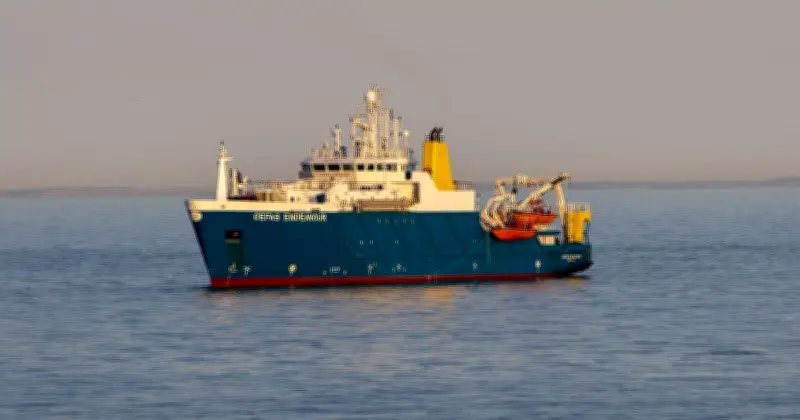
Britain is to build a new £115million research ship to monitor UK seas amid growing fears over Russian activity and the threat of a wider conflict. The 85-metre vessel will be built in a British shipyard and is expected to enter service in 2031 or 2032, replacing the ageing RV Cefas Endeavour.
New national monitoring system
The ship will lead a new national system for monitoring Britain's seas, carrying out marine surveys and collecting vital data on the waters around the UK. It will be capable of assessing fish stocks, mapping the seabed, monitoring pollution and responding rapidly to marine incidents. It will also use automation, robotics and artificial intelligence as part of a major upgrade to Britain's ability to monitor its marine environment.
The Government has committed at least £115million to the new vessel, with the money forming part of a wider push to revive British shipbuilding and strengthen domestic industrial capacity. The £115million figure was announced separately by Chancellor John Healey alongside the Government's shipbuilding plans.
Security context and purpose
The investment comes as European nations face heightened security concerns over Russian military activity and the possibility of a wider confrontation between Moscow and the West. However, the Government's announcement does not describe the vessel as a military ship or say it is being built specifically to counter Russia.
Instead, ministers say the vessel will provide information needed to protect Britain's food, energy and climate security while helping manage the marine environment. The UK's seas contributed more than £200billion to the economy in 2021, according to the Government.
Operation and capabilities
The new vessel will be operated by the Centre for Environment, Fisheries and Aquaculture Science, known as Cefas, which has laboratories in Lowestoft and Weymouth. It will replace the RV Cefas Endeavour, which has supported UK marine science since 2003 and is due to retire in the early 2030s. The new ship will be able to accommodate more than 40 people and will provide scientists with a floating base for a wide range of work around Britain's waters.
Defra chief scientific adviser Professor Anjali Goswami said: “By investing in a next-generation Research Vessel, we can continue to harness marine scientific understanding to make better decisions to safeguard our essential human needs: water, food and energy security.” Cefas chief executive Tim Green described the project as a “once-in-a-generation investment” which would give scientists the capability to monitor and understand changing seas. He said the vessel would support sustainable fisheries, inform management decisions and respond to “growing marine challenges”.
Procurement and wider programme
The Government is expected to begin engaging with Britain's shipbuilding industry in the coming months as it prepares the next stage of the procurement process. The design will be tailored to the ship's specialist scientific mission, with the vessel intended to operate for decades as the successor to the current Cefas fleet flagship.
The announcement forms part of a broader Government drive to put British shipyards at the centre of major maritime projects. It comes alongside plans for three new floating docks for the Royal Navy's submarine service at HM Naval Base Clyde, which are to be procured through a UK-only competition. Ministers say the wider programme is intended to strengthen Britain's industrial base and national security while creating skilled jobs across the country. The new research vessel itself, however, is intended primarily for scientific and marine monitoring work rather than military operations.




