
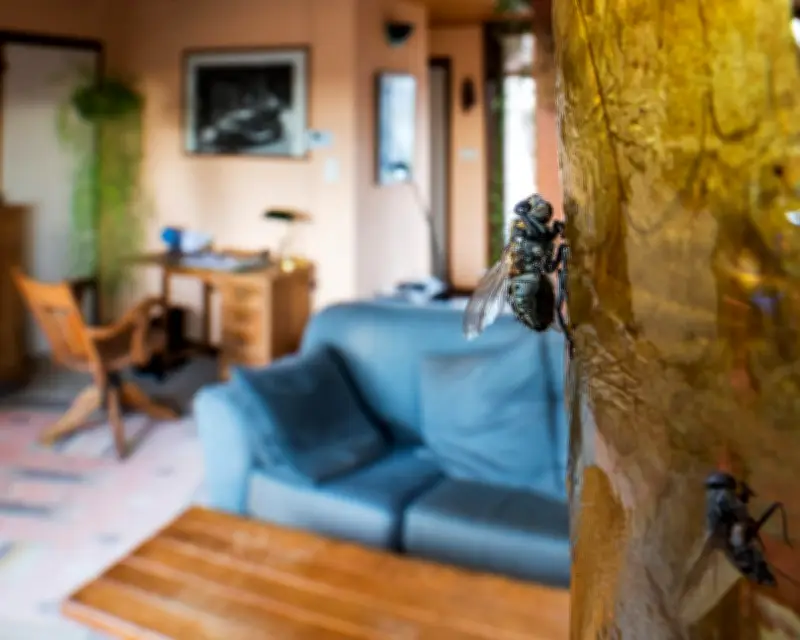
Francesca Davies's living room is absolutely teeming with flies. You can't enter the contact centre worker's home without a cluster of insects rising from the sofa or the floor to buzz around your face. Davies and her family live in West Heath, a suburb of the Cheshire town Congleton. Davies's husband, Alex Andrew, a 29-year-old maintenance engineer, grew up in the market town and he used to think of West Heath as a desirable area, with its well-maintained houses and access to green space. When he and Davies were able to buy a new-build here in 2019 via a shared ownership scheme, they felt incredibly lucky. That is, until they moved in, and realised that every summer swarms of flies descend on their neighbourhood, an issue that is 'getting worse', Davies says.
At the moment, the 27-year-old swats flies out of her young daughters' bedroom every night before she puts them to bed, and keeps doors and windows closed or covered with fly nets as much as possible. She and Andrew have even bought an industrial fly killer (like the ones often found in fish and chip shops) for their kitchen, as it is impossible to start cooking without attracting even more insects. The pair have become used to the sound of flies 'getting zapped throughout the night', Davies says.
Community impact and response
The family have considered moving out of the area because of the flies, and say some of their former neighbours already have. But Davies is reluctant to give up on the house that is her 'pride and joy', she says. 'It is a wonderful place to live. West Heath is so pretty, and everyone's so lovely.' Not to mention, 'You would have to sell it in the winter,' Andrew points out, as prospective buyers would surely be put off by flies swarming around during a viewing. Instead, Davies is attempting to put pressure on the council and the Environment Agency to investigate by setting up a petition, which now has more than 1,000 signatures, asking local authorities 'to take this matter seriously and to prioritise our community's wellbeing'.
The petition has attracted a number of comments from other local people, including one who lives a 20-minute walk away from Andrew and Davies. 'I'm shooing 40-plus flies out of my kitchen regularly throughout the day,' the commenter says. 'It's a constant battle.' Andrew says he has spoken to many neighbours who are struggling with the problem: one orders takeaways every day in the summer to avoid having to cook, while another has draped their newborn baby's cot in a mosquito net. 'They've all had enough,' Andrew and Davies's neighbour Bryan Stahl says.
Residents' struggles and costs
Though it's hard to believe as we swat flies away while we chat, today is a relatively mild day for flies, Stahl tells me, because it is breezier than it has been in recent weeks. At the height of the recent heatwave, the 54-year-old and his partner stayed inside, or in garden chairs under a gazebo walled with fly nets. Davies and Andrew have a similar structure for their garden, which they set up when their daughters want to use their paddling pool. Stahl, a higher level teaching assistant in a school, has spent about £500 on the gazebo and numerous fly screens, he thinks – and is considering forking out thousands more for permanent fly shutters. 'It makes you feel like you've got a really dirty house,' he says.
Ecological importance of flies
But could they be due a rebrand? After all, bees can be just as buzzy and annoying, and even sting us, but that doesn't seem to have damaged their 'cute' reputation. Like bees, flies are pollinators and 'essential to a healthy planet,' says Andrew Whitehouse, head of operations at the invertebrate conservation charity Buglife. In fact, he adds, there are some plants that are only pollinated by flies – including the cacao tree. 'So if you didn't have flies, you wouldn't have chocolate.' And though we might find it gross that flies are so attracted to faeces or rotting matter, it is actually a good thing that they are. 'Fly larvae or maggots will eat lots of dead organic material,' Whitehouse says. 'In doing that, they're recycling nutrients back into the soil, they're getting rid of those things like dead bodies and dung. That prevents the spread of disease as well. So it's incredibly important.' In addition, 'loads and loads of other animals eat flies', Whitehouse says. 'Spiders spring to mind, but lots of vertebrates as well. So birds and bats and amphibians and reptiles and fish all feed on either adult flies or their larvae. And they're a really important food source for lots of these animals.'
There are more than 7,000 species of fly found in the UK, including bluebottles, greenbottles, hoverflies, mosquitoes, fruit flies and crane flies (daddy longlegs). Houseflies are generally considered the UK's most common, although it is difficult to say for sure, because 'weirdly, not enough people study flies', says Erica McAlister, a fly expert and Natural History Museum curator. Houseflies are important pollinators all over the world – in fact, McAlister says, a cousin of the common housefly is the dominant pollinator in the Arctic. 'People are stuck on bees being the most important pollinators – and they are good, I'm not going to deny that,' she says. But while bee larvae don't do anything except consume food until they have grown into their adult form, flies are 'kicked out at birth', and as larvae 'they're out there already helping clean up our environment'. And for anyone stuck on the idea that flies aren't as cute as bees, she urges them to 'go and look up a bee-fly', which she says is 'arguably one of the cutest species in the UK'.
Addressing fly problems without harming them
McAlister is not saying that we should all be living like Davies and Andrew. She is well aware that flies en masse can be a problem – but killing them, particularly in 'a horrible and inhumane way' such as via fly tape, isn't always the answer. Paradoxically, creating fly-friendly environments such as ponds in gardens, or even 'a bucket on the veranda', invites all kinds of wildlife, she says, including fly predators like birds and frogs, so flies actually get eaten and end up bothering humans less. 'There is an argument' for pest control when it comes to fly infestations, she says, but the most important thing to do is to 'find out why that's happened. Because the flies are an indicator that maybe something else is going on.' When fly infestations are reported, usually a link can be found 'to some sort of waste event or some sort of environmental perturbation', the curator says.
Davies and her neighbours think their fly problem is connected to a local recycling plant run by the company Tandom. In a statement sent to the Guardian, Tandom says it has 'implemented a range of additional precautionary measures', and is 'working constructively with the Environment Agency, Cheshire East council and our independent pest control specialists', but emphasised: 'There is currently no evidence that flies are breeding on our site.' A spokesperson for the Environment Agency confirmed that it is in touch with Tandom, and says it has instructed the company 'to take immediate steps to tackle the issue', adding that it 'will not hesitate to take appropriate enforcement action if required'.




