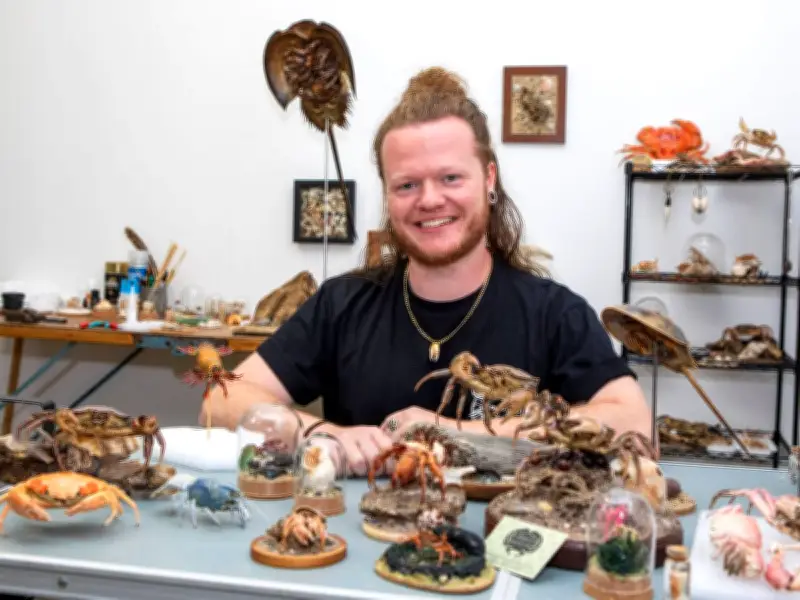
Jason Philip, 32, a specialist in crustacean preservation, offers bereaved owners the chance to immortalize their beloved shellfish, including crabs, prawns, and lobsters. Based in Amble, Northumberland, he carefully preserves the remains of treasured arthropods such as crayfish and vampire crabs for devoted keepers, with commissions ranging from £140 to £300.
From Hobby to Thriving Business
After a period of self-taught learning, Philip transformed his pastime into a successful enterprise, fulfilling orders from as far as Australia and the United States. He operates under the trading name Amble Obscura and initially ventured into this specialized profession after relocating to the coastal settlement of Amble four years ago.
Philip said: "I really wouldn't have expected the crustacean taxidermy thing to take off like it has. I did not realise how popular pet crabs were! It's amazing as I didn't think it would go anywhere but it's opened so many doors for me, particularly as someone who does not have a background in this fascinating field."
Discovery and Early Challenges
Finding himself without a job, Philip spent time walking along the shoreline when he chanced upon a large deceased crab in remarkably pristine condition. He recalled: "I've always been someone who collected rocks and unusual memorabilia. As a kid I would pick up dead animals and grandma would say put it down, you don't know where its been. But on that day I came across what I thought was a large dead crab - it was quite exciting for someone like me. My first thought was there must be a way to preserve it, so I put it in my coffee cup, took it home and started looking up how to preserve a crab tutorials online. There was nothing out there that went into detail - but Reddit was handy!"
Upon attempting to dismantle that crab, Philip discovered the shell was hollow, learning that crabs shed their shells through moulting. From that point, preserving crustaceans became a process of "trial and error." He explained: "Initially it was an experimentation - there were many, many failed attempts. I had to test materials and test all the different ways to dry the shells out. I soon realised that sunlight was a very bad idea after finding an entire batch of crabs I had left out bleached orange and cracked into thousands of tiny pieces!"
Overcoming Obstacles
Philip faced additional challenges, including the distinctive odor while preserving shells and the considerable attention to detail required. His projects have occasionally taken up to eight months to complete. He revealed: "Honestly, the main struggle is the smell - even seasoned taxidermists don't enjoy that. It is also a very gradual process, so you have to be patient. When you are working with smaller crabs they are extremely delicate, so it's very time-consuming."
It was only after successfully preserving his first crab that Philip considered listing it on Etsy. He said: "I thought it was something people would see and want, and I'd never felt that about my previous work as a painter. It was the first time I felt I had made something that was worth leaning into."
Ethical Practice and Notable Commissions
Philip refuses to kill creatures for preservation; he exclusively works with crustaceans that have already perished or vacated their shells. After posting his creations on social media, he was astonished by inquiries from people requesting preservation of their deceased pet crustaceans. He received a notably unusual commission to preserve a peacock mantis shrimp named Ludo, who had a social media presence with millions of followers. Philip's work on Ludo led him to uncover teeth the owner was unaware existed.
Philip recalled: "It turns out the whole internet knows about Ludo! To remove all the flesh you have to disassemble the body, whilst I was in the process of pinning the head portion and trying to arrange the appendages and sets of antennas of Ludo, I noticed his mandibles had these little teeth. Amy, Ludo's owner, had no idea that he had these - she couldn't believe it. After she shared a photo of the work I'd done that's when it all blew up for me."
Other peculiar commissions include preserving a blue crayfish, a horseshoe crab, and a vampire crab. Philip noted: "The blue crayfish was very unusual for me - I had never seen one of those before!"
Rewarding Craft
Despite the time investment, Philip described his craft as "immensely rewarding," especially when helping owners commemorate their cherished companions. He explained: "I didn't realise how connected people were to these types of animals and pets in general. Particularly when I am out selling my work in markets, the number of really young kids who will drag their parents up to their stall and take a crab home with them. A few people have told me they dislike crabs and taxidermy is off-putting - but my work has helped them to understand not only the animals better, but also the value in preserving their incredible shells."
Philip's portfolio includes open displays, glass dome presentations, framed pieces, and crab claw earrings and necklace pendants. More information is available at ambleobscura.com.