
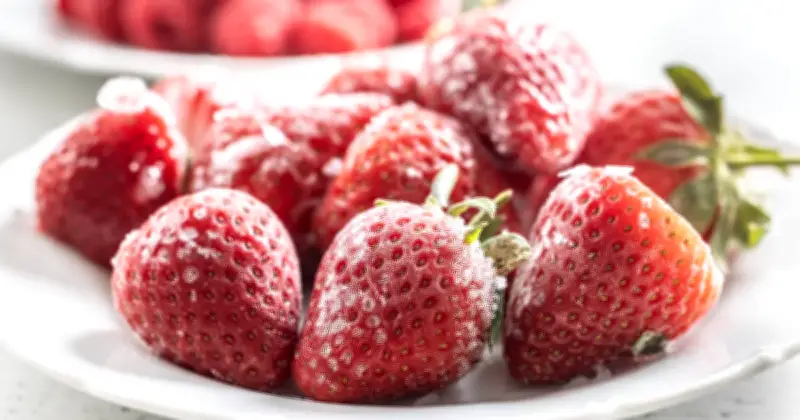
Researchers at the University of British Columbia (UBC) in Vancouver, Canada, have developed an edible coating that keeps strawberries fresh for at least four days at room temperature, outperforming uncoated berries stored in a fridge. The coating, made from agar, a substance extracted from red seaweed, could help reduce spoilage, large-scale food waste, and dependence on refrigeration.
Coating Composition and Application
The agar-based coating is combined with zinc and tannic acid, a plant compound found in grapes and tea. When submerged in the solution, strawberries, grapes, and apple slices emerge with a thin, edible coating that dries completely clear. The material self-assembles into tiny microparticles that create a protective layer around the fruit.
The study, published in the Journal of Agricultural and Food Chemistry, found that coated strawberries lost less than half as much water as uncoated fruit over four days at room temperature. They remained firmer and retained higher levels of vitamin C and antioxidants. Grapes and apple slices showed similar benefits, with improvements lasting 14 days and 24 hours respectively.
Comparison with Untreated Berries
Untreated strawberries stored at room temperature began developing mould within just two days, while refrigeration only marginally extended their shelf life. Coated strawberries stored without refrigeration remained entirely mould-free for at least four days, and those kept in the fridge stayed fresh for a minimum of six days. The coating also demonstrated antibacterial qualities and showed no signs of toxicity in tests using human intestinal cells.
Researchers noted that the coating can be rinsed off with tap water within two minutes if desired. A life-cycle assessment revealed that the coating has a 14% lower carbon footprint than conventional refrigeration and cuts freshwater ecotoxicity by approximately 85%, primarily by reducing dependence on electricity and refrigerants.
Real-World Application and Future Plans
The team substituted lab-grade agar with commercially available food-grade agar and found consistent results, with coated strawberries displaying reduced moisture loss and spoilage. Study senior author Dr Tianxi Yang said: "We wanted to find a simple alternative to cold storage. Once we added the coating, the fruit became far less sensitive to changes in temperature and moisture and stayed fresh longer."
Study lead author Ivy Chiu, a doctoral student at UBC, said: "It was exciting to watch the particles self-assemble in real time, from a cloudy, milky liquid into this incredibly uniform, protective layer. To our knowledge, no one had made an agar-based microparticle coating like this before."
The research team is now trialling the coating on additional fruits and vegetables and exploring how it could be scaled up for commercial food supply systems.




