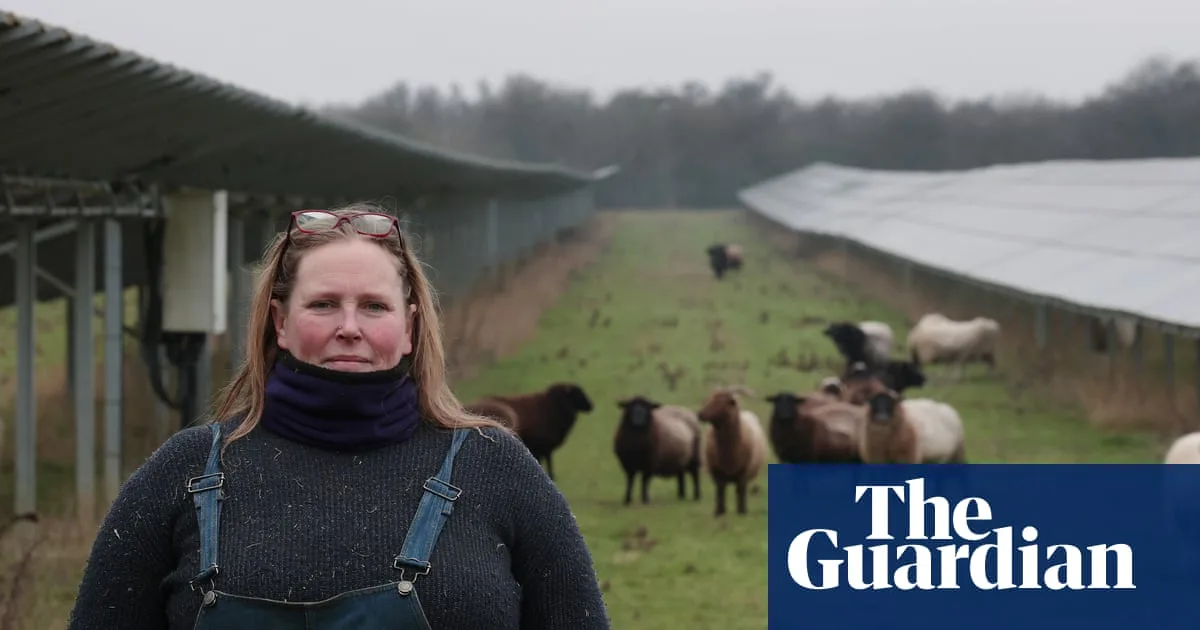
For Hannah Thorogood, a first-generation farmer in Lincolnshire, grazing her sheep on solar land has transformed her business. Starting with just 18 acres and 20 sheep, she now manages 250 acres and over 200 sheep, thanks to free grazing on a solar farm. 'Solar grazing has given me a massive leg-up,' she said.
Across the UK, more farmers are turning to solar grazing as a way to access land that would otherwise be unaffordable. Dr Liz Genever, a farmer in south-east Lincolnshire, has tripled her flock through free grazing. 'If I could increase my flock to the full potential offered by the local solar site, I could potentially increase my income from sheep from £20,000 to £60,000,' she said.
Solar grazing involves using sheep to manage vegetation on solar farms, reducing costs for energy companies. A typical site spends up to £50,000 annually on mowing or spraying, but sheep can do the job more efficiently, working in all weathers and reaching areas machines cannot. Murray Sellars, co-founder of GroundGraze, noted that in areas with insufficient flocks, shepherds could be paid for their services.
Proponents call it a 'triple-win' for farmers, renewables and society. Emilien Simonot of Lightsource BP, which runs one of the UK's largest sheep-grazing programmes, supports this view. Prof Alona Armstrong of Lancaster University added, 'This sort of multiple land use is vital.' A recent study even suggested that sheep grazing in the shade of solar panels may produce higher-quality wool.
However, some are sceptical. Fraser Key, a fourth-generation farmer who built a solar farm in 2012, warns that covering agricultural land with panels is 'dangerous' and could decimate farming communities. Guy Parker of Wychwood Biodiversity Limited noted that high stocking densities can reduce biodiversity. Nicola Noble of the National Sheep Association cautioned that solar grazing could become a 'PR exercise' for energy companies, with grazing promises sometimes unfulfilled after planning approval.
Despite these concerns, solar grazing offers a rare opportunity for farmers locked out of land. 'The sheep improve soil quality, increase pasture diversity and mean the land doesn't need mowing,' Thorogood said. While it won't solve all of British farming's problems, it provides a way in for those who need it most.