
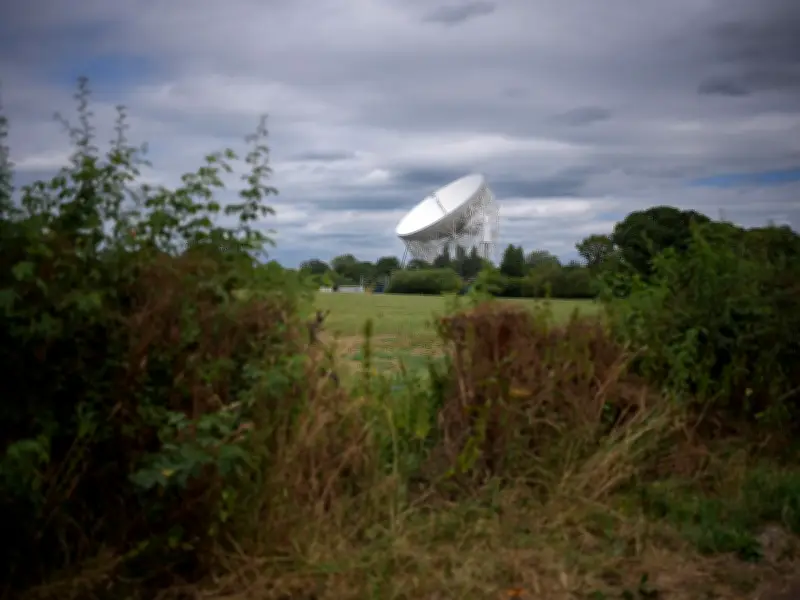
Funding cuts threaten Jodrell Bank's future
Top space scientists have expressed shock and dismay at funding cuts that threaten the future of Jodrell Bank Observatory, calling the news 'devastating for astronomy'. The Royal Astronomical Society (RAS) released a statement hitting out at what it called 'a slew of catastrophic budget cuts' by the Science and Technology Facilities Council (STFC).
Jodrell Bank issued a new statement on Thursday, saying it had received 'an extraordinary number of messages' of support and has now set up a donation page. 'It means a great deal to everyone at Jodrell Bank to know how deeply people care about this remarkable place,' said a spokesperson. 'We remain committed to doing everything we can to sustain the long-term future of this internationally significant scientific facility.'
Budget cuts worth £2.8 million a year
The budget cut — worth £2.8 million to Jodrell Bank a year — will see the end of science at the observatory by March 2028, unless alternative funding can be found. The cuts affect the e-MERLIN network, a group of seven UK radio telescopes including the iconic Lovell Telescope. The RAS said other 'casualties' include UK withdrawal from the James Clerk Maxwell Telescope in Hawaii, a 20 per cent cut for the Square Kilometre Array Regional Centre and activities at the Vera Rubin Telescope in Chile, while the BISON solar observing network would be hit by a 40 per cent cut.
RAS President Professor Jim Wild said: 'This is devastating news for UK astronomy. At a time when technological innovation is crucial to our country's prospects, discarding unique, globally significant observatories threatens both our scientific future and the inspiration of future generations of astronomers.'
Support from scientists worldwide
Scientists from across the world have been posting on social media. Violette Impellizzeri, an Italian astronomer and astrophysicist, said: 'The financial savings from these cuts are small, but the loss of scientific capability, technical expertise AND international leadership would be profound. Once such capabilities disappear, rebuilding them is neither easy nor inexpensive.'
Standing since 1957, the Lovell Telescope is the world's third largest steerable radio telescope and the UK's largest. It played a key role in deep space science, including intercepting the first pictures from the Moon's surface in 1966 and a covert role in the Cold War. The observatory earned Unesco World Heritage status in 2019.
STFC defends decision
A spokesperson for UK Research and Innovation said: 'STFC has undertaken a rigorous prioritisation process to focus investment on the areas that will deliver the greatest long-term scientific capability, impact and value for the UK. The decision to withdraw funding from e-MERLIN at the end of its current funding agreement is the result of a comprehensive, evidence-based prioritisation process.' The current e-MERLIN funding agreement runs until March 2028, providing time to explore alternative funding arrangements. The Jodrell Bank Centre for Engagement, the visitor centre, is a separate entity and is not at risk as a result of the cuts.
The University of Manchester has now set up a donation page.




