
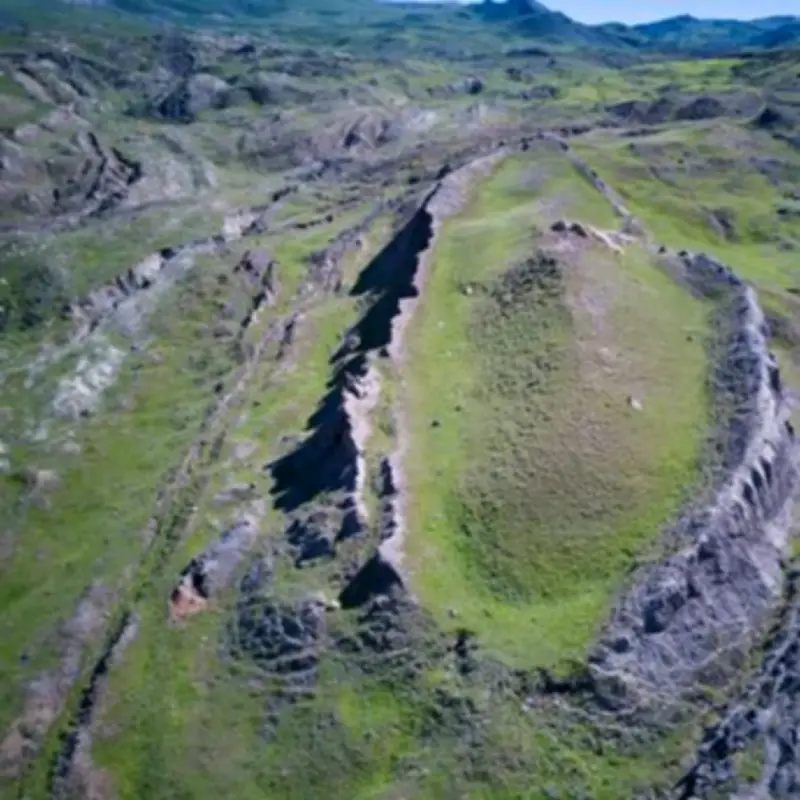
Researchers have won official permits to hunt for 'irrefutable proof' of Noah's Ark at a mysterious, boat-shaped mountain formation in eastern Turkey. The Durupinar Formation, located near Mount Ararat, has long been a subject of debate, with some believing it is the final resting place of the biblical ark.
Government Approval for High-Tech Expedition
The team behind Noah's Ark Scans has secured official government permits to launch the most advanced scientific hunt in history at the site. The high-tech expedition will use non-destructive core drilling, subsurface imaging, and a specialized underground drone named 'Gopher' to map subterranean anomalies. The team hopes to provide the world with 'irrefutable proof' that the Bible's most famous ship has been found.
Dimensions Match Biblical Account
Believers argue the formation perfectly matches the dimensions of the Ark detailed in Genesis: 300 cubits long, 50 cubits wide, and 30 cubits high (around 515 feet by 86 feet). While skeptics insist the structure is merely a unique natural rock formation, stunning radar scans have previously revealed angular structures and large, hollow voids 20 feet beneath the surface.
Noah's Ark Scans fundraiser Lauren Witzke said: 'This is not merely a scientific expedition; this is confirmation that one of the most scoffed-at stories in history, Noah's Ark, is real, as is the God who inspired it and, in his wrath and mercy, sent the flood for which it was needed.'
Historic Authorization
The group hailed the breakthrough, saying: 'This historic authorization marks the first time in modern history that a dedicated international team has been officially cleared to perform extensive, non-destructive investigations at the site using revolutionary new scanning and imaging technologies never before applied to this site.'
The site was first brought to modern attention in 1948 when heavy rains and earthquakes washed away surrounding mud, exposing the ship-like outline to a local Kurdish shepherd. Lead researcher Jones believes the unique physics of the mound prove it is man-made.
Evidence of Man-Made Structure
Jones previously told the Daily Mail: 'Naturally, an object would not form this way with the pointed end uphill. Per fluid dynamics, if this was an obstruction naturally forming around a rock in the earth or mud flow, then the pointed end would be downhill and the rounded end would be uphill.'
Even more shocking are the underground chambers detected by the team's radar. Jones added that he and his team have uncovered 'a tunnel that is not filled in, which leads to a big central void, a room that goes much further down that is square shaped.' He added: 'Some people have theorized that Noah's Ark had a multi-level big atrium to let the light and air circulate between the three decks. Our assumption is that this could be part of Noah's Ark, possibly the central hall and some of the decks. There's definitely something preserved underground.'
Chemical Analysis Points to Decomposing Timber
The team also claims that chemical analysis of the soil inside the formation points to decomposing timber. Soil samples show a lower pH alongside higher levels of organic matter and potassium. Jones said: 'Tests show these soil differences (pH, organic matter and potassium) are real, with less than a five percent chance they're random, giving 95 percent confidence that something like a decayed wooden ship is causing them.'
Addressing critics who point out the site is 18 miles away from the peak of Mount Ararat, Jones noted the Bible specifies a wider region. He said: 'In the Biblical account, it doesn't say Noah's Ark landed on Mount Ararat; it says the mountains, plural, of Ararat. Back in those days, Ararat was an ancient kingdom. So it would be like saying today that Noah's Ark landed in the mountains of Colorado. It's referring to a region of mountains, not one specific peak, and our site fits within that location.'
The historic hunt is scheduled to begin later this year.




