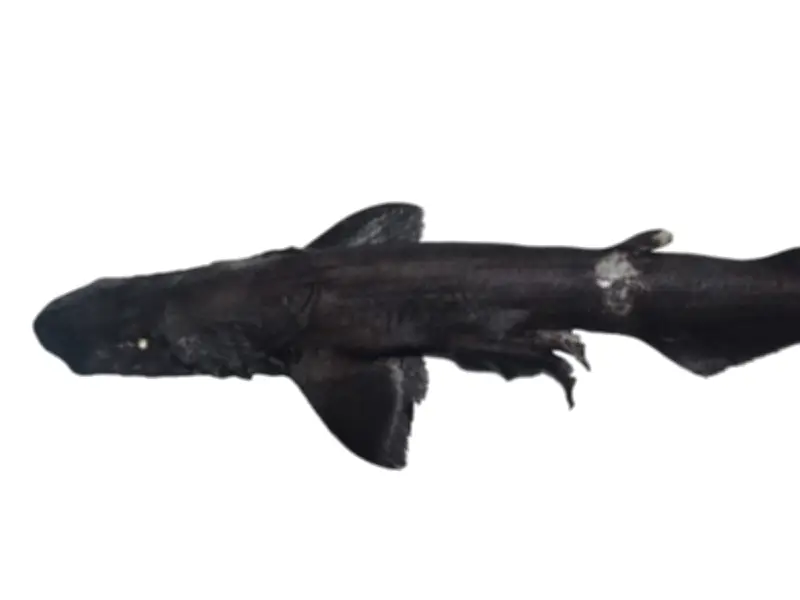
Marine biologists have discovered a brand new species of shark swimming deep below the ocean's surface, which uses its entirely black body to blend into its murky habitat. The Arabian slender catshark was found swimming at a depth of between 400 and 650 metres off the coast of India, with scientists describing it as having a "slender body" and thin, snout-like nostrils.
Distinctive appearance and habits
The jet-black shark, which was first seen in 2022 but has only recently been confirmed as a new species, also features a pair of distinctive bright-white eyes. Measuring in at around 40cm in length, it boasts a set of tiny saw-like or multicusped teeth, which it uses to feed on slippery prey including small fish, squid and crustaceans.
According to a paper by the scientists that discovered the species, the reason the shark has remained undetected is that it avoids parts of the ocean popular with fishing boats. The paper states that "it is only in the last three-four years, when the fishermen increased their depth of fishing that this species has started to appear."
Related to deepwater catshark
The creature is a close relative of the deepwater catshark, which is also found in similar habitats. The discovery comes days after marine biologists warned that great whites could be swimming off the coast of the UK, as researchers tracking marine life have spotted the predators venturing further north than ever recorded.
Scientists from research organization OCEARCH recently tracked two great whites off the northern coast of Newfoundland, Canada. The pair included a 9ft male named Quint and a 10ft female named Bella. While the booming population off North America points to successful conservation efforts, marine experts warn that warming oceans are forcing sharks to shift their hunting grounds.
Marine scientist and shark expert Tom "The Blowfish" Hird said: "As the seas warm, things start to migrate. A shark who used to live at however many degrees of latitude can't stay there anymore because it's too hot. So they need to move somewhere typically cooler that's now increased to the temperature they like."