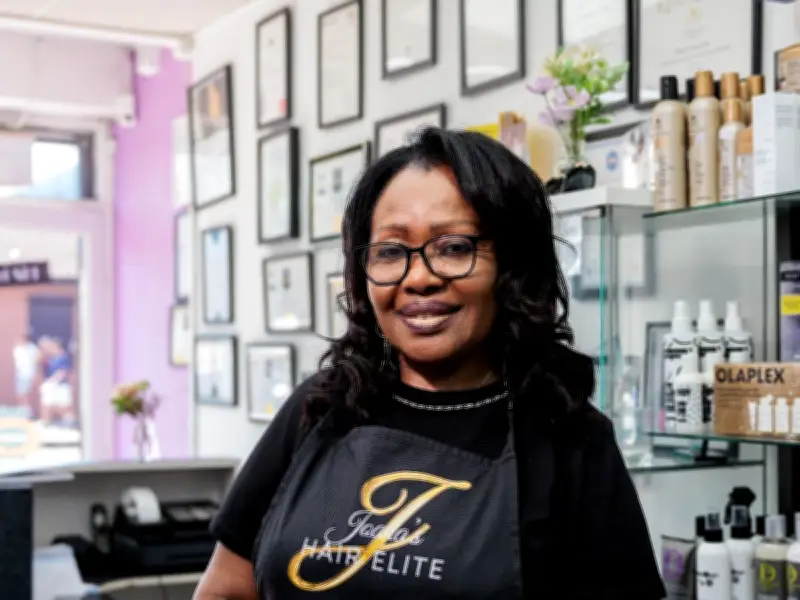
Joana Hesse's Hair Elite salon in Cheetham Hill, Manchester, is more than just a salon; it is a specialist hair loss service that has transformed lives for over 40 years. Joana, originally from Ghana, moved to Manchester in the late 1980s and opened her salon in 1989. Today, she is a go-to for many in Greater Manchester, offering discreet treatments for men with male pattern baldness, chemotherapy patients referred by the NHS, and young people with alopecia.
A Personal Touch for Hair Loss
In an interview with the Manchester Evening News, Joana was seen consulting two students who traveled across the city for a hair kit ahead of a graduation ceremony. “Treating someone like that gives me a bit more joy,” she said. “It’s not like someone who has thick long hair, for someone like her, my treatment will give her more confidence. I do younger ones who have alopecia, older ladies who’ve had hair loss and are trying to get into wigs. There’s no way some of these people could go out without covering their hair.”
Upstairs in her salon is a separate room where she treats clients discreetly. “When you’re suffering from hair loss, it can be very, very emotional,” she explained. “People feel like they can’t do anything, they can’t go out. I started doing hair loss because of dealing with a young later who was suffering from a condition where she pulled her hair. She couldn’t face going to school. So, I came in and did my first consultation and booked her in. For two weeks, I never slept because I was so determined to do something for her. In the end, she came in and did it for her and she was so happy and started going to school. It made me think, if I can change someone’s life like that, then why don’t I add that to what I’m doing already?”
From Ghana to Manchester
Joana moved from Ghana to the UK in the late eighties with her husband. In Ghana, she worked as a secretary at an insurance company, but struggled to find similar office work in the UK. She turned to hairdressing, gaining experience by working for free at a salon in Moss Side, then went to college, obtained qualifications, and opened the first iteration of Joana’s Hair Elite in 1989. “It wasn’t easy,” she recalled. “I had to do flyers and take them to universities in Manchester. I was targeting African students because they’d come here [Manchester] and they didn’t know where to go. There was no social media. It’s either you’re doing Yellow Pages, newspapers or pushing flyers through people’s doors.”
She has been a mainstay in Cheetham Hill ever since, initially operating from a small unit inside an Irish salon on Cheetham Hill Road. When the building was sold, she found her own unit just a few doors down, where she remains today.
Community and Awards
Joana’s work extends beyond business. She has offered opportunities through the Youth Training Scheme, work experience programs, and apprenticeships. Her awards, displayed prominently above her store, include a lifetime achievement award, community champion award, hair loss specialist awards, and a multicultural apprenticeship employer award, with her earliest trophy dated 1989. She has also been a motivational speaker and represented small businesses in a roundtable discussion with then-Chancellor Rishi Sunak and former Conservative Party Chair Amanda Milling, as a member of the Federation of Small Businesses.
“Community has always been at the heart of everything I do,” she said. “Whether mentoring young people, supporting local initiatives, helping people experiencing homelessness, or simply being there for those who need encouragement. I have always believed that a business should give back to the community it serves.”
Challenges for Small Salons
The salon industry faces a difficult climate with rising employers' national insurance contributions, increases in the minimum wage, and a 20% VAT rate on hairdressing services with turnover exceeding £90,000. This has led other salons, like Nicky Oliver Hairdressing, to cool off on apprenticeship programs and hiring. Joana believes the government can do more: “I think there’s so much the government can do to help small businesses. Doing apprenticeships is not easy. There are so many things to do and things you must train them with. I deal with one college, and I get other colleges calling me or writing to me. But there’s only so many you can take; you can’t really take everyone.”