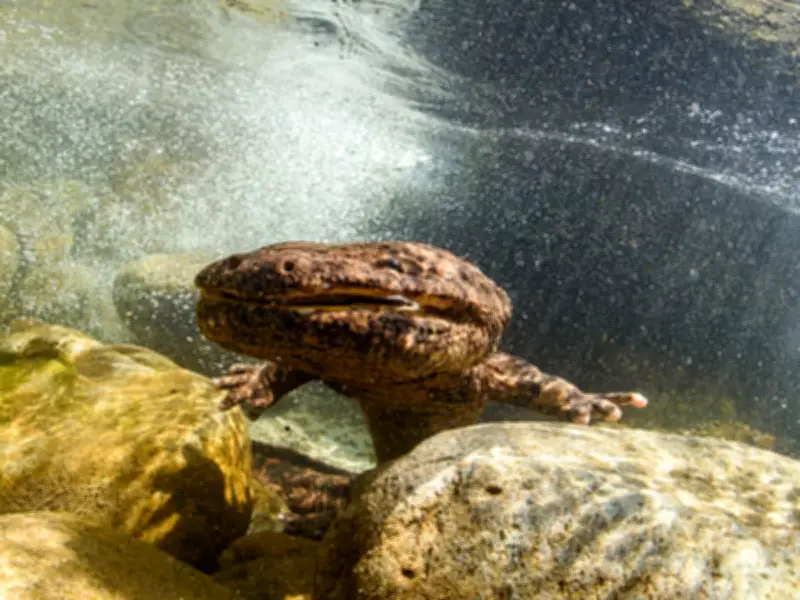
A giant salamander has been identified by scientists in Japan after fossil bones buried for millions of years revealed a previously unknown species.
The ancient amphibian named Limnospondylus ajimuensis is helping researchers fill a huge gap in the evolutionary history of one of the world's most ancient animal groups.
The fossils were discovered in Oita Prefecture and although they varied in size and were found at different sites, scientists believe they belonged to several individuals of the same species. The breakthrough came from a single vertebra taken from the middle of the spine. Researchers found it had a mix of anatomical features never before seen in the giant salamander family, Cryptobranchidae.
New genus and species
The differences were so striking that experts concluded the fossils belonged not only to a new species, but an entirely new genus.
Giant salamanders have existed for around 60 million years, but the Asian fossil record contains a mysterious gap of more than 20 million years between ancient species and those you can see today. The new discovery helps bridge that missing chapter.
Ancient habitat and extinction
Researchers believe Limnospondylus lived in lakes and wetland areas rather than the fast-flowing rivers preferred by many modern giant salamanders. They think the species may have disappeared as global cooling towards the end of the Pliocene transformed freshwater habitats.
The find also suggests that giant salamanders were once far more diverse than previously thought. Fascinatingly, scientists now put forward that fossils sitting in museum collections could belong to other unknown species that have yet to be recognised.
Link to modern species
Today, the Japanese giant salamander (Andrias japonicus) still lives in rivers close to where the fossils were uncovered, providing a rare link between the region's prehistoric wildlife and the animals that survive there today. Researchers say the discovery also highlights the importance of protecting wild giant salamanders, which face growing threats from habitat destruction.
However, it's far from the first time an unassuming fossil has transformed what scientists thought they knew. In recent years, researchers have identified an entirely new species from little more than a tooth, a fragment of jaw, or a single bone.
Some of the biggest discoveries in palaeontology have come not from complete skeletons, but from tiny clues overlooked for decades in museum collections. As new scanning techniques improve, experts are finding that fossils once thought to belong to familiar animals can actually reveal branches of evolution that had been hidden in plain sight.
Sometimes, it only takes a single fossil bone to rewrite millions of years of evolutionary history.