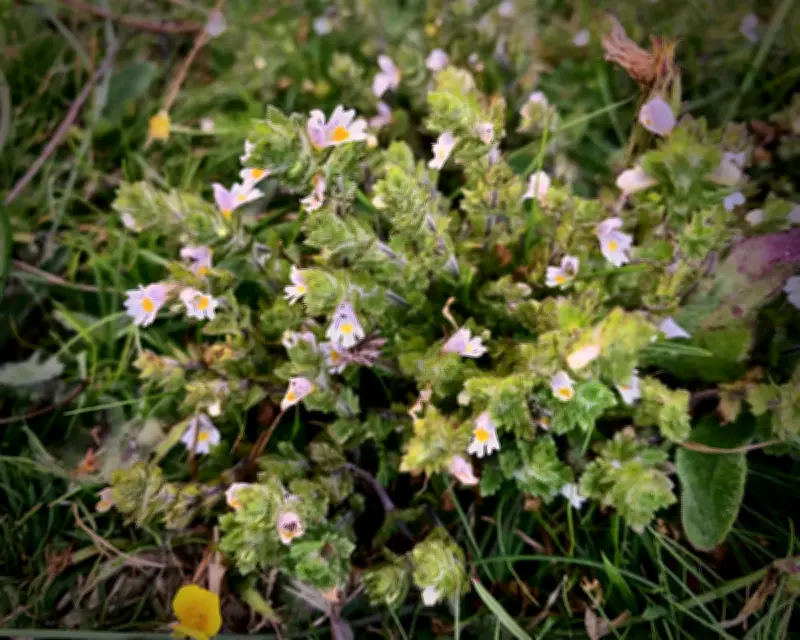
Eyebrights flower in the short turf of Old Racecourse Common as sunlight burns a hole through rowan trees to cast sunset colours on the grass. The eyebrights are annuals with tiny flowers, 4mm-11mm long with a violet vibe, a white corolla with purple marks and a central flash of yellow.
Taxonomic Puzzle
There are about 20 British eyebright species, some of which are endemic. Their genetic complexity makes them an arcane group of plants and a taxonomic puzzle to all but their most dedicated acolytes. "Life's too short to key out [make a precise identification of] eyebrights," one botanist told me.
For the sake of argument, this one is Euphrasia officinalis agg, an aggregate of species, microspecies and hybrids, one of which is E nemorosa, the common eyebright. They belong to Orobanchaceae, the family that also includes lousewort, toothwort and yellow rattle.
Parasitic Nature
Like these, the eyebrights are parasitic, or at least hemi-parasitic, capable of independent living but also sending out roots to penetrate the roots of grasses to siphon water and nutrients from them, like wiring into streetlights to nick the 'leccy. This reduces grass dominance and changes the composition of the turf.
Medicinal Herb
Euphrasia comes from the Greek word for cheerfulness, obvious when you get down to look into their faces, even through the smudgy lenses of my specs. According to the medieval Doctrine of Signatures, objects in nature have trademark characteristics that are key to their influence on human conditions, so gazing at these flowers looking back with such a bright, sunny disposition can help us see and feel better. Following on from intuitions and symbolism, eyebright is an ancient medicinal herb with properties such as aucubin and iridoid glycosides, lignans and flavonoids used in tinctures and compresses to cure eye problems. They also promote wellbeing and were burned as an incense to aid divination.
Conservation Challenges
So, is the future bright for eyebrights? A lack of grazing and encroaching bracken, recently cut here, is a common problem for short-turf habitats. Conventional conservation of distinctive species has to be balanced with the conservation of processes that create the extraordinary evolution of eyebright diversity for these shapers of place and their richly storied lives.