
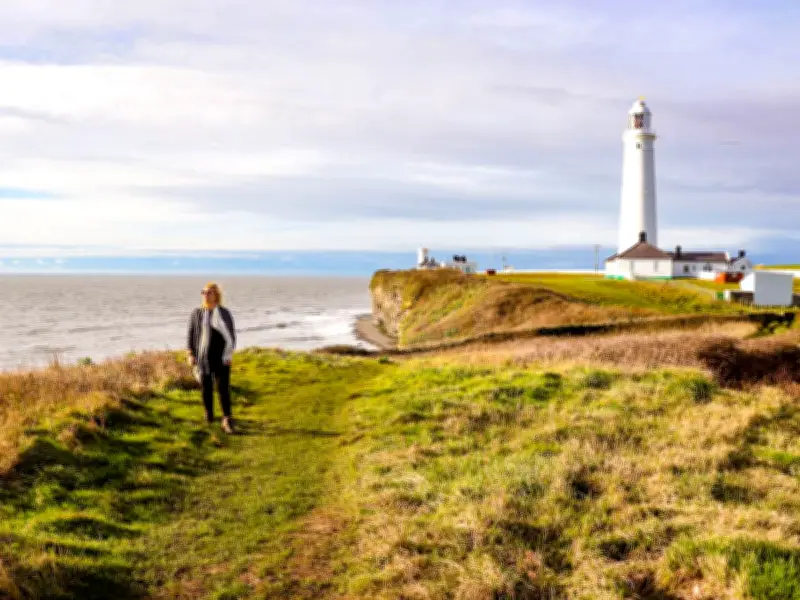
One of my favourite walks features a lovely lighthouse. When you think of a coastal walk in Wales, you might picture epic stretches of the Pembrokeshire coastline or a jaunt around the sandy shorelines of Anglesey. There’s another spot that should be on your radar, though. With miles of heritage coastline, waymarked trails, ocean views and cosy café stops, the Vale of Glamorgan is a massively underrated corner of Wales for a hike.
Vale Trails and Jurassic Features
A marked and numbered 'Vale Trails' series will take you through coastal and countryside routes with the most scenic views and historical features. The Vale has an abundance of short coastal walks thanks to its unique heritage coast with Jurassic features. Stretching from Aberthaw to Porthcawl, the Glamorgan Heritage Coast offers walkers 14 miles of unspoilt coastline via waymarked trails that wind through small villages, rural farmland and sprawling beaches.
One of my favourite walks in this area is the Nash Point loop walk on the sweeping Glamorgan Heritage Coast. There are two interlinked circular routes following sections of the Wales Coast Path. Highlights include Nash Point Lighthouse, St Donat’s Castle and epic views of the spectacular cliffs. You can choose between the Marcross, Atlantic College and Lighthouse Walk (4.5 miles / 7 km) or the Monknash, Lighthouse and Marcross Walk (4 miles / 6.5 km).
The 4.5-Mile Circular Route
On my most recent visit, I opted for the 4.5-mile (7.2 km) circular route in the Vale of Glamorgan that combines dramatic clifftop views of the Glamorgan Heritage Coast with inland farmlands, a lighthouse and a cafe stop. You can follow the route from the Vale Trail leaflet or download it in a hiking app like AllTrails. The route takes in a number of historical sites, including the Nash Point Lighthouse, Atlantic College and Holy Trinity Church, Marcross. Located around 45 minutes from Cardiff, the walk begins at the Nash Point Car Park, where you’ll find the clifftop cafe and campsite.
The fuss-free cafe serves hot and cold drinks, cakes, and hot food like bacon rolls and burgers. It’s usually open Tuesday to Sunday, and day parking for non-campers is £3. Once you have paid to park, exit onto the main road towards Marcross. Continue on the road, passing Marcross Church on your left. It’s worth stopping to admire the Grade I-listed medieval church, with exposed Lias limestone features, including a 12th-century chancel arch and a Romanesque baptismal font. Always nice to have a spot of history on a hike.
Turn right just before the Swn-y-Môr bungalow, follow the track, and then bear left toward a stile. Cross the stile and stay on the footpath through the field, keeping the hedge on your left. The hedge turns sharply left twice. Ignore the footpath that goes off to the left at the second turn. Keep going straight, with the coast on your right, until you reach a stone stile. After the stone stile, keep left and follow the hedge to a gate leading onto a road. Here, turn right and pass The Elms. Continue straight through a gateway for about 100 metres, then cross a stile on your left.
Cross another stile in the opposite direction to enter a large field. Walk diagonally to the right toward a stile in a gap in the wall. Turn left along the path, then head to the wall stile at the bottom of the field. Cross this stile and follow the path left around the building to a second stile that leads onto a lane. Turn right and head toward the gap between a garage and Park Farmhouse. Continue to a gate that leads into woodland along a rough, downhill track. Ignore the main path off to the right. The path comes out onto a road with St. Donat’s Church on the right. This 12th-century church stands next to St Donat's Castle and has been a sanctuary for over 900 years.
St Donat's Castle and Atlantic College
Turn left, walk uphill with St. Donat’s Castle on your right. Wales’s oldest continuously inhabited castle moonlights as UWC Atlantic College, a boarding school for the world's royal offspring and diplomatic wunderkinder. Once described as “Hogwarts for hippies,” UWC has an impressive alumni, including Princess Elisabeth of Belgium, Willem-Alexander, King of the Netherlands, and even Wales’s own First Minister, Eluned Morgan. For most of the year, the castle is off-limits unless you’re fluent in Model United Nations. But you can see it by visiting street food events like Fantastic Fête when you traipse through the grounds like medieval freeloaders in search of bao buns and fried chicken. Street Food Circus is now selling 2026 tickets on its website.
The castle was purchased in 1925 by newspaper magnate William Randolph Hearst, who undertook extensive renovations. In 1960, it was gifted to UWC Atlantic College, which now uses it as its boarding school campus, oozing boy-wizard vibes. While modern touches have crept in, the Castle College still flaunts its medieval drama: Bradenstoke Hall, the Inner Courtyard, the Great Hall, and a Dining Hall straight out of a fantasy film. Stone walls and soaring ceilings, all very “feast before battle.” The large grounds are manicured to perfection and even include a lido by the sea. Once you have admired the exterior, follow the road, as it bears left to the College grounds exit.
Turn right at the main road, pass the College entrance, and pass through a kissing gate on the right, near a lay-by to enter George V playing field. Walk towards the coast, with the woods to your right, through a wooden gate to reach the Wales Coast Path. Go through a kissing gate on your right into the woods. Keep right along the Wales Coast Path, which gradually swings left, offering incredible views of Atlantic College and the coastline. Pass the college, and the path then leads into a second wood. Bearing left at the fork, enter a field with the magnificent Nash Point lighthouse ahead.
Nash Point Lighthouse
Continue along the cliff top towards the lighthouse complex. Make sure to explore the area near Nash Point Lighthouse, built in 1832 as a response to the wreck of the ‘Frolic’ with the loss of 40 lives. According to the Vale website, there are many local tales of smugglers and wreckers who would lure vessels onto rocks, attack the crew, and loot the cargo. On stormy nights, wreckers would attach lanterns to the grazing sheep on the cliff tops, giving the illusion that they were sailing in safe waters when, in fact, they were on course to rocky shores. After the lighthouse was built in 1832, the dependable light meant sailors had a reliable beacon to guide them safely away from the rocks and raiders.
As with all lighthouses in the British Isles, Nash Point is no longer manned, and the last keepers left on 5 August 1998. It was also the last light in Wales to be automated and the penultimate in the UK to be demanned. Sadly, Nash Point Lighthouse is no longer open to the general public, but you can stay in two former lighthouse keepers’ cottages, Ariel and Stella. More information is available on this website. Once you have walked around the lighthouse, return to the Nash Point car park.
Perfect Pub Stop
After your long walk, the historic Plough and Harrow Pub in Monknash is perfect for a cosy drink or traditional pub food. It has a fascinating but grisly past; dating back to 1383, its backroom was used to store shipwrecked bodies who had been killed at the hands of the Wreckers of Wick and Dunraven, criminals who looted stricken vessels and lured sailors to their doom. The rustic pub is said to be home to these ghostly victims, and staff and customers have reported dozens of strange incidents, including seeing a man in a cloak walking through the pub. Spooky happenings aside, this is an excellent spot for a pint in historic surroundings.




