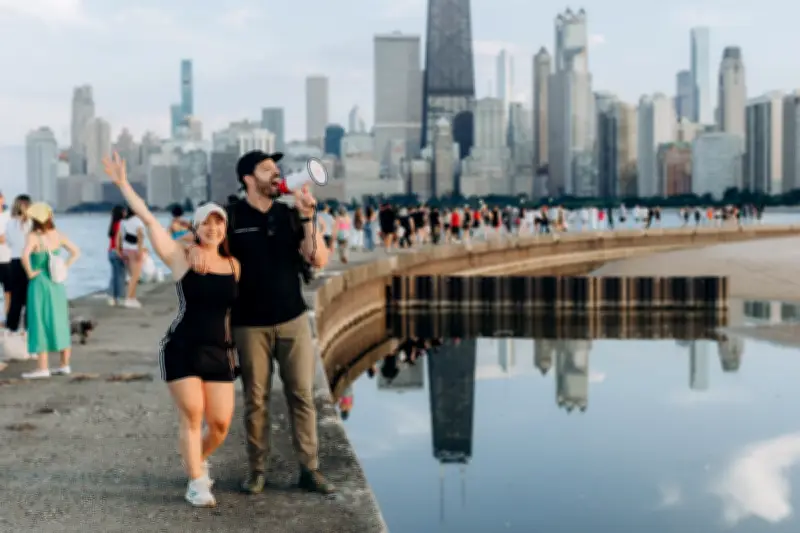
Every Sunday evening during warmer months, people strolling along North Avenue Beach in Chicago's Lincoln Park neighborhood witness an unusual sight: the Chicago Scream Club meeting, where up to 300 people gather to scream out over Lake Michigan. The activity appears to be gaining traction across the United States.
Origins of the club
Founded last year by couple Emanuel Hernandez and Elena Soboleva, the Chicago Scream Club has become a popular outlet for stress relief and even celebration—one new bride recently screamed with her friends to mark her wedding. Videos online show people lining up and shrieking into the lake, highlighting the group’s appeal.
Hernandez, a breathwork practitioner, men’s coach, and fitness coach, said: “I think a lot of people think screaming is silly by themselves. So then, when they have permission from other people, screaming with them, I think it just gives them confidence to be able to do it.”
The screaming sessions began after Hernandez and Soboleva, struggling to settle into their new routine after Hernandez moved to Chicago, found themselves arguing. One day while walking by the lake, Hernandez suggested they scream into it. Soboleva agreed, but wondered what if people were around. Hernandez responded by asking strangers to join them.
Hernandez, 41, recalled: “We found a pier that goes out into the water far enough so that if somebody was around they wouldn’t be able to hear us, but there were people there. So we just asked them: ‘Hey, look, we’re about to scream into the lake. If you’d like to join us, you’re more than welcome.’” Those people responded “Hell yeah” and joined in.
Growing popularity
After that experience, the couple created a poster inviting others to scream with them. Attendance grew steadily; by the sixth week, over 300 people were showing up. The club has since expanded, with screaming events held in Austin, Phoenix, and Washington DC. An online Scream Club website, unaffiliated with Hernandez and Soboleva, also exists for virtual screaming.
Soboleva, 36, a branding consultant for women-owned businesses who moved to the US from Russia in 2011, said: “Everyone has a very different reason [for coming]. Some do come because they need to release that stress and those anxieties, and the buildup of emotions, but there are some people who come to celebrate.” She noted attendees of all ages, nationalities, and walks of life, with some crying and breaking down as they release pent-up emotions.
How to participate
The pair guide attendees through the session. Each person receives a piece of biodegradable paper on which they write what they want to let go of or their intention. They then throw the paper into the water and scream. Soboleva said no specialist clothing or equipment is needed—just comfort. Hernandez advised starting quietly and building to the loudest scream.
“The biggest tip I would just tell people is just: don’t be afraid. It’s: just give in and let go,” Hernandez said. “It’s such a taboo thing to think about screaming, so when we give people that permission to do it, it’s just like just: show up. That’s the most important thing. You’re not only showing up for yourself, but you’re showing up to the people in your life who love you and want to see you doing well.”