Campaigners are demanding a statutory national school uniform grant in England as soaring costs push parents into debt and leave pupils facing isolation. A new survey by Save the Children found 47% of parents rank school uniform as their biggest back-to-school financial anxiety, with a third going without things for themselves to cover the bills.
Record demand at uniform banks
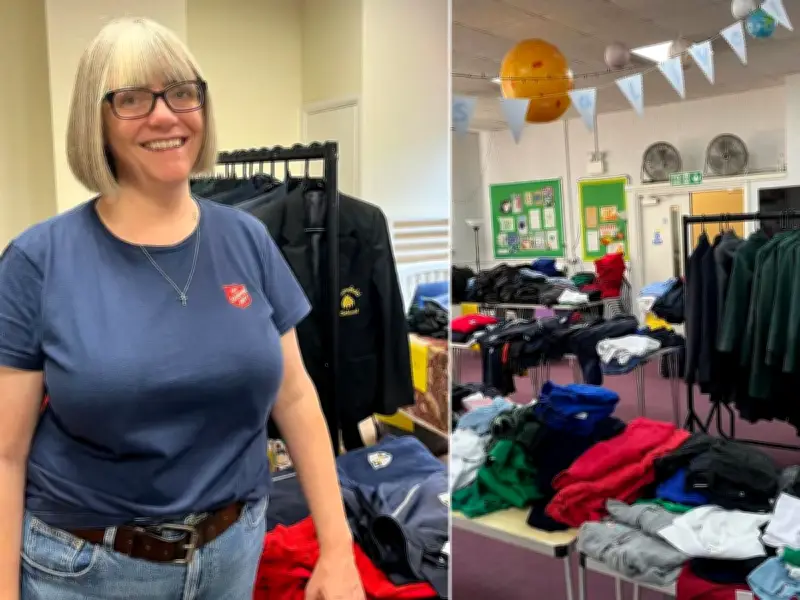
Major Julie Pell, who runs a Salvation Army uniform bank out of a church in Walthamstow, east London, said they are seeing more families than ever before. "Families can't cope," Major Julie told the Mirror. "After feeding their children, buying food and meeting the ever-rising cost of bills, there's no money left to buy school uniforms."
Last year, the Salvation Army handed out more than 29,000 pieces of uniform, and Julie expects that figure to rise this year. "It is heartbreaking seeing parents unable to afford essentials. They just want their child to go to school looking the exact same as every other child. I can see just how desperate they are to send their children to school properly dressed."

Julie says some parents leave the uniform bank in tears, overwhelmed by the relief of being able to get what their children need. "There are points when it just gets overwhelmingly heartbreaking," she said. "You know you're helping people but you know there are still so many parents out there struggling. We're seeing first hand that something needs to be done."
Costs and consequences
Government research estimates the average cost of a secondary school uniform at £442, while primary school uniform costs average £343. Research by The Children's Society found that 38% of parents struggled with uniform costs last year, rising to more than half among the lowest-income households.
A nationwide poll of 3,000 parents conducted for The Children's Society found that more than two in five children (44%) have experienced negative consequences at school due to unaffordable uniform requirements. Across the UK, children have been subjected to detentions (12%), isolation (9%), and even formal exclusions (8%) over unaffordable uniforms. Secondary school pupils face the harshest treatment, with one in eight (12%) placed in isolation for uniform breaches entirely outside their control.
Despite minor improvements, such as increased availability of second-hand uniforms, 42% of parents said uniform costs had not become more affordable. Matthew Sheeran, external relations manager at Money Wellness, warned that children are unfairly bearing the brunt of the price squeeze. "If there are disciplinary measures in place, or they are having to wear different school uniform, it can cause bullying or name calling," he said. "It's never the children's fault, and that's the main thing to focus on."
New rules and parental experiences
The government is introducing new rules in England from September, limiting the number of branded items schools can require parents to buy. Primary schools will generally be limited to three compulsory branded items, while secondary and middle schools can require four where one is a tie. The rules are designed to allow parents to buy more generic items from cheaper retailers, with the Government estimating families could save up to £50 per child.
However, parents and campaigners warn that the rules don't go far enough, with schools demanding specific colour shades, requiring expansive PE kits, or marking up the prices of the remaining branded items. Dr Sasha Hall, 41, a child psychologist from Essex, spent around £400 getting her four-year-old daughter and her three-year-old son ready for Reception and nursery respectively. "I am in a dual-income household with decent salaries and I couldn't believe how much it cost," Sasha said. "The shade of blue on my kids is not the kind of blue you can get off Amazon or in Asda."

Her children wear the same size, meaning she cannot rely on hand-me-downs between them. The mum bought ten jumpers at £12.95 each from their local uniform shop, eight pairs of shorts at £6.95, joggers at £10.95 each, compulsory book bags at £8.95 each and hats costing £5.75. She says she was also required to buy specific rain anoraks costing £26.95, as well as black coats and particular water bottles. "When I was a child, you had those logos that you could sew on, so you could get anything from anywhere but now you can only buy it from the local uniform shop and it costs whatever their price is," she added. "The only thing I saved money on was the polo shirts which I bought a pack of five for £7 from Asda," she said. "I saw the same jumpers for a third of the cost but I needed ones with the embroidered logo on, so I had to buy them from the uniform shop. I just wonder how are other people paying for this?"
Donna Richardson, 45, from Loughborough, had to replace her daughter's uniform when the school changed its logo, forcing her to replace perfectly good clothing. "My daughter's current uniform is still perfectly usable, but because the school has changed its logo, we are expected to buy new items with the updated branding," she said. "What makes it even more frustrating is that my daughter moves to senior school next year, meaning this uniform will only be used for one year. It feels completely wasteful." "For parents, these aren't small costs. Every new item adds up, and having to replace something that isn't worn out or damaged purely because of a logo feels incredibly unfair."
Meanwhile, Lauren Witter, 34, a social worker from Richmond-upon-Thames, has already spent £150 preparing her four-year-old daughter Gabriella for Reception - without even buying shoes yet. Because her daughter is "very active", Lauren bought multiples of items to avoid nightly washing, with the list of items including branded cardigans and jumpers, a separate PE kit, pinafores, shirts, underwear, socks and tights. "I was shocked at how quickly the costs accumulated," she said. "I'm happy the rules are coming in. I think it's about time that it's recognised school uniform is expensive."
Postcode lottery and local authority cuts
Support across England remains a postcode lottery. Money Wellness found that just 22 of England's 153 local authorities offer a dedicated school uniform grant for the 2026/27 school year, with support ranging from £25 to £160 depending on location. In Barnsley, the new Reform council has cut back what was previously one of England's largest school uniform voucher schemes. The scheme was introduced last year and all pupils in compulsory education were eligible for the discounts. Study support packs were also offered to children in year 11. Previously, over 33,000 uniform vouchers were issued to families, totalling £2.5 million, reported The Star.
It provided £50 for primary school pupils and £100 for secondary pupils, and study support packs for Year 11 students, but now it is limited to children starting Reception and Year 7, with 5,500 families set to benefit. James Higginbottom, leader of Barnsley Labour, estimated about 28,000 families would miss out. Penistone and Stocksbridge MP Marie Tidball criticised the reduction, saying the scheme had supported more than 33,000 children and young people and that 94% of vouchers had been cashed in. "Just a few months into a Reform-led council, Barnsley families are already seeing what their priorities look like: cutting back practical support that thousands of parents have relied on," she said. "This money had already been allocated in the Budget by Labour and should be delivered, so it is a political choice that Reform are making, to take this support away from children and families."
At a time when families are still feeling the squeeze, Reform councillors should be expanding practical support, not cutting back a scheme that parents have used and valued. At the time, Cllr leader William Brown told the Barnsley Chronicle: "We want to move away from one-off, universal payments and instead offer more targeted and flexible support. To do this, we'll use more external funding from Barnsley Council's £4.7m allocation of the government's new Crisis and Resilience Fund to help our residents. Our approach also means we can spend taxpayers' money wisely, use external funding where possible and focus support where it will have the biggest impact."
East Riding of Yorkshire has withdrawn its dedicated school clothing grant altogether and now signposts eligible families to its Crisis and Resilience Fund. Elsewhere, Greenwich has expanded its scheme to include eligible pupils attending academy schools, while Brent has introduced a new pilot school uniform grant for low-income families.
With official support falling short, parents are taking matters into their own hands. In Bristol, retail supervisor Faye Psyden, 36, helped run a free uniform swap in her local library after her two children moved to different schools. "We had so much uniform built up, we wondered what are we going to do with it all?" she said. At their first event, more than 100 people turned up. "People were so grateful," Faye added. Most of the uniform was taken, with three large boxes remaining for the next swap. Faye says branded uniform can cost around £10 per item at her children's school, and the expense quickly adds up as children lose, stain or grow out of clothes. "It's racking up," she said. "I have struggled with school uniform cost," she added. "You have to think in advance how you are going to afford things." She worries that even unbranded uniform could become more expensive, if further action isn't taken.
A Department for Education spokesperson said: "School uniform matters, but it shouldn't break the bank. No family should have to choose between putting food on the table and buying a new blazer. Parents have told us they want fewer costly branded items and that's exactly what we're delivering, limiting branded items from September 2026 giving families breathing space, and saving some parents up to £50 per child. We are also supporting schools with our new guidance to take more steps to bring down the cost of individual items. We are keeping more money in the pockets of hardworking families, so the back-to-school shop doesn't push parents into debt and children can focus on their education, not their outfit."
But campaigners say the changes need to go further. "It's only 22 of the local authorities that have a dedicated grant, so the vast majority of people aren't getting that support," Matthew added. "Someone who is struggling in a different part of the UK is having to find alternative ways to support that. As long as the responsibility sits with the council, it will be hard to have every council on the same path."
In Scotland, you can apply for a school clothing grant through mygov.scot. In Wales, you can apply for the School Essentials Grant through gov.wales. In Northern Ireland, apply through the Education Authority.