
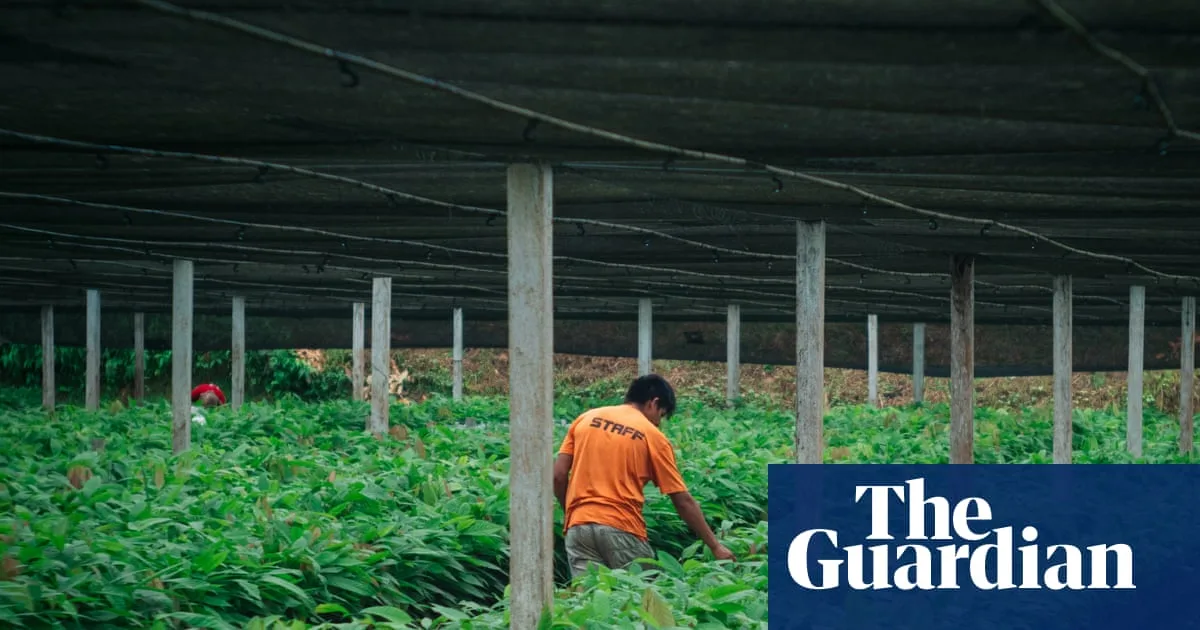
Communities in Bolivia’s biodiverse north-west have secured local bans on gold mining, protecting their organic cacao farms from the environmental destruction fuelled by soaring gold prices. The municipalities of Palos Blancos and Alto Beni passed ordinances in 2021 prohibiting mining, a move that has safeguarded the livelihoods of farmers belonging to El Ceibo, the country’s largest organic cacao co-operative.
Herminio Mamani, a former president of El Ceibo, said the agroforestry model used by its 1,300 members is vital for maintaining cacao quality and keeping mining at bay. “We cacao producers would never kill an animal here. The parcels can never be monocultures – all the crops grow together,” he said, as parrots squawked nearby.
The initiative began in 2017 after a mining dredge appeared on the Boopi River, which borders the two municipalities. Farmers witnessed the devastation caused by mining in nearby towns, such as Mayaya, where water levels have dropped and fish have disappeared due to pollution. Roberto Gutierrez, a farmer in Alto Beni, recalled: “I’ve known Mayaya since I was young, and the river used to be deep and full of fish. Now the water levels have dropped, pollution has seeped in, and the fish are disappearing.”
Communities reacted swiftly, with mass protests and warnings to miners. “People gathered in mass protest and issued a warning: ‘Leave, or we burn your machinery,’” said Nancy Chambi, a farmer and Alto Beni councillor. The miners left. After four years of grassroots pressure, both municipalities passed mining bans in 2021, and a 2024 departmental law further legitimised their stance against the national government’s will.
The bans have secured farmers’ organic certifications, enabling El Ceibo to export 2,000 tonnes of cacao in 2025, mostly to Europe and the US. Jesús Tapia, an El Ceibo producer, said: “With the country’s economy in such bad shape, people here are a bit more at ease.” For Chambi and Gutierrez, who sell crops through a smaller co-operative, the laws have been transformative. “If Mayaya has yellow gold, we have purple gold,” Gutierrez said of their cacao pods.
At least 10 other municipalities and Indigenous territories are now pursuing similar bans. Pablo Solón, an environmental activist and former Bolivian ambassador to the UN, said: “This is the beginning of the fight. We have to build a wall to prevent mining from coming down the river.” He sees the most potential for resistance in areas with strong tourism or Indigenous governance, while acknowledging that mining will continue elsewhere.




