
Eight defendants in the Prairieland case have been sentenced to 30 to 100 years in federal prison after a protest at a Texas ICE facility, with prosecutors using leftist zines and book club membership as evidence of terrorism. Advocates warn the case sets a dangerous precedent for First Amendment rights.
Protest and Conviction
On July 4, 2025, a group from Dallas-Fort Worth held a nighttime noise demonstration outside the Prairieland Immigration and Customs Enforcement (ICE) detention facility, setting off fireworks in solidarity with detainees. Some protesters spray-painted graffiti on employee cars and a security post, slashed tires on a government van, and broke a security camera. When a police officer arrived and drew his gun, a protester fired a rifle, hitting the officer in the shoulder. The officer survived.
After a three-week trial, a jury found eight of nine protesters guilty of “providing material support to terrorists” and other crimes. All eight sentenced so far received unusually harsh sentences—30 to 100 years—effectively life in prison. Their attorneys announced plans to appeal, but supporters doubt anything short of a presidential pardon could free them.
Role of Zines and Literature
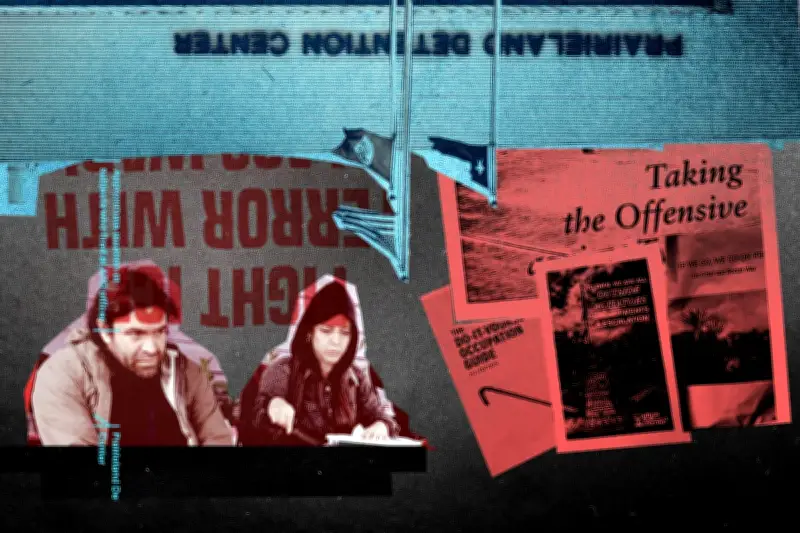
For Elizabeth and Ines Soto, the “material support” included owning a “printing press” used to print anarchist zines and being part of a leftist book club named after Emma Goldman. The couple had left the scene before shots were fired. Elizabeth Soto was sentenced to 50 years; Ines Soto’s sentencing is set for July 1. “They didn’t like my book club,” Elizabeth said, her laugh not reaching her eyes.
The FBI seized zines, a standard office printer, paper cutter, and book binder from the Sotos’ home. During the raid, one of their children was interrogated after police put a bag over their head, according to Elizabeth’s attorney. The Department of Justice did not comment on the raid or the use of counterterrorism law.
Xavier de Janon, director of mass defense at the National Lawyers Guild and Elizabeth’s attorney in her state case, said, “Zines are a foundational First Amendment document… Zines discussing ideas of revolution, mutual aid, ideas of a world after capitalism, should not be able to be criminalized in and of themselves… That’s just dangerous to all of us.”
Government’s Counterterrorism Strategy
The Prairieland case was the first tried under the Trump Department of Justice’s “counter-terrorism” initiatives targeting “antifa,” a decentralized movement officially categorized as a “domestic terrorist organization.” The government argued the defendants, called a “North Texas Antifa cell,” planned the demonstration as an assassination attempt against a law enforcement officer, despite loose connections among them.
In total, 22 people have been charged: five took plea deals, five have state charges pending, and three were indicted last month. The government described “antifa extremists” as trans people, tattoo artists, vegans, and anti-ICE community members. Prosecutors used possession of leftist literature, Faraday bags, encrypted messaging apps, and all-black clothing as evidence of criminal intent.
Impact on Defendants and Community
Defendants Autumn Hill and Meagan Morris, both trans women, are held in men’s facilities, vulnerable to sexual abuse, despite federal rulings that trans women should be in women’s facilities. Morris was denied hormone treatments in Johnson County, which could have severe medical consequences. The Johnson County sheriff’s department did not comment.
Daniel “Des” Sanchez-Estrada, a green card holder and artist, was not at the protest but was convicted of “corruptly concealing a document or record” and sentenced to 30 years. His illustrations criticizing ICE and police were entered as evidence. “I’m a father, a husband, and a teacher. But I’m not a terrorist,” he told the court.
Savanna Batten, another book club member, received a 50-year sentence. “It’s crazy that we live in a world where it’s not safe to ask what books you’re reading,” she said. Batten, a vegan, often goes hungry in prison and reads about hermit crabs, noting the irony of living in captivity.
Legal and Civil Liberties Concerns
Chip Gibbons, policy director at Defending Rights and Dissent, said, “It is not only an attempt at chilling speech, but an indication that the [Trump administration is] going to continue going after protests extremely hard.” He noted a long history of conflating leftist activism with criminal conspiracies, from Emma Goldman to Black Panther members.
Shayana Kadidal, senior managing attorney at the Center for Constitutional Rights, said the combination of property damage and injuring an officer allowed the state to build a conspiracy case. He questioned charging terrorism in this context: “It strikes me as excessive, and I think it would strike an ordinary American as excessive.”
Broader Crackdown on Protests
The Department of Justice’s success in Prairieland is part of a broader crackdown. In Spokane, Washington, three people were convicted last month of conspiring to impede a federal officer over an ICE protest. Last week, 15 people in Minneapolis were charged with conspiracy to obstruct ICE operations, accused of being part of “antifa” groups.
A ProPublica and Frontline investigation found that over a third of more than 300 anti-ICE protest cases “crumbled.” In Chicago, the Broadview Six case was tossed over prosecutorial misconduct. But legal experts say Prairieland differs because a police officer was shot.
Benjamin “Champagne” Song, a former US Marine, was the only defendant convicted of attempted murder and received 100 years. She wrote that she brought her weapon out of fear law enforcement would hurt protesters, as in the cases of Renee Good and Alex Pretti, killed by ICE officers earlier in 2025. “This is mass punishment… guilt by association. This is injustice,” she said.
Community Response and Future
Supporters have formed a committee, holding potlucks and writing character letters. A local bookstore sells zines about the case and patches reading “Zines are not a crime.” The committee encourages others to start Emma Goldman book clubs. A zine distributor sells a packet of zines from the government’s exhibit files to fundraise, titled “The Government Doesn’t Want You To Read These Zines.”
Hunter Dunn, national press coordinator for 50501, said the FBI is using the Trump administration’s NSPM-7 memo to categorize leftist protest as “domestic terrorism,” justifying action against protesters they fear “may lead to the eventual end of their administration by nonviolent means.”
Amber Lowrey, Batten’s sister, said joining the support committee changed her outlook. “We will not rest until they are free!” she pledged. The defendants and supporters know most would get the harshest punishment, but they are sustained by the knowledge that nothing lasts forever.




