Sonam Wangchuk, the Cockroach activist, has ended a 26-day hunger strike as youth-led protests continued across India and movement leaders reported no breakthrough in talks with the government.
Wangchuk had been fasting since June in solidarity with the Cockroach Janata party (CJP), a youth-led movement holding mass protests demanding government accountability and the resignation of education minister Dharmendra Pradhan over exam paper leaks. The leaks affected 2 million students in May and have been linked to more than a dozen suicides.
Wangchuk ends hunger strike
On Friday morning, Wangchuk posted that he had ended the hunger strike in Delhi after striking a “hard bargain” with the government. In a video from his hospital bed, he said he had been assured in writing that accountability in the examination system would be taken up on the parliament floor and that no cases would be registered against young people who took part in mass protests in Delhi on Monday.

After 26 days without food, Wangchuk appeared weak but in lively spirits. The hunger strike has long been a powerful tool of protest in India, repeatedly used by Mahatma Gandhi in the fight for independence. Gandhi’s longest hunger strike was 21 days.
Protests continue
After Wangchuk ended his hunger strike, Modi urged the activist to follow doctors’ advice and regain the weight he had lost. The CJP’s founder, Abhijeet Dipke, thanked Wangchuk for his “courage and sacrifice” and said the protests would continue until Pradhan resigned. “We won’t let Sonam sir’s sacrifice go in vain,” Dipke added.
On Friday, CJP leaders said the government had agreed to meet them in a “neutral location” to discuss their demands. However, the CJP’s spokesperson, Ashutosh Ranka, said that no resolution had been agreed and the government had requested more time to consider their key demand, the resignation of Pradhan.
Talks stall
“We hope the government will dismiss Dharmendra Pradhan at the earliest, or that he will resign, so that we can bring this matter to a conclusion,” said Ranka. The senior government minister JP Nadda confirmed that talks between the two sides would resume on Saturday.
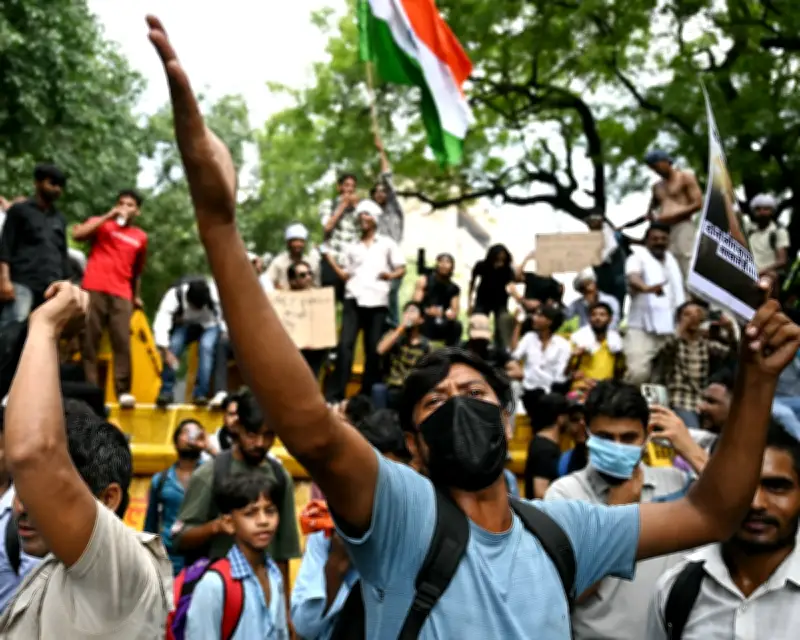
As talks stalled on Friday, thousands of protesters continued to gather at CJP’s protest site in Delhi, in an unprecedented show of support. Tens of thousands more are expected to turn up over the weekend. Authorities shut down 17 metro rail stations near the protest site and ordered telecom companies to block mobile internet services in the area, a move criticised by human rights groups, but it did little to stem the tide of people turning out.
Youth movement
“It feels so positive out here,” said Afreen Ali, 21, a student at Delhi university, who stood among the crowds. “I’m feeling so mesmerised to see all my Indian brothers, my sisters, my youth, everyone out here protesting for their rights and for their education. It was the blood of our freedom fighters that brought us independence, and we are here to fight for that country.”
Protests erupted across India on Friday as part of the countrywide callout, with demonstrations in Bengalaru, Mumbai, Pune, Thiruvananthapuram and Kolkata. The protests represent the biggest youth challenge to Modi since he came to power in 2014. Opposition parties have echoed the youth movement’s demands and have disrupted the monsoon session of parliament that began this week.
Government response
On Thursday, Modi said special courts would be set up to prosecute those behind exam paper leaks, his first public response to the crisis. “Nothing is more important than the welfare and future of our youth!” he posted on social media. But the CJP rejected the proposal, with Ranka saying, “But Modi-ji, tell us why are paper leaks happening in this country in the first place? Fast-track courts are set up in this country for every other issue, but whether those fast-track courts have actually solved those issues – you know the answer to that question, and so do we.”

Later in the day, Modi said on social media that the government would announce more strict actions against paper leaks at a cabinet meeting on Friday. After top Bollywood stars were hit with criticism for staying silent about the protests, some of India’s biggest actors, including Salman Khan, Alia Bhatt and Kareena Kapoor, released social media posts saying it was heartening to see students come together to fight for a cause, though stopped short of criticising the Modi government.