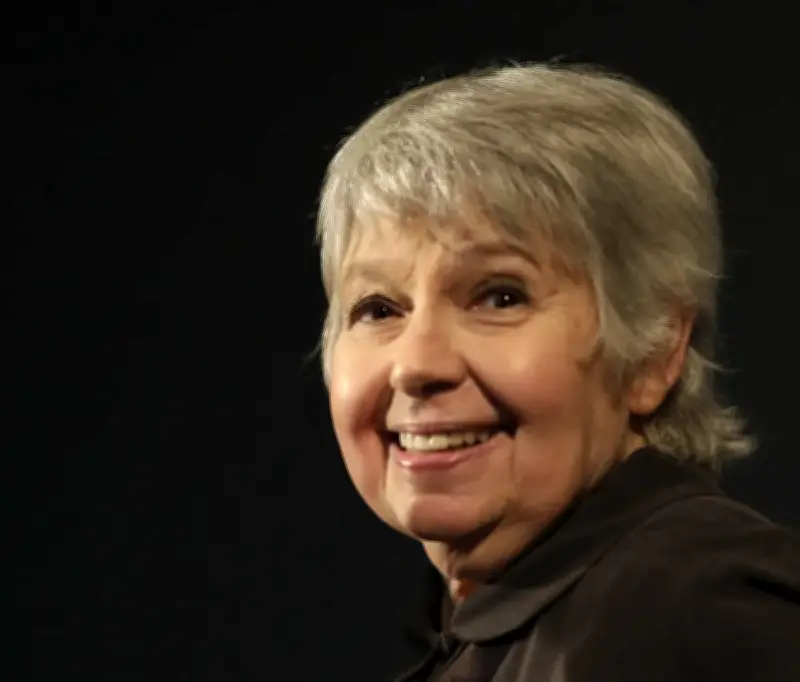
Robin Morgan, a child star of the 1940s and 50s who became a leading second-wave feminist as a poet, essayist, and editor, has died at the age of 85.
Her death was confirmed Saturday by the Women's Media Center, an organization she co-founded with Jane Fonda and Gloria Steinem, who died Wednesday.
Architect of the contemporary women's movement
During the 1960s and 70s, Morgan embodied and inspired historic changes in how women lived and thought. The one-time "ideal American girl" was a rule breaker and justice seeker with a notable list of achievements, along with a prison record and an FBI file.

Julie Burton, president of the Women's Media Center, called Morgan "one of the architects of the contemporary women's movement", hailing her writing and "global leadership for justice and equality". The statement didn't specify the location, date or cause of Morgan's death.
Key moments in second-wave feminism
In 1968, Morgan was among the organizers of the first protest against the Miss America pageant, joining fellow activists in tossing their bras into a "freedom trash can". The 1970 essay anthology she edited, Sisterhood Is Powerful, is considered one of the essential texts of the modern women's movement.
Morgan is widely credited with coining the term "herstory" and popularizing the clenched fist/female symbol icon of the liberation movement. Her poem Monster was quoted at feminist rallies, and her poem Arraignment helped capture the movement's embrace of Sylvia Plath and condemnation of her husband, poet Ted Hughes. Morgan's rhyming couplet "I accuse/Ted Hughes" inspired the title for Sonic Youth's song J'Accuse Ted Hughes.
Activism and personal life
Labeled an "anarchist housewife" in one government report, Morgan confronted the establishment. In 1970, she and fellow protesters were arrested and jailed after occupying the offices of Grove Press. In the widely reprinted 1970 essay Goodbye to All That, she called out activists and libertines from Abbie Hoffman and Hugh Hefner to Dave Dellinger and the Fugs.
In her personal life, Morgan had male and female lovers and was married for more than 20 years to the gay poet Kenneth Pitchford, with whom she had a son, Blake Morgan. She once described her marriage as a "two-member commune" and was so resistant to labels that she remembered being "straight-baited" by feminists and chastised by conservatives.
Legacy and later years
Besides her 2001 memoir Saturday's Child, Morgan completed more than 20 books, including The Word of a Woman and the poetry collections Monster and Dark Matter. She followed Sisterhood Is Powerful with Sisterhood Is Global (1984) and Sisterhood Is Forever (2002). For several years, she was editor-in-chief of Ms magazine.
In 1984, she was a founder of the Sisterhood Is Global Institute. In 2005, she, Steinem and Fonda launched the Women's Media Center. More recently, she hosted a syndicated radio show and remained active despite being diagnosed with Parkinson's, which inspired several poems and a TEDWomen talk in 2015.
Born in 1941 in Lake Worth, Florida, and raised in New York, she never saw her father while growing up and was told falsely by her mother that he was dead. Her mother also shaved a year off her age, claiming she was born in 1942, to make her early public career seem even more impressive.
As she recalled in Saturday's Child, producer Dan Ehrenreich squeezed her shoulder so hard that Morgan could feel his fingernails. He turned her microphone away and eventually placed his hand over her mouth. Morgan wrote: "I realized that I loved and respected that child who fought back in what was the first political act I recall ever daring to make."