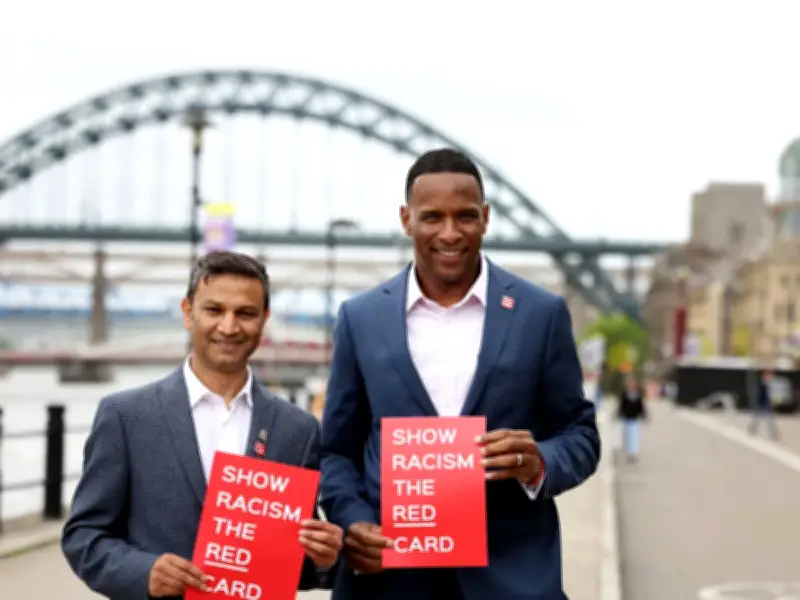
Campaigners have warned that the fight against racism is more important today than ever before due to the rise of the far right in the UK and beyond. Union leaders and sporting stars joined forces to celebrate the 30th anniversary of Show Racism the Red Card, the charity founded in 1996 after Newcastle United goalkeeper Shaka Hislop was racially abused by youths on a garage forecourt.
The youths shouted insults from across a road near St James' Park before recognising him, asking for his autograph, and then chanting his name. "I realised then that we had to do something to educate young people," Shaka, 57, a dad-of-five, told the Sunday Mirror. "That experience summed it up for me. From 50 yards away, I was a black man and they shouted abuse; from 50 yards away, I was a hero.
Shaka Hislop on teaching young people
"As you get closer to people, you recognise their value. That is what we needed to teach young people." He added: "But we need to recognise how far we have come too. I was at the refugee centre in Newcastle, and they told me that 40 years ago, they were warned to keep out of town on match days."

"That is no longer the case. In my playing days, I was a young black man sitting next to players from Colombia, Georgia, and Belgium; we went out at the weekend and celebrated together, and we went out together when we lost. That shows the best of us. In 2010 and 2015, we were told our work was no longer needed, and that complacency has always been our greatest challenge."
Online racist abuse during World Cup
Research indicates that racist abuse aimed at England footballers on social media was amplified during the World Cup to maximise engagement. The activist group Hope Not Hate analysed more than 300,000 posts on the platform X (formerly Twitter) during the tournament and found more than 5,500 explicitly racist posts targeting England players. The organisation argued that X's recommender algorithm pushed toxic content into millions of feeds because posts provoking anger and outrage generate more interaction.
Jude Bellingham was the player most targeted by racist abuse, while Bukayo Saka and Kobbie Mainoo experienced the highest proportion of racism relative to the total number of posts mentioning them. Djed Spence, who converted to Islam in recent years, was also subjected to a distinct stream of anti-Muslim abuse, Hope Not Hate said.
An FA spokesperson stressed that "all players have the right to play without being exposed to hateful, discriminatory and distressing content online". It added: "We want service providers to take all the necessary steps to create a safer online environment for everyone." Hope Not Hate said current attempts to tackle online abuse often focused too heavily on what happens after a racist post had already been seen.
Workplace racism and political concerns
Our Stop Online Hate campaign has called on tech firms to act to tackle abuse. Clare Williams, assistant secretary of Unison, warned that the rise of the far right was having a 'devastating' impact on workers and their experiences in the workplace. "There has been a rise in racism in our communities and in our workplaces," she said. "It impacts people trying to lead their lives in peace and dignity. Our black members have to deal with it in their day to day lives. We need to build alliances and state clearly that this is not how the world should be."
England legend Peter Reid, the patron of Show Racism the Red Card, is concerned about the rise of Reform, not just in his old stamping ground but across the country. "Sunderland was the first city to vote for Brexit," he said. "I love Sunderland and the North East, but you worry about the future with Reform. They keep going on about boats and Brexit. It is not rocket science. Some of the comments before the local elections were ridiculous."
"They hide behind social media, but there is no excuse. Liverpool is a great city, and we were socially aware. I think what Farage has done to change that is frightening. The people who came in are what made our place, our society, our community. That's why people like Farage are wrong."

Kevin Keegan remembered
Shaka, now based in the US as a TV pundit with ESPN, told how his old manager Kevin Keegan supported him throughout his career in the fight against racism. He added: "I spoke to John Beresford, who saw Kevin a week or two before he passed. He said that he was full of stories and in such good spirits, telling jokes about the old times. We had a moment where we thought we would see him again. That chance to see him was snatched away so quickly after the news that he was doing so well. We had conversations about a big event with him there; he was going to be a part of that, and it felt really tough not being able to see him."
Shaka, who is recovering from prostate cancer and still receiving treatment, added: "I will be tested for the next few years; it is the new normal. I am fine otherwise. I had zero symptoms. Hearing about Kevin, hearing his story, makes you consider your mortality; his passing hit me a little extra hard."
Ged Grebby, chief executive of Show Racism the Red Card, told the charity's supporters that Keegan stood up against the far right National Front when he was a Newcastle United player in 1982. "His anti racism credentials go back years," said Ged. "He found a National Front pamphlet with a monkey on the front that read, 'Don't let a monkey take your job'. He went into the ground and said 'I don't want them here'."
"He started the 'Geordies are black and white' movement, long before Show Racism the Red Card was launched. Then he supported us when he became Newcastle's manager." A memorial service for fans and the wider football community is set to be held in honour of Kevin Keegan in Newcastle later this year.