
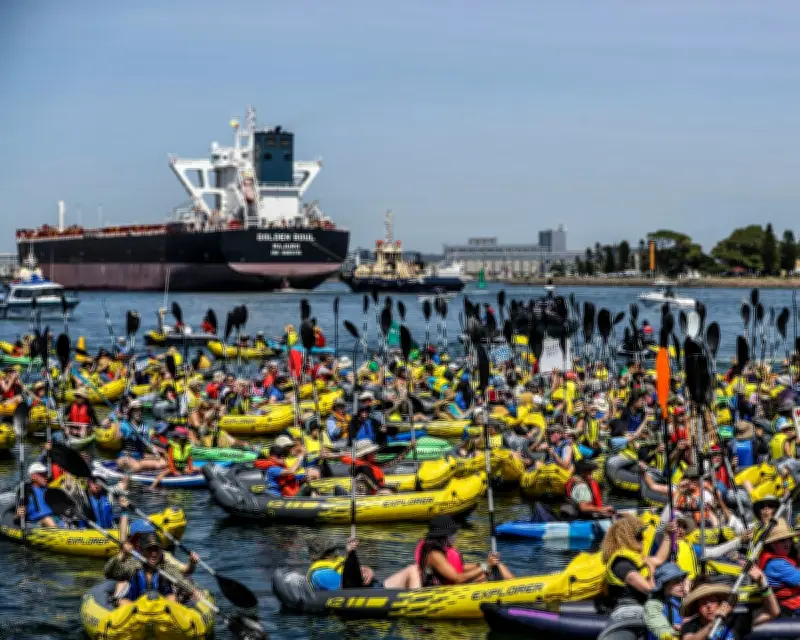
Police have dropped charges against 125 protesters who blockaded the port of Newcastle in 2024 as part of one of Australia's largest climate protests. The charges were withdrawn in Newcastle local court on Friday, two years after the event.
Legal group welcomes decision
Legal group Climate Defenders Australia, which represented 110 of the protesters, said it had petitioned police to drop the charges. Julia Grix, the group's founder and executive director, said: "Police should have withdrawn these charges long ago, once it was clear they could not make out the cases against them."
Grix added: "Australia leads the world for arresting climate protestors. That statistic alone is alarming – but it captures nothing of the long, anxious road that follows for those who then have to navigate the criminal justice system. Here, more than one hundred people have spent almost two years waiting for justice."
Charges and penalties
The protesters faced two charges: one under the Marine Safety Act, carrying a fine of up to $5,500, and another under the 2022 anti-protest laws, which carry a maximum penalty of two years in prison or a $22,000 fine. They were charged after attending Rising Tide's six-day blockade of the port in November 2024, when thousands of protesters entered the water with kayaks and rafts.
Dr Elizabeth Manning, a neuroscientist from Newcastle who had her charges withdrawn on Friday, called the actions against protesters "undemocratic". She said: "I understood that getting arrested that day has consequences, but a criminal charge is absolutely disproportionate to the offence, and has real outcomes for people's lives." Manning said the charge prevented her from travelling to a neuroscience conference to present her research and that she knew of others who faced issues at work. "All for standing up for the earth and for climate justice," she said.
Protest demands and legal challenges
Rising Tide runs the protest annually, demanding the cancellation of all new fossil fuel projects, an end to coal exports from Newcastle by 2030, and a 78% tax on fossil fuel profits to fund transitions and climate loss and damage. During the 2024 protest, the Minns government attempted to stop the event by imposing a four-day maritime exclusion zone around the port, but the supreme court ruled the zone invalid after Rising Tide challenged it.
For the 2025 blockade, the government did not attempt to stop the protest. Police arrested and charged 129 protesters at that event, which stopped three coal ships from entering the port. Those cases remain before the court.
Outcomes and broader context
In 2024, a total of 173 protesters were charged. Forty-five have had their matters finalised, and police were ordered to pay $73,000 in costs for eight protesters whose charges were dismissed last October. Four protesters facing a separate charge of failing to comply with a direction under the Marine Safety Act remain before the court.
A 2025 study, Criminalisation and Repression of Climate and Environmental Protests, found that Australian police arrested the most climate protesters out of 13 countries analysed, including the UK and the US.




