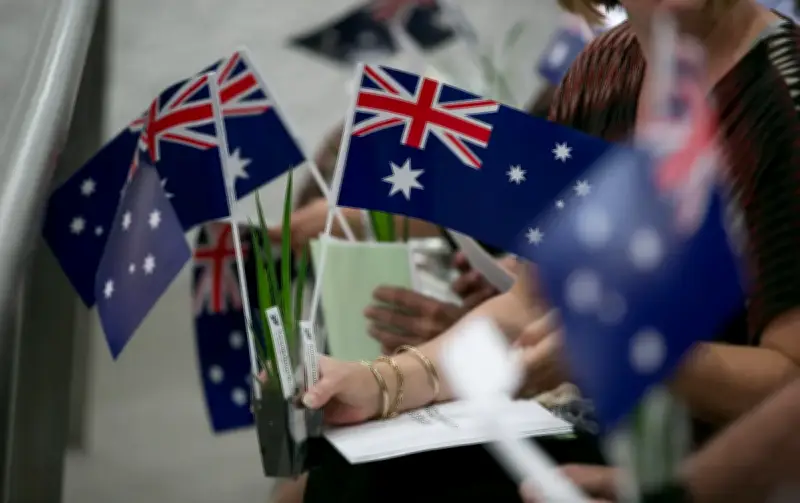
Paul Daley, a columnist for Guardian Australia, has expressed that he is not usually patriotic, but Pauline Hanson's "cheap nationalism" has led him to root for multicultural Australia. He describes patriotism as potentially angry and stridently militaristic, or as a gentle pride in the success of an experiment like multiculturalism.
Patriotism and National Days
Daley notes that patriotism is always absent in him on days of official national commemoration. He says Australia Day – Invasion Day – has always left him cold for its divisiveness, historical asymmetry and exclusivity. Anzac Day, an unofficial national day for many, has never raised a patriotic shiver in him.
He admits to feeling buoyant on particular international sporting occasions, such as Australia beating England in an Ashes Test series, which gives him an anticolonial glow, but not exactly a patriotic high. However, true stories of Australian multi-ethnicity that play out on sporting fields or in cultural spheres, reinforcing his faith in an Australia that would be altered irrevocably by those advocating monoculturalism, do make him feel patriotic.

The Socceroos and Multiculturalism
Daley cites the Socceroos and the football World Cup as representing a modern nation built on an overwhelming rejection of the abhorrent white Australia policy. He says the blind racism and profound illogicality underpinning much of One Nation's policies on economics, immigration and social cohesion were exposed by Pauline Hanson's absurd proposition that the Socceroos, for all their racial diversity, represent an Australian monoculture.
The Socceroos embody and embrace a repudiation of the cheap nationalistic racial and religious prejudice that some One Nation officials and others blithely parrot. Daley found it reassuring to see senior federal government figure Penny Wong robustly debunk such fever-dream jingoistic bunkum.
A Frypan's Story
Daley recounts that Australia's cultural institutions are replete with stories that celebrate an enduring multicultural Australia. While at Sydney's Australian National Maritime Museum, he was stopped by a small exhibit: a battered and blackened metal frypan with a plastic handle brought to Australia by Vietnamese "boat person" Tuyet Lu. She made the perilous journey to Darwin on a small fishing boat with her husband, former store owner Tan Than Lu, who fought for South Vietnam, and their children. They arrived in Darwin in November 1977 with few personal possessions, the pan among them.
She cooked with the pan in South Vietnam, on the boat for her family and other refugees, and after arriving in Darwin and during six months at Brisbane's Wacol migrant hostel, she used it to cook Vietnamese food in Australia. Six months later, they were granted Australian asylum.
From Boat People to Australian Cuisine
Daley recalls the heated debate around the influx of thousands of Vietnamese asylum seekers arriving by boat from South Vietnam after the fall of Saigon. The last vestiges of the White Australia policy had only recently been removed. The Vietnamese were viewed by some as a threat to some nebulous Australian cohesion, despite the early federation's bitter social and political divisions over sectarianism, conscription, women's suffrage, racial equity and the appeasement of European fascism.
Those opposing the settlement of "boat people" from Asia in the late 1970s could not have foreseen today's proliferation of Vietnamese restaurants in just about every suburban shopping district and country high street. Vietnamese cuisine is now Australian, a defiant reality of the Australian social and migration amalgam. It is a fitting postscript that Tuyet Lu used her battered and blackened pan in restaurants that she and her husband came to own and run in Australia.

Daley concludes that patriotism can be angry and stridently militaristic, but it can also take the form of a gentle pride in the success of an experiment like multiculturalism. He notes it is no coincidence that those advocating the impossibility of an Australian monoculture began political life three decades ago attacking First Nations peoples, promoting the fanciful fallacy that Aboriginal and Torres Strait Islander people had it too good. Indigenous antiquity on this continent, 60,000 years and counting of human civilisation's unbroken connection with the land, seas and skies, has long been a bedrock of his quiet, reflective form of Australian patriotism.