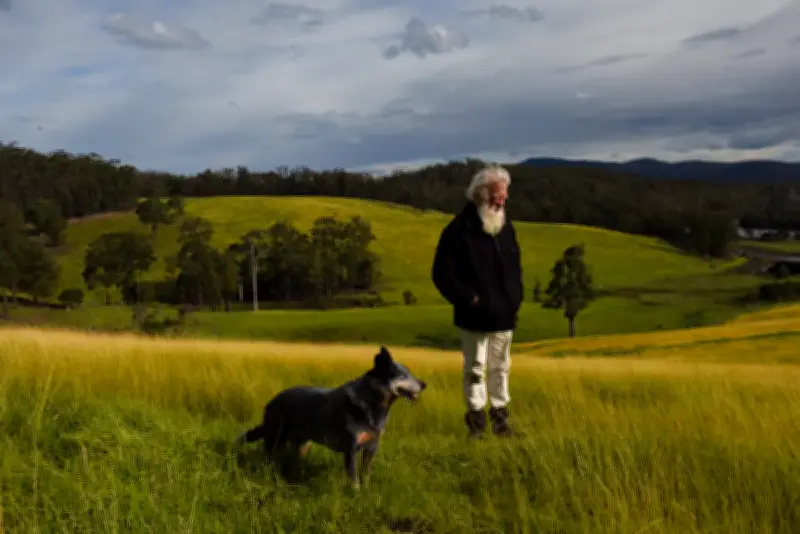
Bruce Pascoe is bracing for potential controversy over his new book, The European Mind: Colonialism, Capitalism, Christianity and How to Recover, which blames a trio of Western institutions—Christianity, capitalism and colonialism—for the worst excesses of racism and dispossession. The 79-year-old author of the landmark 2014 book Dark Emu, which rewrote Australian history by reframing pre-invasion First Nations people as farmer-cultivators rather than hunter-gatherers, acknowledges the new work is likely to provoke a significant reaction.
Speaking at an event at the New South Wales State Library in Sydney to promote the book, Pascoe joked about the anticipated backlash. "I'll have the noise and these attacks going on [again]. But you know I'm loved by my family, and I'm loved by my Country ... Once again there'll be a storm, you know. I'll be accused by some of eating kittens. And eating them slowly, which is worse," he said with good humour.
Readying for Another Storm
Pascoe, a farmer of Yuin, Bunurong and Tasmanian ancestry, admits there have "been times, I admit, when I struggle" following the bitter attacks over Dark Emu, which included renewed allegations questioning the veracity of his Aboriginal identity and a major academic takedown of his research and methodology.
Asked if he is ready for another pile-on, he said: "I hope I am. I have been readying myself for it. I think I am about as ready as I can be for it. But look, it's very difficult to hurt an old man, because you've become very aware of how many years you've got left – active years I mean. And you can't bribe an old man because he doesn't want anything. And you can't intimidate an old man because he's going to die anyway soon, so you can't hurt him. I'm trying to placate myself I think, but I'm also trying to ready myself. I find hatred to be unproductive."
He acknowledged that writing critically about capitalism, Christianity and colonialism in a single book is bound to draw fire. "Realistically you can't go and write [critically] about capitalism, Christianity and colonialism in a single book and expect not to get a significant reaction ... because it deliberately evokes comment and disagreement. These things are very important to people, so I have to be ready for those arguments. But I just hope that, you know, there's a bit of decency about it and a bit of intellectual curiosity."
A First Nations Perspective on Western Institutions
Pascoe's argument, drawn from a First Nations perspective, is that Western religion's view of "other" spiritual beliefs as inferior, Europe's innate sense of moral and racial superiority, and capitalism's insatiable appetite for natural resources drove global First Nations dispossession as equally as a yearning for exploration and mercantile expansion.
The book is not a polemic rant. As with Dark Emu, Pascoe quotes exhaustively from various Western and European colonial and later historical sources. The European Mind includes a four-page bibliography and 14 pages of endnotes. Dark Emu has sold 406,000 copies, with 110,000 of the children's edition, making it one of Australia's highest-selling books in the broad category of Australian history.
Among the historical figures Pascoe targets are Baden Powell, the British army officer and founder of the Boy Scouts, who was "dismayed when his foe surrenders"; Lord Wolseley, a British army general at the vanguard of late 19th century imperial expansion, who revelled in the "rapture-giving delight which attack upon an enemy affords"; and Winston Churchill, whom Pascoe called "a horrible bastard" at the library event. Even Walt Whitman, Shakespeare and Charles Dickens are criticised.
Pascoe writes: "The American poet, Walt Whitman, was a fervent supporter of the white establishment; Charles Dickens rooted for the Empire in India; and Shakespeare, while sublimely sardonic, seemed resigned to the fact that the world would be a treacherous place dominated by big men."
He contends that European colonial expansion drew moral weight and certainty from many institutional and cultural sources, including the Catholic church and Pope Alexander VI's 1493 papal bull, The Doctrine of Discovery, which deemed that exploring Christians could rightfully claim territory where Indigenes did not know the name Jesus Christ.
A Call for Civil Discussion
Despite the anticipated backlash, Pascoe wants a discussion—national, universal and personal—that might lead to better human understanding among different faiths and traditional knowledge holders. "I do feel an obligation to be hopeful because I've got grandchildren. But I also have to interrogate myself about this, because I don't want to be talking bullshit just because it sounds good. I have to ask myself, 'Do you really believe this?' And I do. I think there is enough goodness in the world. The vast majority of us want decency, we want love, we want care. We want to look after each other and the world. And we've been diverted by a very small, powerful group – people who hate everything," he says.
"We need to talk – to find common ground."
He speaks passionately about his deeply Christian mother and their respectful conversations about his disenchantment with the church, which he says inspired greater mutual understanding. "I was sceptical [of Christian religion] from a very early age ... but I understand people's spiritual needs because I have that as well." He believes most people of religion, regardless of faith, are pursuing the same thing: peace and togetherness.
"I don't believe that most Christians want to see Pete Hegseth praying for violence ... and I still can't believe how [Christian] clerics let that go unchallenged."
The discussion turns to his beloved AFL, with Pascoe asserting that "the game's spirit is Aboriginal." The European Mind: Colonialism, Capitalism, Christianity and How to Recover is out 28 September through Magabala Books.