
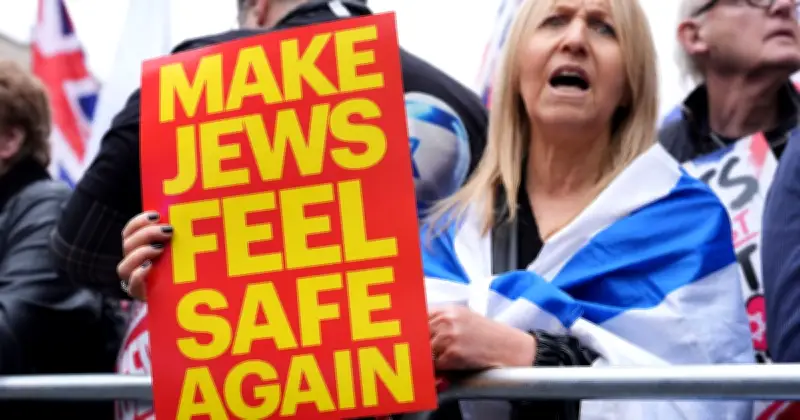
Standing in Trafalgar Square to mark two years since the October 7 attacks, just two days after two Jews had been killed in an Islamist terrorist attack in the city I call home, I felt a glimmer of hope amidst the despair. Rumours of a ceasefire between Israel and Hamas were beginning to circulate, promising the release of the remaining hostages and an end to the fighting in Gaza. I allowed myself to think: finally, they can leave us alone. Finally, this issue will no longer dominate our streets, media or Parliament. How wrong I was.
Record Antisemitism Levels
The Community Security Trust’s figures published this week show that antisemitism remains at record levels. While the Palestine Solidarity Campaign no longer marches through Central London every Saturday, when it does, the banners and chants at those marches are more extreme than ever. While the BBC News website no longer has a prominent Israel-Gaza shortcut on its homepage, our national broadcaster continues to devote disproportionate attention to this particular conflict.
And while Parliament no longer debates Gaza every week, some MPs have become increasingly willing to use their platform to accuse the world's only Jewish state of genocide with language reminiscent of medieval blood libels. This matters because hatred of Israel, not criticism of the Israeli government or concern for innocent Palestinians, but hatred of Israel, can, and too often does, spill over into hatred of Jews.
Rising Violence and Incidents
The record levels of antisemitism we are seeing in the UK were catalysed by Hamas’s murderous attack on southern Israel on October 7, 2023. Since that day, there has been a constant ratcheting up of antisemitism across British society. Every escalation in the Middle East and every violent attack against Jews at home or abroad has been accompanied by another surge in antisemitic incidents. The level never quite falls back to where it was. As a result, antisemitism has become more normalised, and antisemites have become more emboldened to act with violence.
The stabbing of two visibly Jewish men in Golders Green in April was the second terrorist attack targeting Jews in Britain, following the Heaton Park attack last year. It came after weeks of arson attacks against synagogues, Jewish charities and Jewish-owned businesses.
Government Response and Criticism
Against that backdrop, it is no surprise that the Community Security Trust recorded 1,926 anti-Jewish hate incidents in the first six months of 2026. This is the second-highest number of antisemitic incidents documented in the first half of any year, eclipsed only by the immediate aftermath of October 7. Those figures encompass everything from playground bullying and online abuse to assaults, terrorist attacks and hostile state-backed threats.
The government's record investment into security for Jewish schools, synagogues and communal buildings is both welcome and necessary. But it is also an indictment of modern Britain that such protection is required at all. Security measures can only mitigate the consequences of antisemitism. They cannot address its causes.
Following the horror of Heaton Park, Keir Starmer's government appeared to recognise that tackling antisemitism requires confronting the extremism that fuels it. This must include the role hatred of Israel plays. Yet under Andy Burnham, the government appears to have continued a troubling preoccupation with Israel.
Burnham used some of his first public comments after it became clear he would succeed Keir Starmer to revisit and apologise for Labour’s initial response to the war in Gaza. He then repeated that apology on Gary Lineker’s podcast, who left the BBC days after he was forced to apologise for sharing online posts with antisemitic connotations.
Nowhere did we hear acknowledgment of Hamas's responsibility for launching the conflict, continuing to hold Israeli hostages for two years or embedding its military within the civilian population and for its enduring commitment to Israel’s destruction. If mainstream politicians are unable to speak on this conflict with nuance, can we really be surprised that British Jews must put up with constant accusations of being child killers complicit in genocide?
Away from Whitehall and over to City Hall, Sadiq Khan once again encouraged this rhetoric and used his platform to comment on matters of foreign affairs beyond the Mayor of London's remit. His repeated inaccurate and irresponsible interventions do nothing to improve the situation in Gaza; they only deepen division in London and cause pain to the Jewish community. It is striking that, while conflicts across the world claim hundreds of thousands of lives, Israel continues to occupy a uniquely dominant place in our public discourse.
The Prime Minister has pledged a zero-tolerance approach to antisemitism. I welcome that commitment, but it must be matched by a recognition that continually placing Israel at the centre of British politics is helping to fuel the very climate in which antisemitism can flourish. This constant obsession will not bring peace any closer. It will only increase the intolerable levels of antisemitism British Jews continue to face in 2026.




